

Many thanks to our loyal Patreon fan, Roger, who reached out and wanted to delve into this fascinating topic. We love answering all your Viking-related questions, so keep them coming!
UNESCO confirms what all Swedes knew already
In 1993, UNESCO confirmed what many local Swedes knew already: that the area around Lake Mälaren, just to the west of the nation's uber-cool capital, Stockholm, was important.
It was in this year that UNESCO granted two sites of Viking-era settlements on islands as "World Heritage Sites," meaning that not only are they protected under international law, but they are deemed of the highest cultural and historical importance.
One of these sites, Birka, on the island of Björkö, is one of the most famous archeological sites in all of Sweden. It was here that, from about 750, a trading center emerged, which was one of the most important early medieval hubs in the Viking world.
Its location allowed it to capitalize on emerging trade networks that connected East and West, the Scandinavian peninsula to farther afield. Nowadays, it is still very much alive, though with a steady stream of archeologists, not merchants.
Recent discoveries have included a Viking Age shipyard and the possible proof of a shieldmaiden, the famed female Viking warrior.
By the early 10th century, its importance declined as other centers of economic and religious importance emerged in the nascent Swedish nation.
Whilst Birka gets all the historical attention (and hordes of tourists), we first turn to the other site that was granted this status, Hovgården, before uncovering the other Viking sites around Lake Mälaren that helped to shape the early Swedish state.

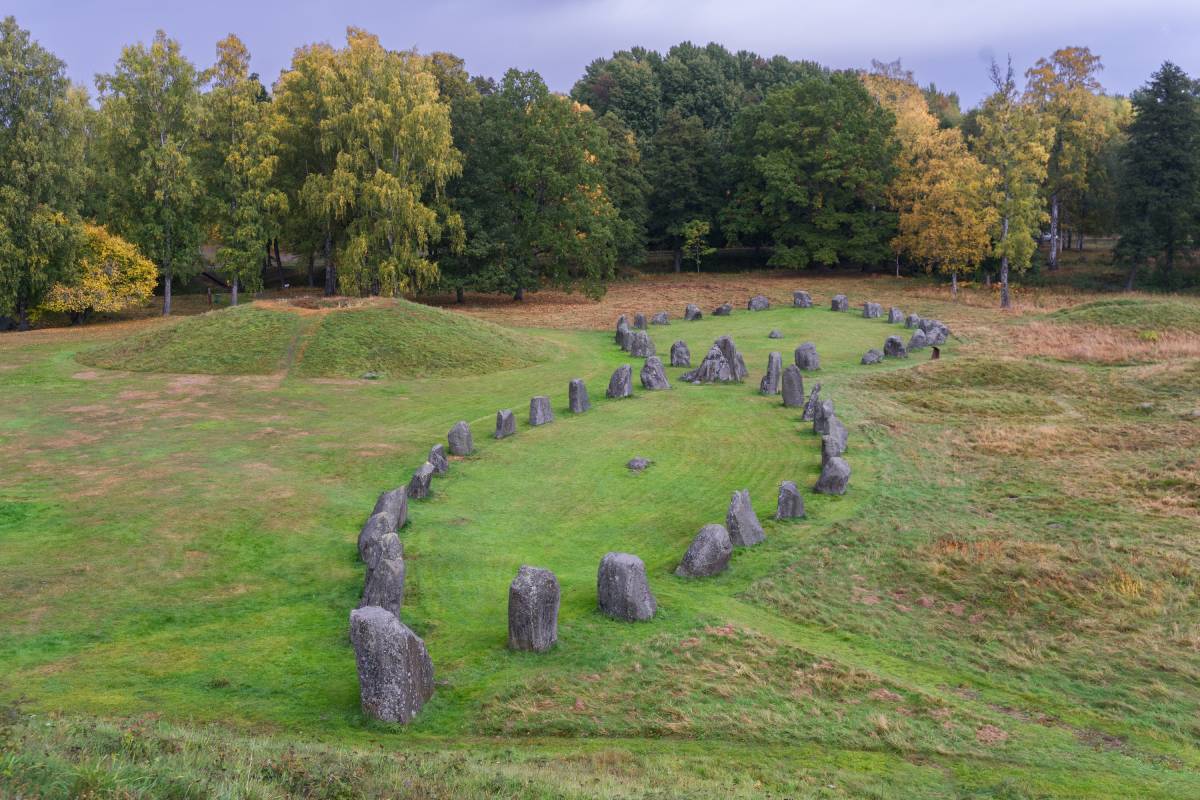
A royal estate in Viking times, Hovgården features graves, runestones, and remnants of a castle. Photo: Inspired By Maps / Shutterstock
Hovgården: A royal eye on lucrative trade
Situated just across from Birka, on another island, Adelsö, in the balmy waters of Lake Mälaren (well, balmy is debatable when it comes to Northern Europe), is the site of Hovgården.
Whilst this ancient site houses graves (more than 124 spanning the early Nordic Iron Age to the 11th century) and burial mounds from the Bronze Age, it is the sites of later Viking history that we are interested in.
For more than 600 years, spanning roughly Sweden's Viking Age and into the medieval period, the island housed what archeologists believe was a royal estate. Perched on a hill, with a view of the surrounding lake, only a small part of this estate survives today, including the remains of a castle.
It was here that historians assumed rulers could control Birka and its lucrative trade. Not only is there a parish church here, but the island also houses a collection of runestones dating back to the rule of the enigmatic Håkan Röde (Haakon the Red), who ruled Sweden in the latter half of the 11th century.
Yet it is the three "royal" burial mounds (Kungshögar in Swedish) that have cemented this island as a place of importance in the Swedish collective memory.
Archeological excavations of one of these mounds, back in 1917, uncovered the remains of a man who had been burned in a boat, dressed in fine garb, and accompanied by animals.
Hovgården saw some reconstruction and repair in the 13th century, including the construction of a palace. Yet by the end of that century, the palace was destroyed, and the estate fell out of favor with the Swedish ruling class.
- READ MORE: The Viking history of Sweden at a glance
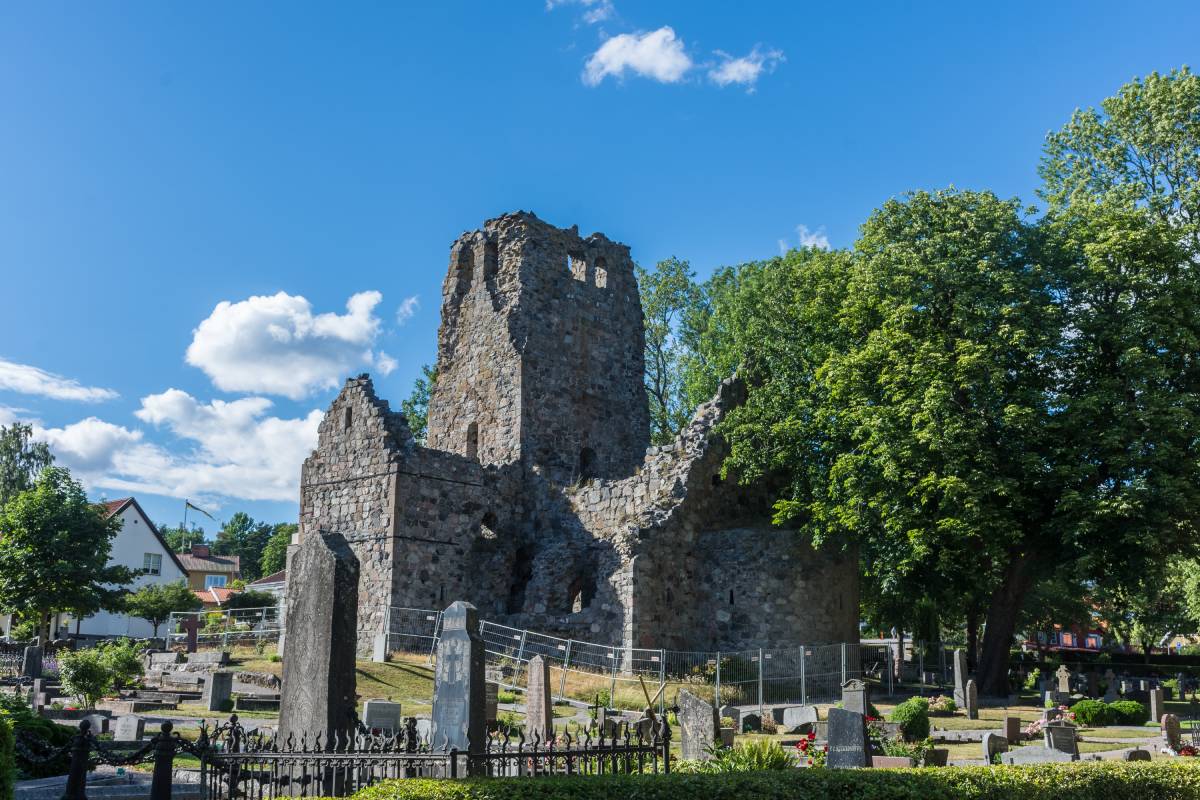
Once home to Sweden's first Christian king, Sigtuna also housed early churches like St Olof's. Photo: Stefano Zaccaria / Shutterstock
Sigtuna: Religion, power, and money in Sweden's oldest town
Lying just northeast of Lake Mälaren is what the Swedish tourism board labels "Sweden's oldest town": Sigtuna.
Its foundation in the 10th century coincided with the decline of Birka and is instrumental in the transition of Sweden from the Viking Age to the medieval period.
The Swedish king Eric the Victorious is traditionally seen as responsible for the town's foundation in 980.
However, this legendary founder is challenged in recent academic work, as Torun Zachrisson suggests in her article in the 2020 book Viking Encounters: Proceedings of the Eighteenth Viking Congress, that "King Harald Bluetooth was, directly or indirectly, its [the town's] founder..." Regardless of who founded it, it remains Sweden's most important pre-modern town.
Like other contemporary Viking Age towns, think Ribe in Denmark or even Jórvík in England, much of Sigtuna was constructed in long, narrow plots facing Sweden's oldest paved road, Stora gatan. This was the first urban center in Swedish history.
A large amount of Sigtuna, however, was reserved for what modern historians believe was a royal seat.
Not only was there a mint, but also a church, meaning that the nation's first Christian king, Olof Skötkonung, had firm control of affairs of both the spiritual and very earthly nature.
Church, power, and money, in the medieval period, were often intrinsically interconnected with one another.
It has been suggested that the construction of Sigtuna marked a shift away from the paganism of the nation's past and a shift into Christianity that would dominate its medieval history.
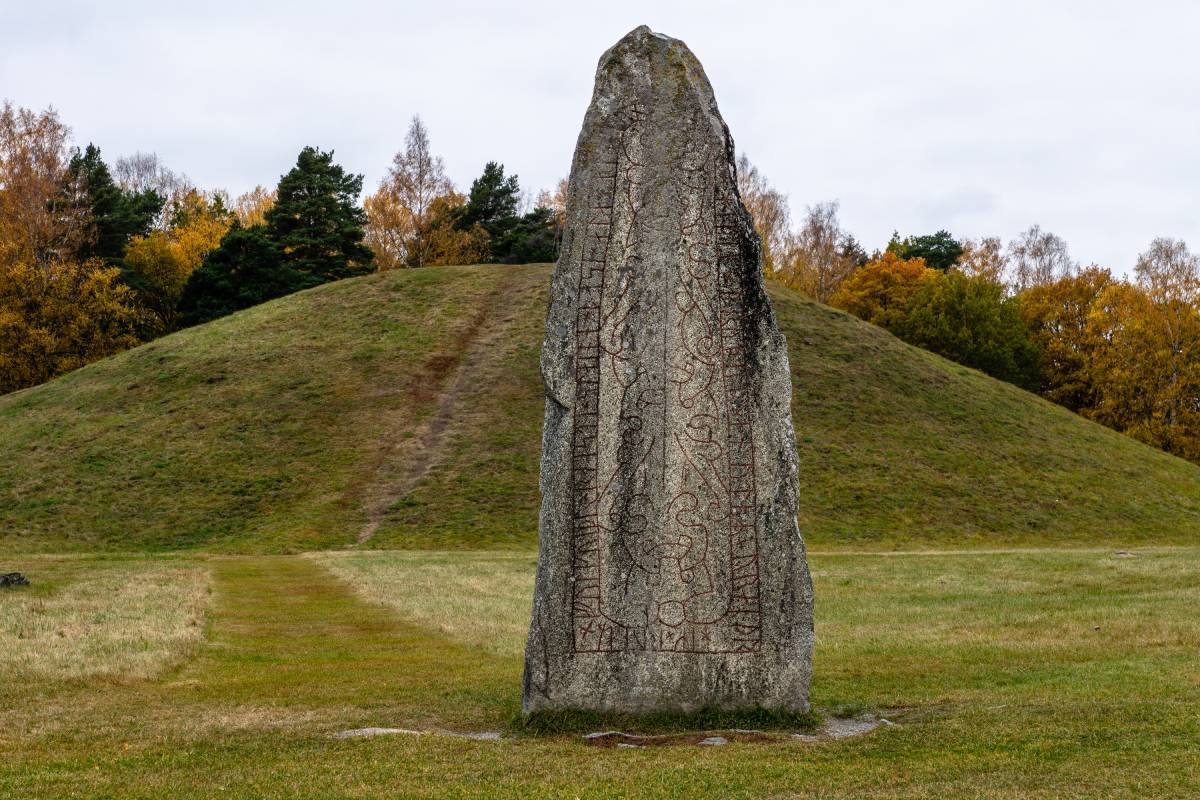
The runestone Vs 13 stands beside Anundshög's monumental burial mound and stone ship setting. Photo: Magnus Binnerstam / Shutterstock
Anundshög: An ancient site of ritual and royal power
We now travel further south to the outskirts of Västerås on the eastern edges of Lake Mälaren.
Here is Anundshög, what is believed to be Sweden's largest burial mound, measuring approximately 9 meters (30 feet) tall and with a diameter of approximately 60 meters (200 feet).
It is likely that this mound dates to the very beginnings of the Viking Age, perhaps sometime in the 7th century or before. However, despite its ancient origins, it remained a place of high cultural importance during the Viking Age.
As the site's name suggests, this burial mound is believed to have been constructed for Anund.
Scouring the sagas, we find reference to King Anund of the Yngling Dynasty, who was said to have ruled in the 7th century. Though a semi-legendary ruler, what makes this theory even more interesting is the presence of a runestone that reads:
"Folkvid raised all of these stones after his son Heden, Anund's brother. Vred carved the runes."
Adding further historical fuel to the fire is that the site included stone ship settings (which have been reconstructed in modern times).
This, along with the burial mound, makes the place one of ritual importance.
Historians have also pointed out its location, which is along Eriksgata, a royal processional road that early Swedish monarchs traveled to exert their royal authority and power.
Walking this route was, as Caroline Wilhelmsen discusses in her 2022 article in the journal Parergon: An Australasian Journal of Medieval and Early Modern Studies, "a ritual, but also... a political and diplomatic act."
An act no doubt fit for a king, even if semi-legendary!

The Helgö Buddha is a striking reminder that early Swedes were part of a global exchange network. Photo: The Swedish History Museum (CC BY-SA 2.5)
Best of the rest
Aside from these three historical sites of striking importance, the surroundings of Lake Mälaren house many others.
On the island of Helgö, we find the remains of one of the oldest trading towns in Sweden's history, believed to have been founded around the turn of the 3rd century.
Among the archeological treasures uncovered here is a small statue of the Buddha, as well as a Coptic Christian christening scoop from Egypt.
Both of these artifacts date to the 6th century and speak to the global connections of the early medieval period that linked Scandinavia with the wider world.
Finally, slightly further northeast is another lake, Vallentuna, where dotting the shoreline is a Viking Age Thing and what is believed to be the world's largest concentration of runestones, including many that speak of faraway Viking adventures in the Byzantine Empire.
There is no doubt that the historical site of Birka played a larger role in the early history of the Swedish state.
However, in the nearby region, many other sites helped lay the cultural, economic, political, and religious foundations that medieval Sweden would build upon.
For more information on what makes Birka and Hovgården UNESCO World Heritage Sites, visit the UNESCO website here.
This article was written at the request of our Patron, Roger, who wanted to explore Viking sites around Lake Mälaren. If you enjoy our work and would like to propose a topic of your own, you can do so by joining our Patreon here.
Feel free to reach out to discuss potential stories that may be in the public interest. You can reach us via email at [email protected] with the understanding that the information you provide might be used in our reporting and stories.