

One of the popular TikTok crazes of 2024 – or so I'm told, as this author, born in the late 1980s, is alas a decade or two too old to uncringeworthily install that app – was people realizing how much time we in the 21st century still spend thinking about the Roman Empire.
Open up any history book of Europe, Asia, or Africa, and there is no doubt that there will be some reference to the might and power of Rome.
We here at The Viking Herald (thankfully for our audience) write articles and don't make TikTok reels (yet), but we are not immune to the lure of Rome.
Though our subject matter – people from Viking societies and their feared warriors – operated centuries after the fall of the (Western) Roman Empire, they were able to exploit a politically insecure and unstable (Western) Europe left in pieces by Rome's collapse.
Yet by the late 8th century CE, a new regional power was emerging in what was the former Roman province of Gaul.
This area had been invaded by a series of Germanic peoples since Rome's collapse, and after a few centuries of cultural and social mixing with the local Romano-Gallic population, the Franks had emerged.
One ruler, Charlemagne, who tried to glue back the broken pieces of a Western Roman Empire and extended his realm's boundaries from the Pyrenees to the borders of Denmark, from the English Channel to Rome, though a military great, saw a storm coming from the north: the Vikings were coming!
- READ MORE: The Viking history of France (Part 1)
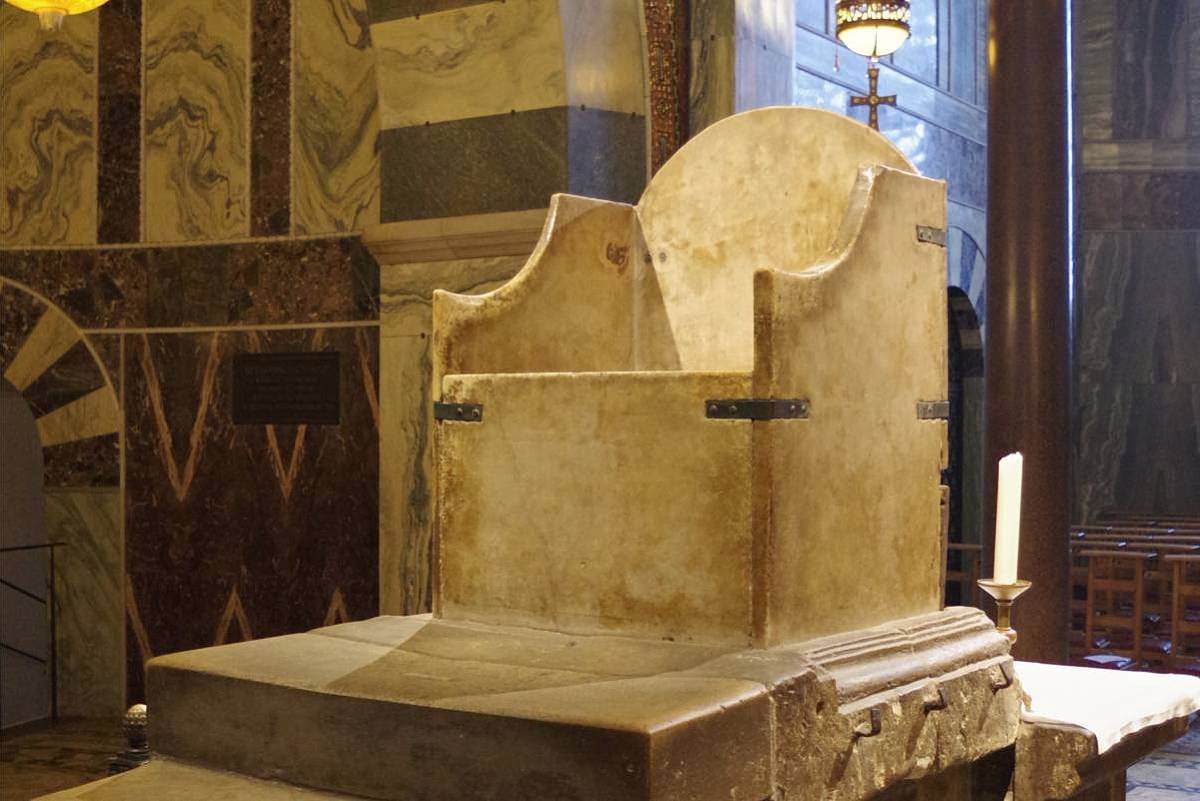
Charlemagne’s marble throne in Aachen Cathedral was a symbol of authority in a post-Roman world dominated by instability. Photo: Berthold Werner
The three stages of the Viking presence in Francia
Despite the supposed supremacy of Charlemagne by the early 9th century CE in much of Western Europe, his death in 814 CE would see Frankish power disintegrate and be nibbled away at by, in part, our Viking friends from the north.
It is in this milieu that Noah Tetzner sets the latest installment in the Combat series, titled Viking Warrior vs Frankish Warrior: Francia 799–911 (available on Amazon here), which focuses on the clashes between Frankish warriors and their Viking counterparts.
Let us be clear from the start: while Tetzner clearly has a passion for Vikings (as the host of the popular and scholarly podcast The History of Vikings – a rare blend of both, which Tetzner's podcast navigates with aplomb), this book remains balanced in its portrayal of both the scourge of the Franks and the Franks themselves.
This is a mature and scholarly approach to what were two of the greatest warrior cultures of the early medieval period.
Tetzner gives as much explanation and historical background to the societal and military forces that helped make Frankish warriors often the equal of any battle-hardened Viking warrior.
The book is divided into three periods. The first covers the initial clashes between Vikings and the Franks, consisting mainly of sporadic and predatory raids up until the mid-9th century CE.
The second focuses on the more advanced and permanent assaults from 840 CE onwards.
The final phase examines the later raids that culminated in the most permanent Viking presence in Francia: the creation of Normandy in 911 CE.
In these three divisions, numerous important battles, campaigns, and skirmishes are given, allowing the reader to follow, sometimes with fear, sometimes with anguish, and always with excitement, the slow but inevitable domination of much of Francia by Viking warriors.
As the saying goes, Frankish warriors may have won the battle, but ultimately, it was the Vikings who won the war for much of this early medieval period.
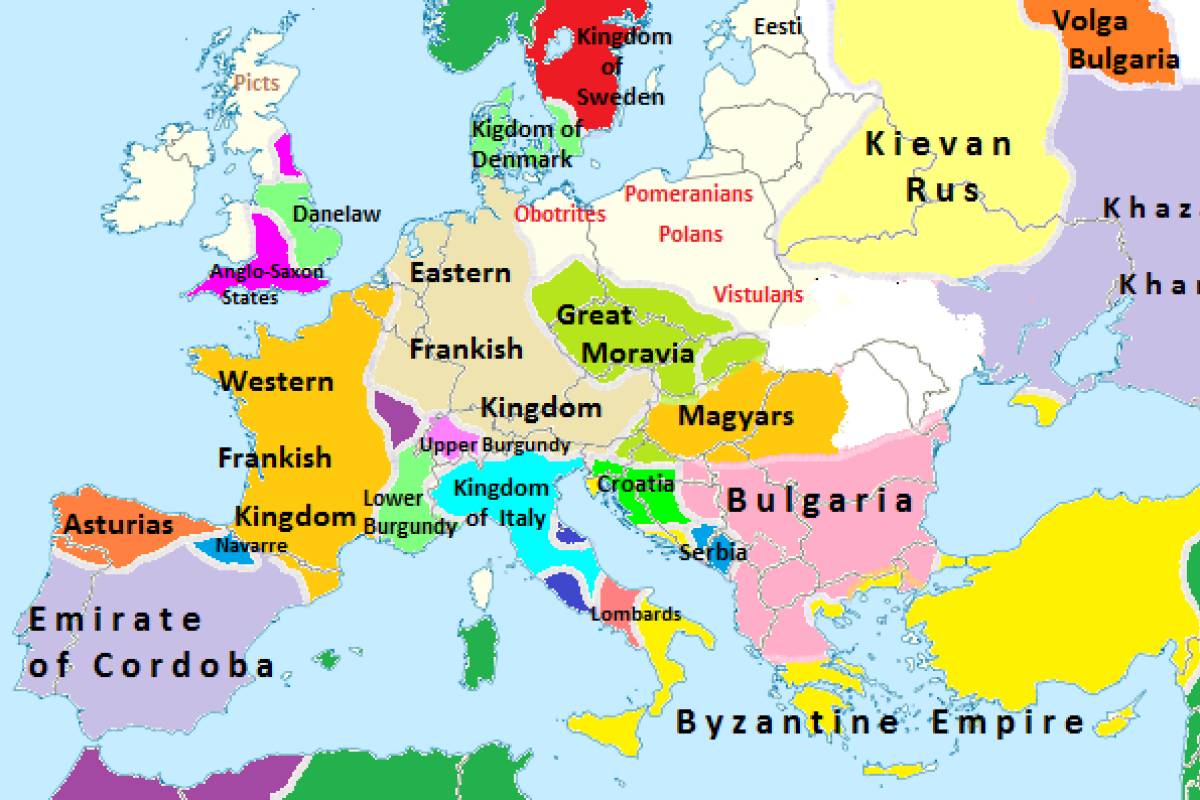
A map of Europe in 900 illustrates the fractured political landscape that shaped Viking and Frankish interactions. Source: Mandramunjak
Beautifully written but even more beautifully illustrated
Truly, one of the highlights of this short book is its vibrant approach; unlike many history tomes that can be stuffy and unimaginative, Tetzner's is full of color.
It is a stunningly illustrated book that draws on illustrations, maps, and photographs to help shed light on a period often derided as the "Dark Ages."
This visual beauty helps make Tetzner's book a truly movable feast for the eyes.
For the beginner history buff, there are helpful maps of the areas these two warriors plied as well as descriptive illustrations of an "average" Frankish or Viking warrior – what clothes and armor they wore, as well as the deadly weapons they wielded.
We also have pictorial action illustrations showing a river encounter between the two early medieval foes or a raid on Dorestad.
Not only is the battle depicted with historical accuracy, but Tetzner also explains the (probable) battlefield tactics of the two sides.
This discussion of battlefield tactics and short-term gains – as well as the larger strategic aims and broader history – should please those with more advanced historical knowledge.
It is, at times, so detailed that you can almost hear the clash of sword against shield or lancea striking chainmail.
Written with a clear passion for the subject, Tetzner has crafted a book that is surely something to cuddle up with on the couch during these colder (Northern Hemisphere) months.
It is both a great introduction to the Viking history of France and a valuable resource for those who can comfortably tell their Rollo from their Louis III or Louis the Pious.
Viking Warrior vs Frankish Warrior: Francia 799–911 by Noah Tetzner is available for purchase on Amazon here.
We get to provide readers with original coverage thanks to our loyal supporters. Do you enjoy our work? You can become a PATRON here or via our Patreon page. You'll get access to exclusive content and early access.
Feel free to reach out to discuss potential stories that may be in the public interest. You can reach us via email at [email protected] with the understanding that the information you provide might be used in our reporting and stories.