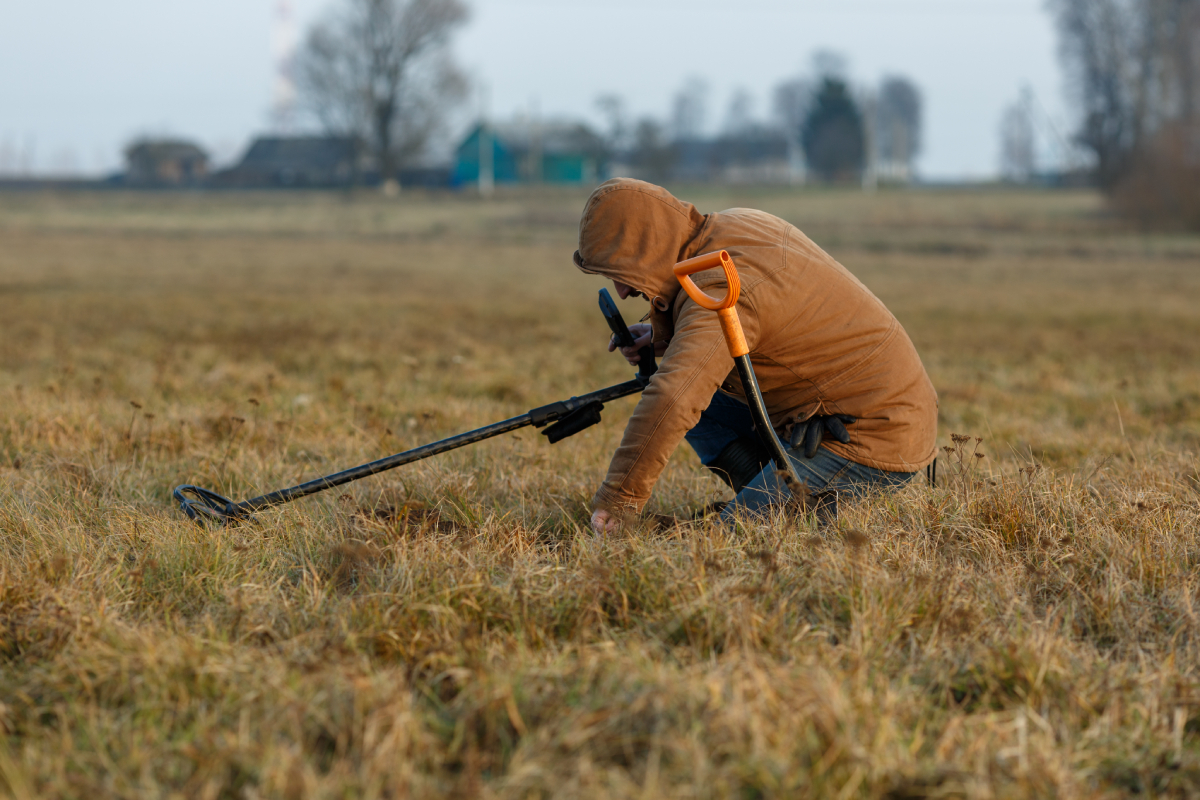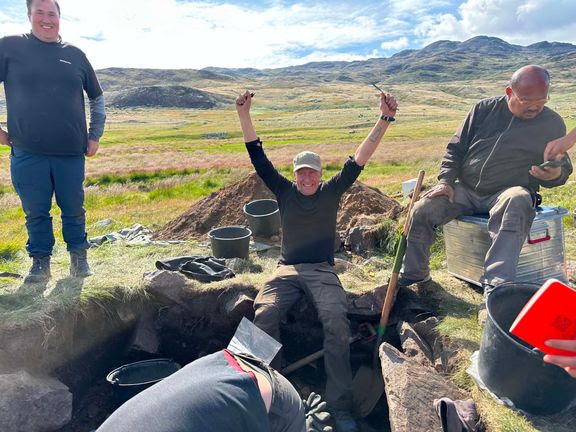


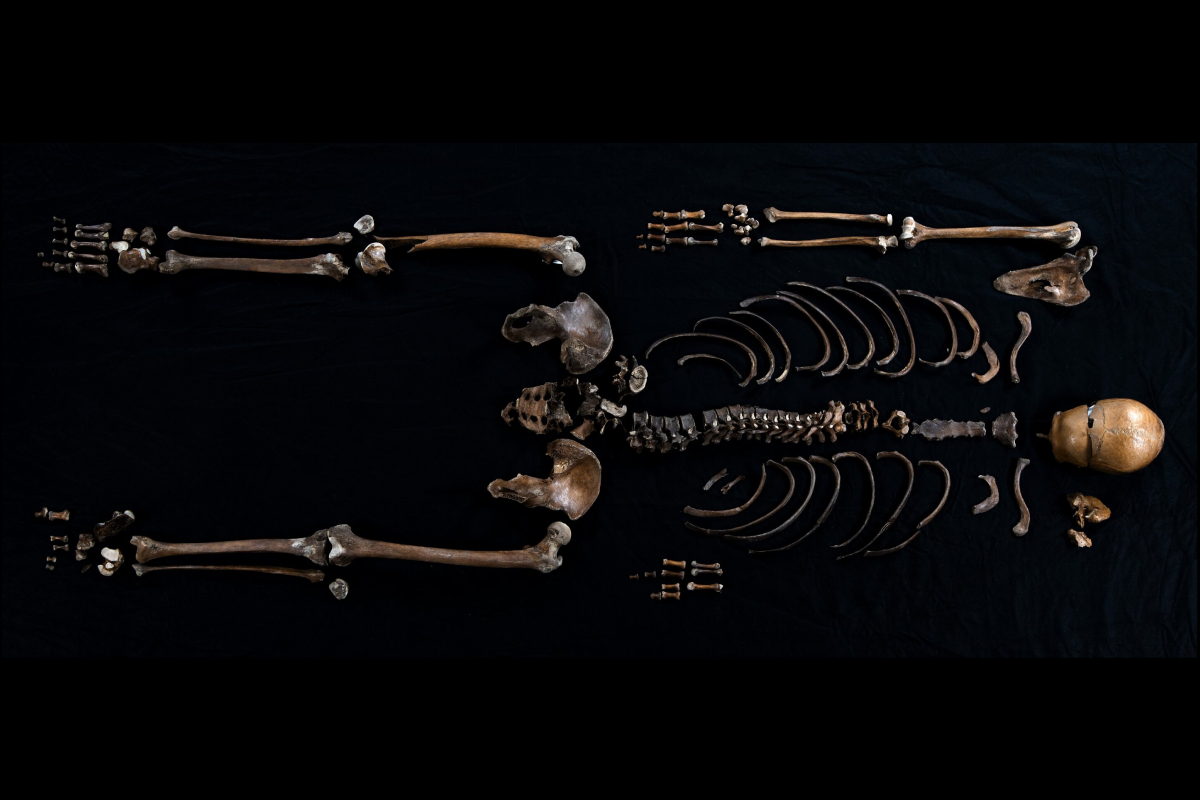
What do these three have in common: a dead king, a community car park in the English Midlands, and King Sverre Sigurdsson of Norway?
No, this is not the author's belated attempt to enter the world of standup comedy. The common link between these three is bioarcheology.
Thanks to Hollywood depictions, everyone knows what an archeologist is (but you can keep your hats and whips at home, please!).
Yet there is a new and emerging field of archeology that, in the humble opinion of those of us at The Viking Herald, is even more intriguing than anything Harrison Ford could serve up.
Thanks to advances in modern science and technology, bioarcheology – a whole new field of archeology focused on biological remains from archeological sites – has emerged in recent years.
Though a relatively new field, it has helped unlock one of the most significant archeological finds in history: the discovery of the body of English King Richard III under a car park in the English city of Leicester in 2012.
Bioarcheology has also played a role in uncovering the truth about the 800-year-old skeletal remains of a man discovered near Trondheim, Norway.
Furthermore, a recent study published in iScience on October 25, 2024, titled Corroborating Written History with Ancient DNA: The Case of the Well-Man Described in an Old Norse Saga, has cast even more light on the identity of this poor soul.
Thanks to DNA analysis – part of the technological tools that bioarcheologists wield – we now know that the remains belong to a male with ancestry from southern Norway, aligning with details from the medieval Sverris Saga.
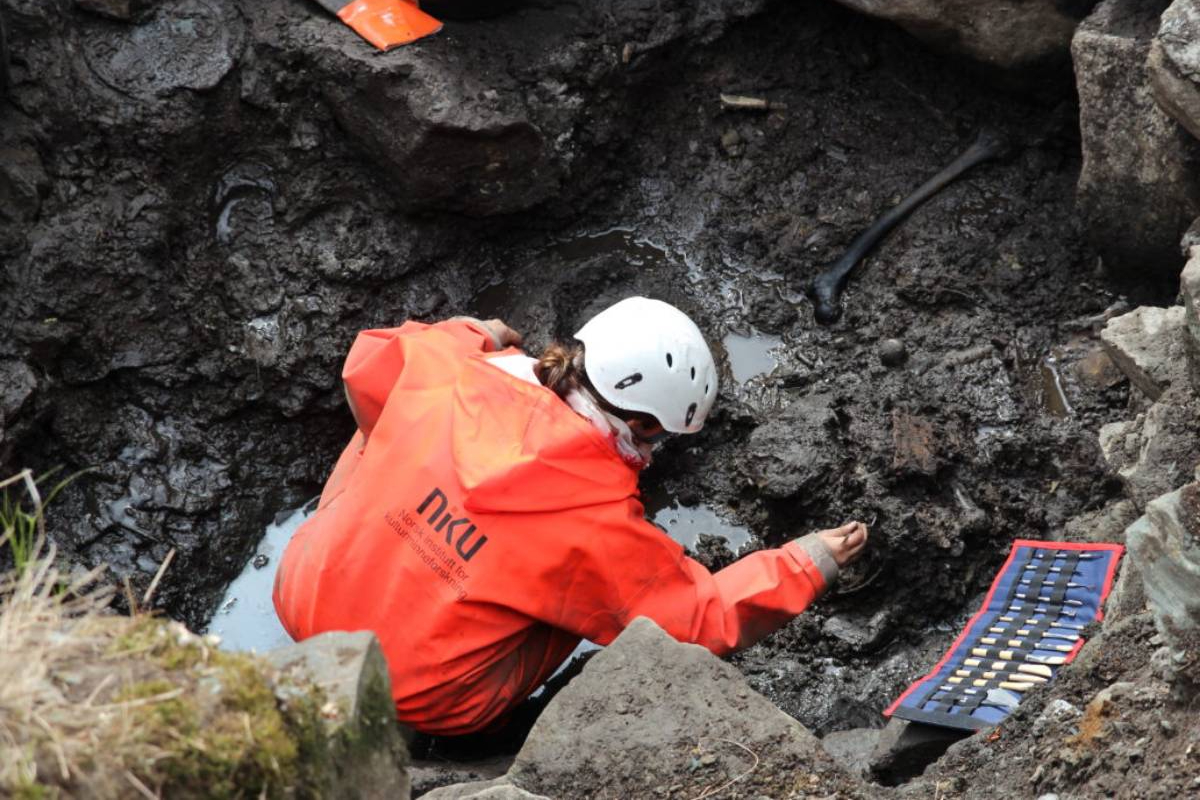
The skeleton was first discovered in a well at Sverresborg in 1938, with further excavations uncovering more remains in 2014 and 2016. Photo: NIKU
Biological warfare in the medieval era
We know that bioarcheology has already helped prove the validity of a sordid tale in one of the Norse sagas.
King Sverre Sigurdsson of Norway (r. 1184–1202) oversaw the compilation of his own saga, Sverris Saga, which was later included by Snorri Sturluson in the famous Heimskringla – a collection of sagas detailing the lives of early medieval Scandinavian kings and rulers.
One of the most famous episodes describes when King Sverre was holed up in a fortress, with his enemies literally baying at the gates.
A dead man's body was said to have been thrown down a water well, then covered with stones to poison the water supply and force Sverre and his men to surrender after a prolonged siege.
This act of biological warfare, centuries before the horrors of the First World War, was dismissed as a mere tall tale until the discovery of an 800-year-old male skeleton in 2022.
Yet a new scientific examination has unlocked even more detail and knowledge about this mystery man.
Before we delve into what this DNA analysis has revealed, we must understand a little about the milieu in which he lived – the "Norwegian Civil War" period.
- READ MORE: A Viking history of Norway – Part 1

The remains, known as the “Well-man,” were identified as male, with physical features likely including blond hair and blue eyes. Photo: NIKU
End of one era and the start of a new one
Harald Fairhair, a man shrouded in myth and mystery, is said to have been the first ruler to unite the petty kingdoms of Norway into a centralized kingdom in 873.
Over the course of the next few centuries, which spanned much of the Viking Age (c. 750–1100), this process of centralizing power was supercharged by the introduction of Christianity.
As Hans Jacob Orning discusses in his 2013 book, Disputing Strategies in Medieval Scandinavia, by the end of the 11th century, Norway had evolved into a medieval Christian kingdom with a sole monarch at its apex.
The death of King Sigurd the Crusader in 1130 sparked a dynastic dispute, with several individuals claiming legitimacy and the crown, leading to what has been called the "Norwegian Civil War Era" (1130–1240).
By the end of the 12th century, two factions had emerged: the Bagler and the Birkebeiner.
The Baglers were broadly said to represent the upper echelons of Norwegian society, including the aristocracy, clergy, and wealthy merchants who backed pretenders to the Norwegian crown.
They named their rival faction – the Birkebeiner (Birch Legs), who were said to represent the less privileged and supported descendants of King Sigurd – mockingly, claiming they were so poor they could only afford to make shoes from birch bark.
Rather than take offense, the rival faction embraced this patronizing nickname, which stuck.
It was in this divided nation that Sverre Sigurdsson was born in the mid-12th century.
His early life was the stuff of sagas: born in the Faroes and ordained for the priesthood, his mother later shockingly revealed he was of royal blood, the son of Sigurd Munn.
He journeyed to Norway to seek his destiny and eventually joined the Birkebeiners, who chose him as their leader.
For over six years, he battled the forces of the incumbent King Magnus V until a crushing victory at the Battle of Fimreite saw him kill his foe and claim the ultimate prize: the throne of Norway.

Despite the siege described in the saga, King Sverre maintained his rule until he died in 1202 and was laid to rest in Nidaros Cathedral. Photo: Mikolaj Niemczewski
A very troubled reign
Despite a crushing victory, King Sverre's hard-fought kingdom was not a peaceful one. Insurrections and rebellions plagued his 18-year reign.
The forces loyal to his former rival, King Magnus, those who held the reins of power throughout much of Norway, grew bolder each year until launching a full-scale insurrection in 1196.
During this insurrection, the Bagler faction attacked a fortress in 1197. near Nidaros (modern-day Trondheim), then the nation's capital, where King Sverre and his forces were holed up.
As Sverre Bagge explains in his 1995 article in the Scandinavian Journal of History, the Sverris Saga – commissioned during Sverre's reign and considered more propaganda than historical record – describes how the despicable Baglers allegedly threw a body down a well to poison the water supply, intending to force an end to the siege.
This act of biowarfare was ultimately unsuccessful, as King Sverre survived and continued to rule Norway until his death in 1202.
Fast forward almost a millennium and a new study of the skeletal remains published last week sheds more light on this morbid tale.
Whilst much has been made of the date of death of the poor individual – coinciding exactly with the Bagler siege in 1197 – new DNA analysis has also brought to life more personal features.
The man was said to bear all the hallmarks of your stereotypical Scandinavian – blue eyes and blonde hair – and was also said to hail from the south of the kingdom, near Agder.
His origin is particularly interesting, as it now raises questions about whether the dead man was a fallen foe from Sverre's side, as previously theorized, or part of the Bagler warring faction.
Shedding light on hidden history
Thanks to this latest DNA analysis, what was once thought to be a tall tale from a piece of medieval literature or propaganda can now be confidently labeled as more fact than fiction.
Spare a thought, though, for the man whose remains were studied. It's bad enough to die in battle – regardless of whose side you were on – but then to have scientists examining your bones almost a millennium later.
Whilst the rich tapestry of Norse sagas is enjoyed as works of great world literature, their historical accuracy is, at best, unreliable.
Yet thanks to the latest technological advances in bioarcheology, many more of history's hidden secrets – whether found under our feet or in the pages of the sagas – are being uncovered.
For more information on a recent dispute over medieval manuscripts chronicling the Norse sagas, visit the Al Jazeera website here.
We get to provide readers with original coverage thanks to our loyal supporters. Do you enjoy our work? You can become a PATRON here or via our Patreon page. You'll get access to exclusive content and early access.
Feel free to reach out to discuss potential stories that may be in the public interest. You can reach us via email at [email protected] with the understanding that the information you provide might be used in our reporting and stories.