

A project conceived at the Royal Birmingham Conservatoire in the UK, Augmented Vocality seeks to create a sonic landscape for Old Norse and Early Irish texts.
Funded by a grant from the Arts and Humanities Research Council, the project focuses on Old Norse and Early Irish, combining linguistic expertise with sophisticated voice-processing technologies to breathe new life into early languages and help reclaim the oral quality at the heart of medieval literature.
The Viking Herald speaks with co-investigator on the project, Dr. Edmund Hunt, who has worked closely with colleagues in Cambridge on specific Old Norse texts and written music inspired by them.
The Viking Herald: Can you tell us a little about music during the Viking era – do we know anything about the role of music then, the instruments played, and so on?
Dr. Edmund Hunt: Some of what we know about music during the Viking era comes from archaeology. For example, instruments such as panpipes, whistles, and jaws harps have been found in York. However, archaeology can't tell us how these instruments might have been played or what the repertoire might have been. Poems and sagas do not give detailed information about music, although music-making was clearly a part of Viking-age culture.
The arrival of Christianity would have been accompanied by new forms of religious music and liturgical chants. It's possible that there may have been some influence on secular music, but there's very little evidence.
The earliest Northern European musical notation (like literature) tends to come from ecclesiastical centers of learning. However, secular notated music is generally later than the Old Norse literature that forms the basis of Augmented Vocality.
TVH: How have Old Norse texts and sagas influenced music since? Are there specific examples, certain pieces or work by certain composers, that refer back to this kind of material?
EH: Composers have been influenced by Old Norse texts and sagas for centuries. In the 19th century, this interest often reflected national and Romantic ideas; think of the appearance of the Old Norse pantheon in Wagner's operas. More recently, British composer Gavin Bryars used Old Norse text in his opera From Egil's Saga (2004).
Natasha Barrett, a composer who mainly creates electroacoustic work, used samples of the Poetic Edda (spoken in Old Norse by Magnus Rindal) in ...The Fetters of a Dream… (2001). Another British composer, Stef Conner, has done fascinating work with texts from across the early medieval and ancient worlds, and she also performs some of her compositions on reconstructed early instruments.
TVH: Can you tell us more about your project, how it came about, and the idea behind it?
EH: The idea for my project, Augmented Vocality: Recomposing the Sounds of Early Irish and Old Norse, came from the desire to reengage with the sonic, performative qualities of medieval poetry. I have a background in Old Irish and Old Norse, as I studied both of these languages during my degree in Anglo-Saxon, Norse, and Celtic at the University of Cambridge.
During Augmented Vocality, I and colleagues from Royal Birmingham Conservatoire, led by Professor Lamberto Cocccioli, worked with two researchers from the Department of Anglo-Saxon, Norse, and Celtic: Professor Máire Ní Mhaonaigh and Dr. Brittany Schorn. The Cambridge team worked on preparing the texts and coaching the voice actors who recorded spoken versions of the poems.
From the outset, the project was designed with a cross-disciplinary audience in mind. We intended to create materials that would appeal to musicians as well as anyone with an interest in early medieval languages and literature. In the compositions, I deliberately chose not to try to recreate a version of medieval music.
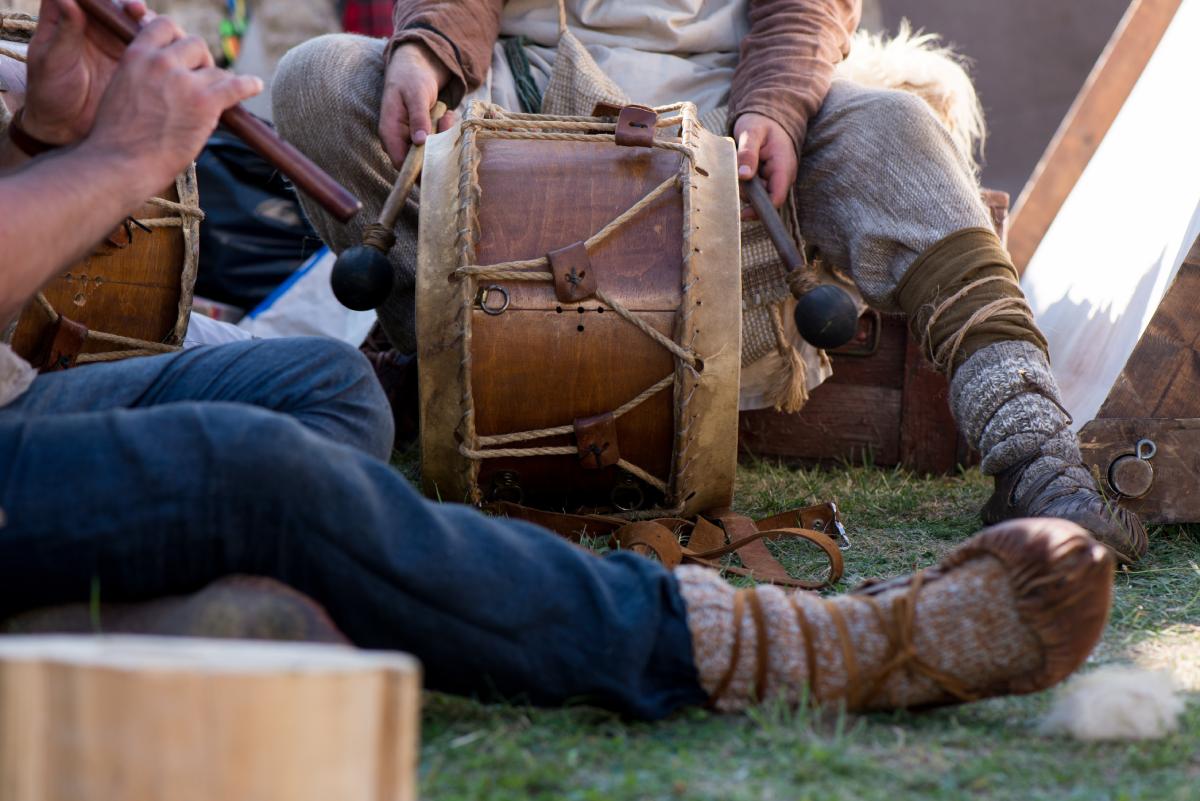
Pictured are musicians playing traditional musical instruments in a Viking and Roman reenactment camp. Photo: RoberG / Shuttestock
Instead, I intended to re-present Old Norse and Old Irish poetry in its untranslated form but in a contemporary music context. By doing this, I wanted to allow modern audiences to hear the sounds of Early medieval languages within a twenty-first-century performance setting.
As a composer, I have a particular kind of musical language, influenced by the sounds I like and the education I have received. My Augmented Vocality compositions might be described as 'contemporary classical' music.
Another musician might approach the same texts very differently – in fact, we hope that other people will engage with the Augmented Vocality materials in order to create their own musical responses to this wonderful collection of poetry.
TVH: Why do you think people – musicians, filmmakers, writers – find inspiration in these Norse texts?
EH: There is a vast quantity of literature in Old Norse. Some of this literature is fantastical, such as many of the mythological Eddic poems. Other texts seem to give us a glimpse of a distant time, when people's lives and worldviews were very different from ours. As a composer, I was particularly drawn to texts in which the speaker had a clear identity.
Many of the poems featured in Augmented Vocality describe timeless human experiences, such as grief, love, relationships, memory, life, and death. Despite the centuries that separate us from the authors of these texts, it is clear that there is more that unites us than divides us as human beings.
TVH: What concrete plans do you have for your project? Something recorded in the studio? Performances of some kind? Is there anything that people might be able to listen to already?
EH: During the project, I composed three pieces; two based on Old Norse texts and one based on Old Irish material. Performances took place in October, November, and April, and videos will be available on the project website.
The website includes the texts that we used, recordings (spoken by actors), databases of words and sounds, and also creative tools to transform speech into musical sounds.
All of these resources are freely available. As a project team, we hope that other people will engage with these materials, either to delve into the language and literature, create their own music, or explore similar approaches with other languages.
The funded part of Augmented Vocality may have come to an end, but we have barely touched the vast quantity of literature that exists.
We get to provide readers with original coverage thanks to our loyal supporters. Do you enjoy our work? You can become a PATRON here or via our Patreon page. You'll get access to exclusive content and early access.
Feel free to reach out to discuss potential stories that may be in the public interest. You can reach us via email at [email protected] with the understanding that the information you provide might be used in our reporting and stories.