

A team of researchers has confirmed that the remains of a residence unearthed in the village of Bosham, Sussex, likely belonged to Harold Godwinson, the last crowned Anglo-Saxon king of England.
The house, which is depicted in the Bayeux Tapestry, is thought to be a typical example of the timber-built lordly centers favored by the elite society of Viking Age England.
The Viking Herald speaks exclusively to one of the lead archeologists, Duncan Wright of Newcastle University, about the details behind the discovery, the related research project Where Power Lies, and why an 11th-century toilet was crucial in the identification of the Godwinson manor.
Opening the tale
The Bayeux Tapestry famously depicts the tumultuous events of the year 1066, when the death of the king of England, Edward the Confessor, led to a bitter struggle for power that resulted in the deaths of two more monarchs, the eventual triumph of William the Conqueror, and seismic changes throughout the British Isles and beyond.
The story of the tapestry, however, actually begins in 1064 with a meeting between King Edward, who had reigned since 1042, and his brother-in-law Harold, the Earl of Wessex.
After a discussion with Edward, Harold departs with his followers and hunting dogs for his family estate in Bosham, Sussex.
In the second scene, Harold enters a church at Bosham, enjoys a feast at his manor house, and then departs for Normandy, where he eventually encounters William, his future nemesis.
In other words, Harold Godwinson's house at Bosham takes center stage at the start of probably the most famous pictorial narrative in European history.
Bosham is also mentioned in the Anglo-Saxon Chronicle as the residence of Harold's father, Earl Godwin, who served under King Cnut and Edward the Confessor and became one of the most powerful men in England.
Until now, however, the exact location had never been confirmed, which is why a team of archeologists led by Duncan Wright and Oliver Crichton (the University of Exeter) attempted to find out the truth.
The investigation at Bosham took place as part of a more wide-reaching project, Where Power Lies: Lordly Power Centres in the English Landscape, which had the goal of identifying physical evidence of elite centers of power in England in the period 800 to 1200 CE.
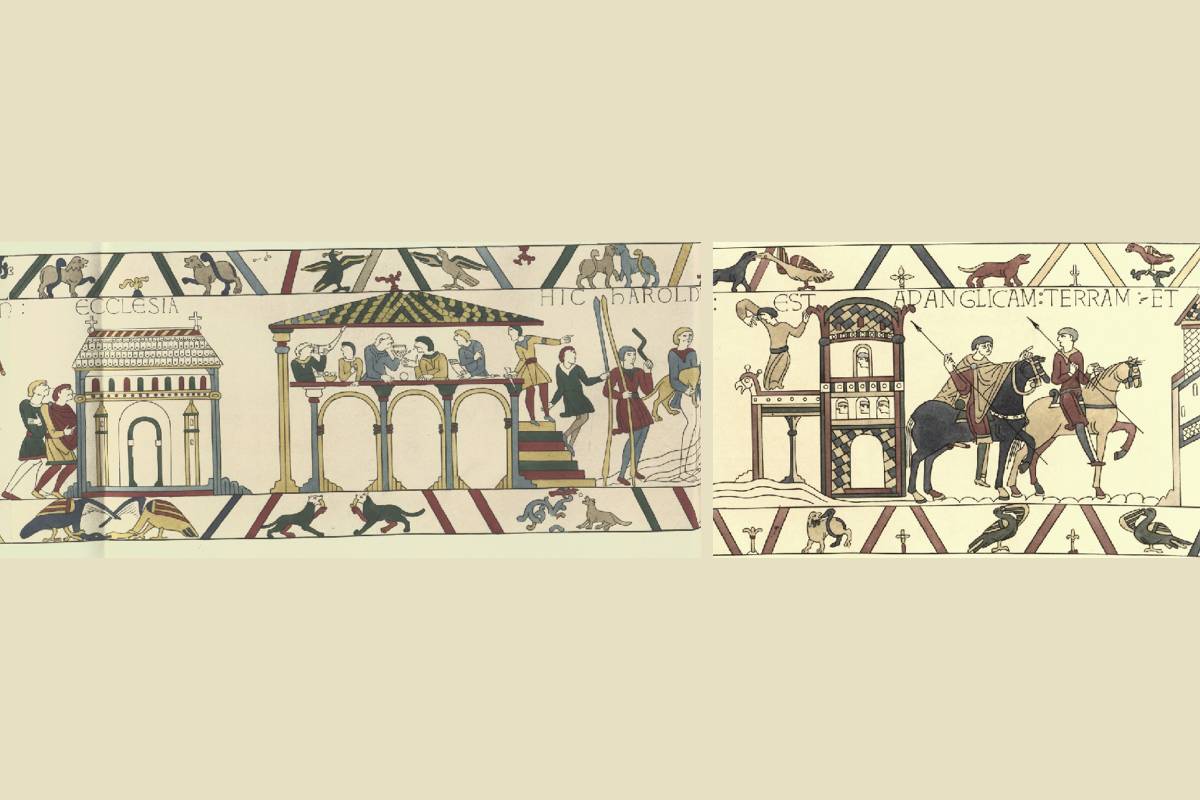
The Bayeux Tapestry shows Harold Godwinson at his Bosham manor, a site now linked to a real-world location. Source: The Society of Antiquaries of London
Confirming history
"Together with Oliver, I am the principal investigator in the project," Duncan tells The Viking Herald.
"Our aim was to try to find hard archeological evidence that can back up local rumors and hearsay. We have identified several residences, and Bosham actually came across as a sort of low-hanging fruit for us."
"After all, Bosham is the only lordly center from our period of study that has been depicted in the Bayeux Tapestry – it's a really rare example of a building featuring in a contemporary illustration."
"Naturally, the tapestry can't be read as a completely accurate portrayal of the historical events of the era," Duncan continues.
"At the same time, I think the scene that shows Harold going from Westminster to Bosham, attending church, and then feasting in a great hall probably captures the essence of what we are trying to look at in our project."
Fortunately, Bosham, the name mentioned in the Bayeux Tapestry, still survives today as a small village of just a few thousand residents on the coast of southern England.
"What really leaped out was that no one had really tried to look for the residence at this location with any sort of purpose," Duncan says.
"For us, the question was: Where is Harold's residence in Bosham? Is it in the modern village or elsewhere on the peninsula?"
"And can we be more confident in locating it on the ground through geophysics or remote sensing techniques?"
"It seemed a really obvious question, but a thousand years later, no one had been able to answer it."
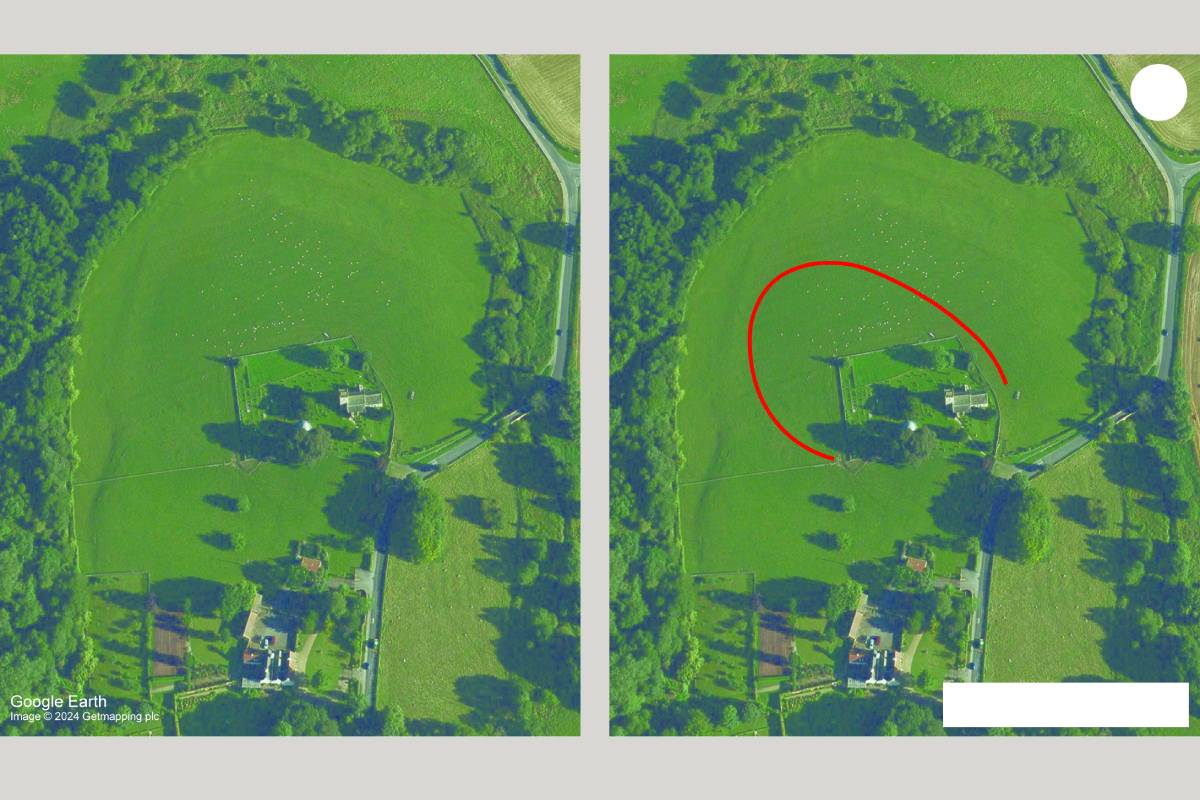
Researchers combined geophysics, surveys, and historical records to investigate Bosham Manor House. Source: Gould, Creighton, Chaussée, Shapland, and Wright
The most likely location
Fortunately, the project team was able to rely on a previous 2006 study from West Sussex Archeology that had detected an early medieval structure on the grounds of the current Bosham Manor House.
With the help of ground-penetrating radar, the team was able to identify the presence of an extensive complex on the site.
"We used a combination of different approaches at Bosham," Duncan tells us. "It was a real combined effort, with a standing building survey, geophysics, the desk-based analyses we usually do, and also looking at the previous excavations."
"The work done in 2006 by West Sussex Archeology was especially important for pushing the chronology back before the Conquest."
"The owners of Bosham Manor House were also really generous. They not only allowed us into their gardens to do the geophysics but also into their house as well."
"At one point, we were literally climbing all over different parts of the attic in our socks!"
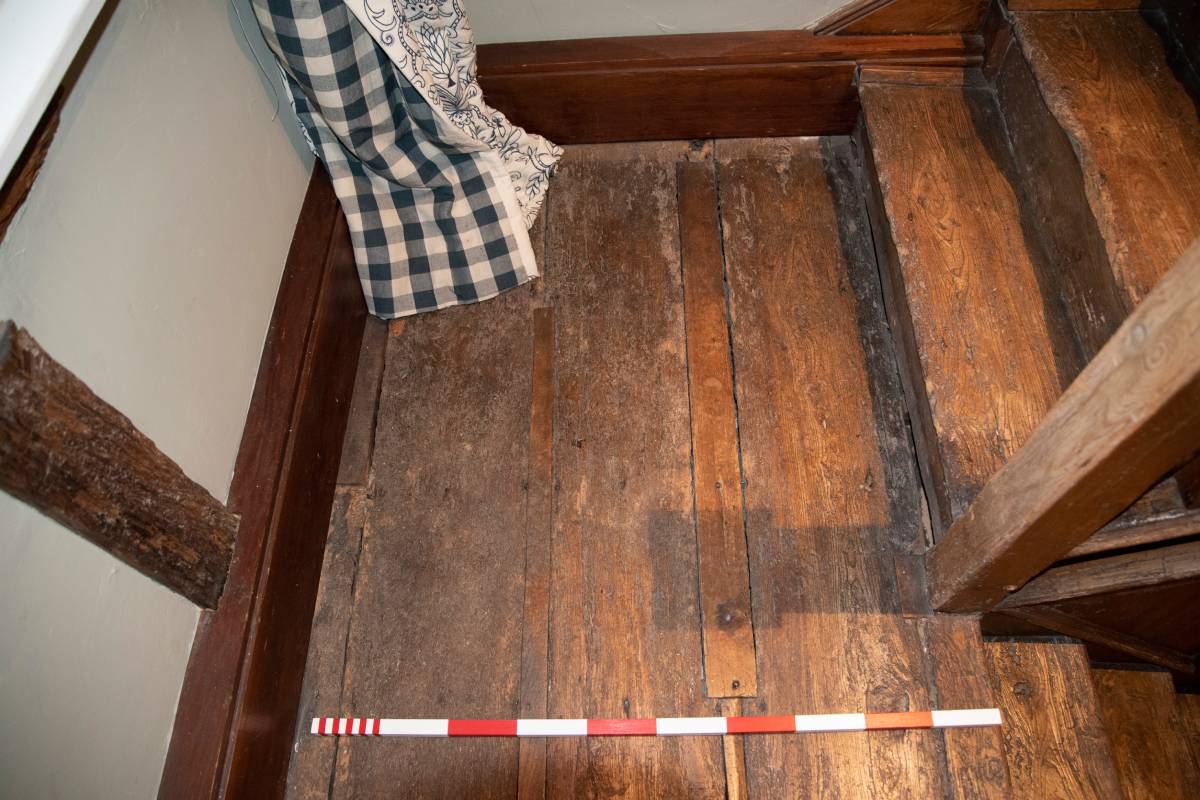
A preserved medieval tie beam in the hall of the existing manor, hinting at its early origins. Source: Gould, Creighton, Chaussée, Shapland, and Wright
The toilet that speaks of history
Yet, while the team was able to confirm the presence of a large pre-Norman residence at the Bosham site, they continued to look for further evidence that it was the manor depicted in the Bayeux Tapestry.
They would finally find confirmation in the form of a most unlikely object: a late-Saxon toilet unearthed in the 2006 investigations.
"It sounds an odd thing to say – there's a slight tension to identifying a whole site through a toilet," Duncan admits. "But in the late-Saxon period, by about 950, you start to see latrines being integrated into really high-status houses – and only in high-status houses."
The significance of latrines in the housing of this period was identified only after the 2006 excavation in two studies by Gabor Thomas and John Blair, respectively.
Duncan and Oliver Crichton believe this research provides a crucial clue to their investigation.
"The identification of a latrine in the context of a large timber building dated to the late-Saxon and early Norman period is pretty convincing evidence that this is a very high-status residence," Duncan states to The Viking Herald.
"It then follows that this is indeed the lordly site we see on the tapestry."
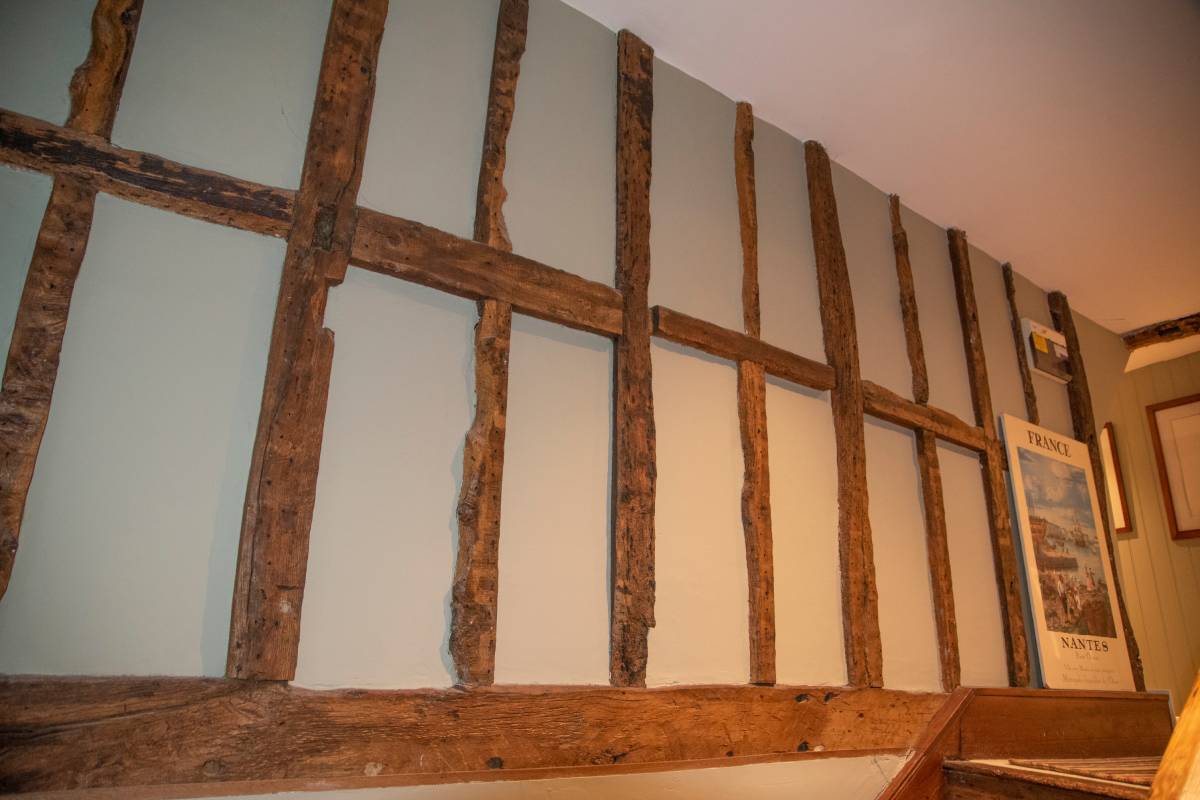
Exposed medieval timbers inside Bosham Manor House, possibly part of the original structure. Source: Gould, Creighton, Chaussée, Shapland, and Wright
The quintessential 10th-century English manor
Duncan also notes that Bosham bears several similarities with other complexes identified in the Where Power Lies study, including one believed to have belonged to Earl Edwin of Mercia, Harold's brother-in-law.
Unlike the stone castles of the Norman era, these manors were typically built with wood and often placed next to a stone church.
"Often, we see those in a kind of symbiotic relationship, with a high-status sort of church and residence paired together," Duncan explains.
"I think it's significant that only the churches are rendered in stone in early medieval England."
"The archeologist Michael Chapman has made the argument that stone is deliberately reserved for the church – it's seen as Roman, as ancestral."
"The Old English word for building is timber – a building is timber, and a church is something quite different."
"At Bosham, we also know from the excavations that the main building was joined to the church, as there was a bridge going between the two structures."
"In all likelihood, the complex would be defined by a large bank and ditch and a palisade enclosure."
"They would probably have placed the main entrance of the manor so that you would be facing the full length of the hall. It would give you a really impressive vista of the entire length of this grand building," Duncan adds.
"It would have been very distinctive. You would also have had other buildings within the complex, such as domestic buildings, kitchens, and stables."
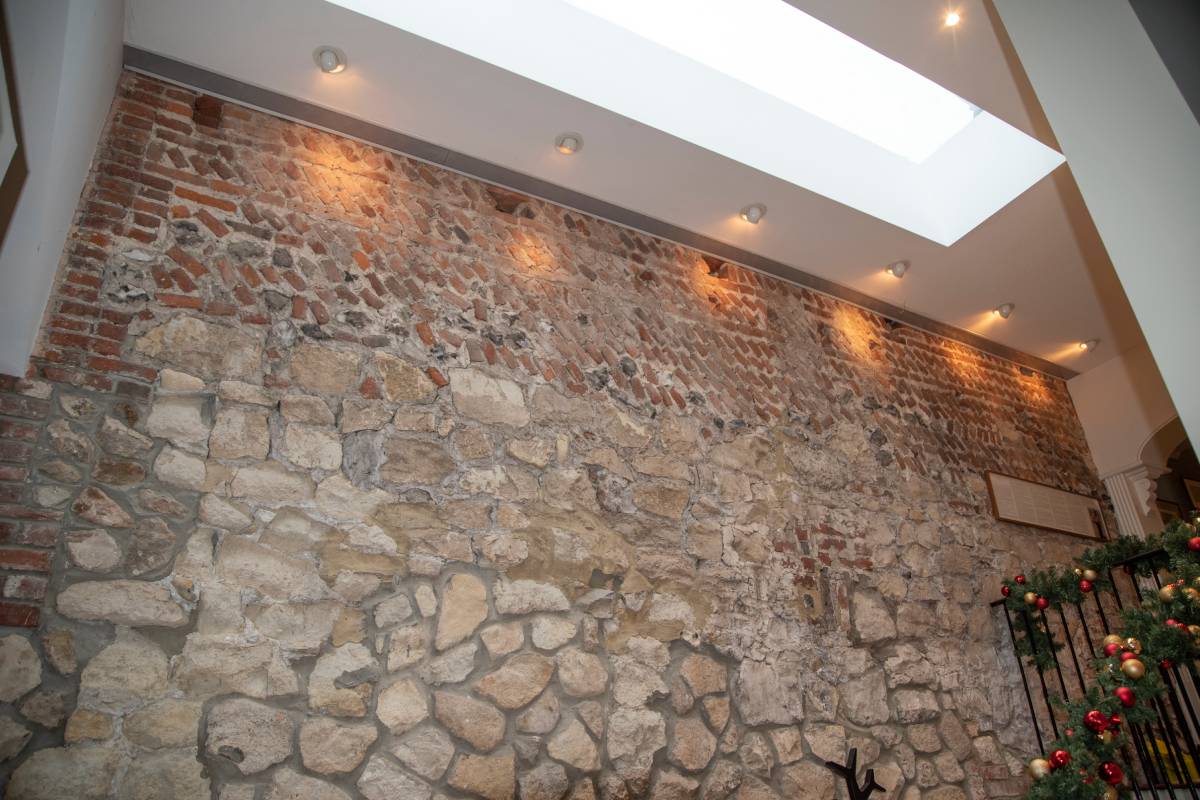
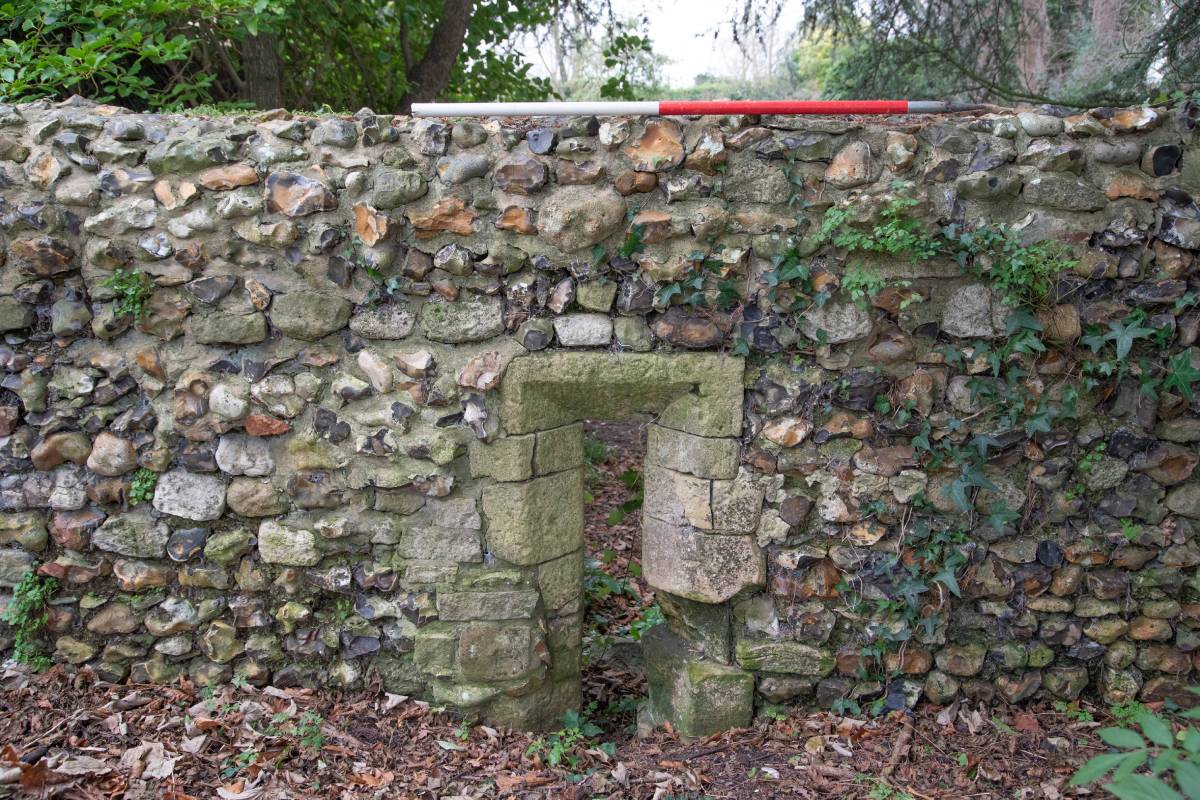
A section of a medieval wall inside Bosham Manor House, possibly part of Harold Godwinson’s estate. Source: Gould, Creighton, Chaussée, Shapland, and Wright
The move to conspicuous wealth
Duncan has observed a clear pattern of development emerging in the residences of the elite of 10th- and 11th-century England, possibly caused in part by both the threat and the cultural influence of the Vikings.
"We think there's something really significant about looking beyond the Norman Conquest and back to this time when elites begin to invest in themselves and demonstrate their richness."
"In fact, the word rich goes through a sort of transformation in the 10th century," he points out.
"At the start of the 10th century in England, rich meant authority and was synonymous with power. By the end of that century, however, it became synonymous with the modern concept of being conspicuously wealthy."
"These lordly centers provide a kind of window on this transformation that we're seeing across a lot of Western Europe, where powerful people are having to show their wealth more conspicuously."
"The project is really trying to burrow down and characterize the archeology of these primary places, where the elites showed their wealth to each other through their residences."
Is it the one?
One question remains, however: can we really be sure that the main building at Bosham truly is the one depicted in the Bayeux Tapestry?
"Firmly locating this residence with the picture on the tapestry is difficult. Archeology always has a level of uncertainty," Duncan admits. "But I do think this study allows us to become as certain as we can be that this is the location of Godwinson's residence."
"It's very satisfying that we've got such a good result – it's just such a recognizable piece of history."
"It also helps tell a story of such a transformative period as well, toward the end of the English Viking Age – Harold himself, of course, was of part Scandinavian descent."
"I think that's what's been so popular about the story in the press as well – it's synonymous with a very formative period of English and European history."
"The actual project and these lordly centers are quite slippery and difficult to understand, so we're really pleased that it's caught people's imagination. This is a real touchstone piece of popular culture."
We get to provide readers with original coverage thanks to our loyal supporters. Do you enjoy our work? You can become a PATRON here or via our Patreon page. You'll get access to exclusive content and early access.
Feel free to reach out to discuss potential stories that may be in the public interest. You can reach us via email at [email protected] with the understanding that the information you provide might be used in our reporting and stories.