


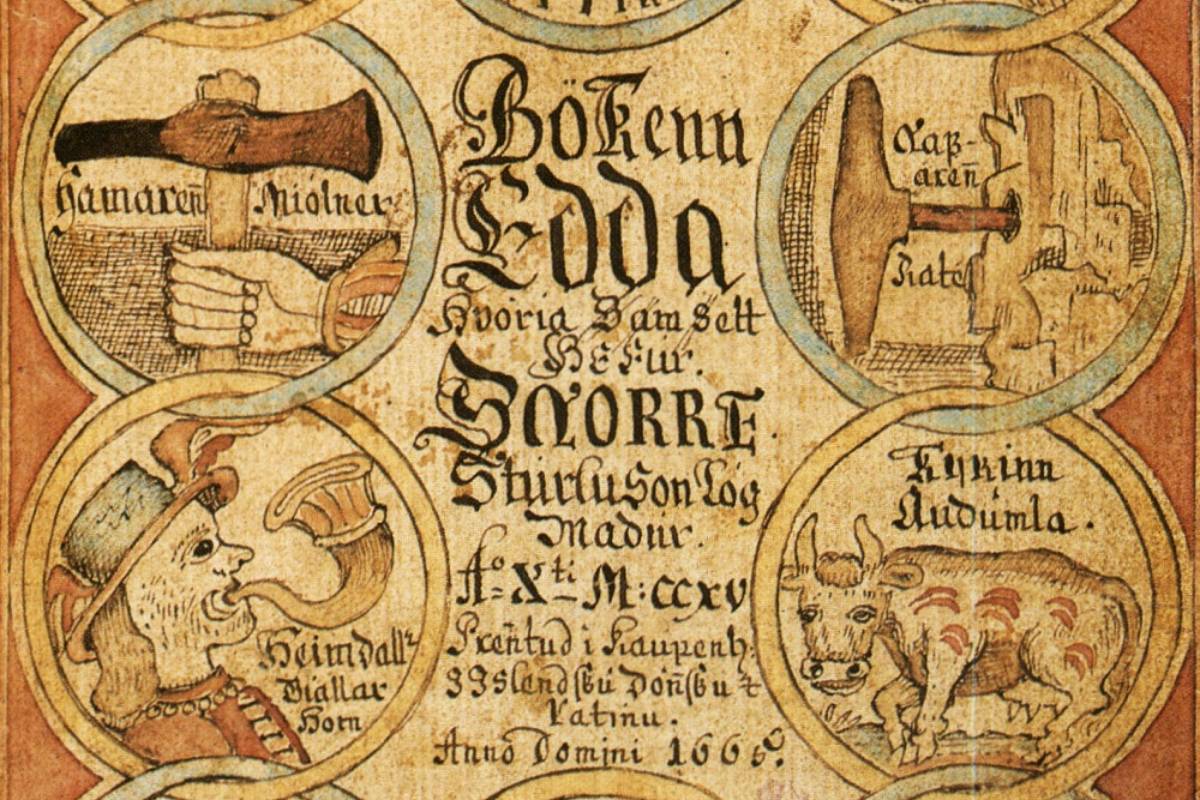
In many Western countries, birth rates have declined for decades. Within living memory, postwar baby boom cohorts reshaped demographics in many countries.
A whole horde of academics, politicians, and thinkers the world over have been musing about falling birth rates and how best to address them.
It seems that along with families, everything else in this modern world is shrinking – phones, cars, houses, and (thankfully) mortality rates. This trend of downsizing has also impacted religion.
In much of the modern West, monotheistic traditions have been historically dominant. Wind the clock back a millennium, and let us visit people in Viking societies who believe not in a single God but in many.
Not only did they have larger families (death was a sad but ever-present fact of life in early medieval Europe), but they also believed in a myriad of powerful deities.
We moderns somewhat clumsily lump this worship of deities and this distinctive spiritual belief system under one label: the Old Norse religion. What has been preserved from these beliefs includes Eddic poetry, the Prose Edda, and saga literature.
These form a body of legends, myths, stories, and tales that people in Viking societies created, and they are where we most often find the "back stories" of these Norse gods and goddesses – their trials, tribulations, and triumphs.
Getting one's head around such a number of mythical characters (and family members) is hard. Fear not, though, as a 13th-century CE textbook, the Prose Edda, is the perfect companion to Norse mythology.
Written and compiled, in part, by a famous Icelandic poet and politician, this tome is vital to appreciate and educate oneself, as well as better understand the rich tapestry of Norse mythology.
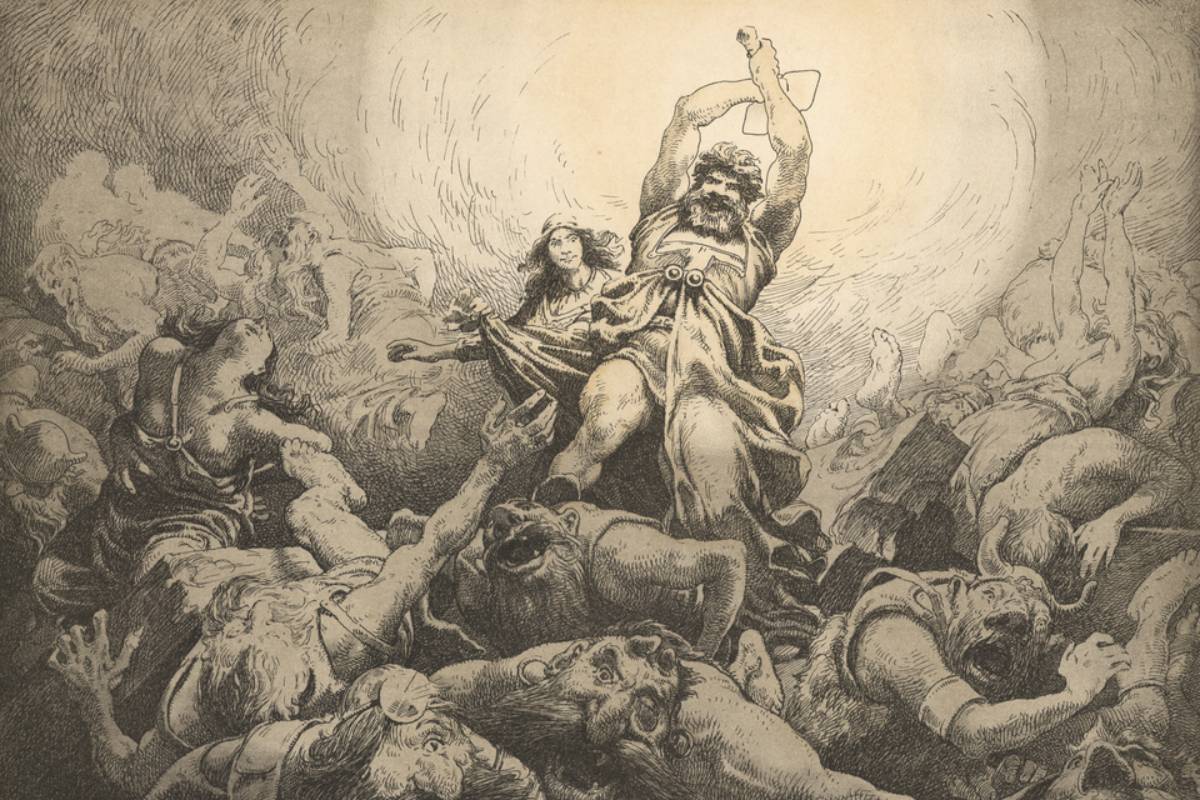
A 19th-century illustration showing Thor at the moment he regains Mjölnir in Thrym's hall. Source: Louis Moe (1857–1945), CC BY-SA 4.0
Big numbers
So in an era when everything grows smaller, let us open the pages of the Prose Edda and delve into a larger-than-life mythological world.
It is large indeed, due to the myriad beings, creatures, and deities in Norse mythology. An exact number of Norse deities is hard to give, partly due to the aforementioned two pantheons, as well as how one "defines" a Norse deity.
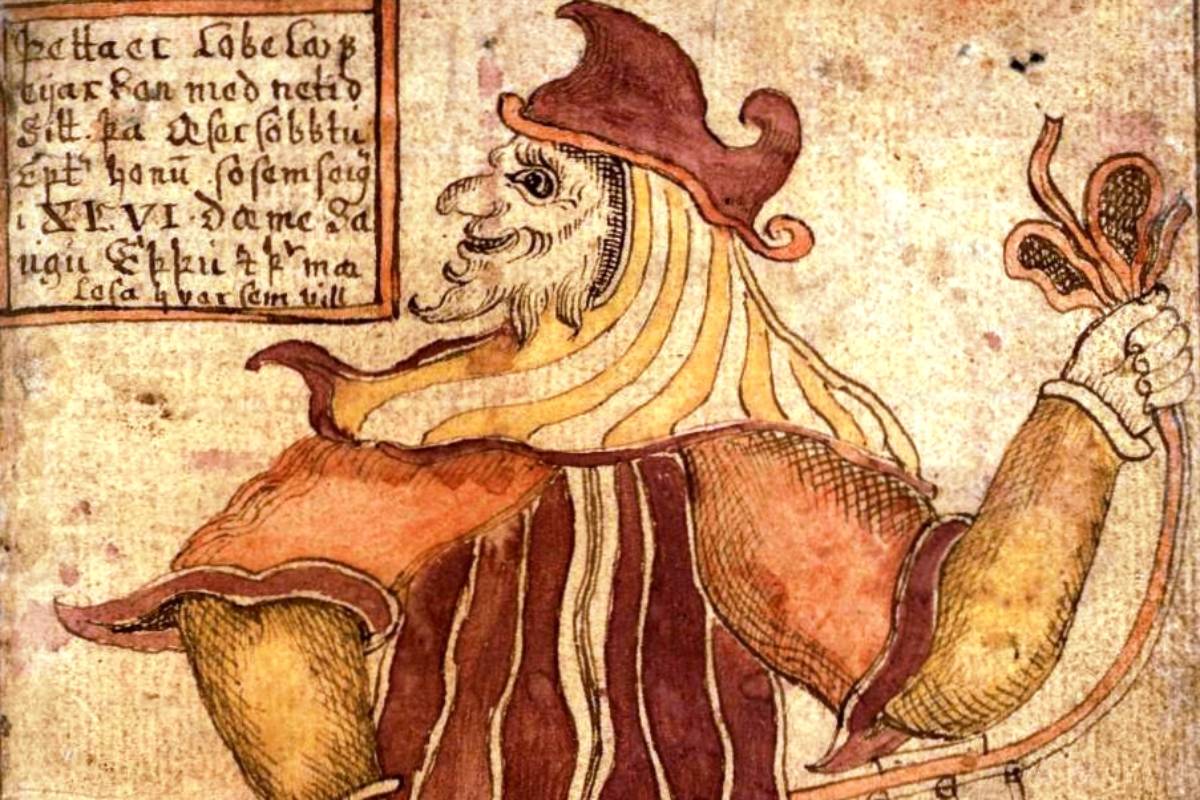
For example, Loki is difficult to place, and clear evidence of cult worship is debated. However, many of the tales told about him revolve around his interactions with other Norse gods, particularly Thor.
There is no single agreed count of Norse deities, and the cast of named figures in the myths can feel like a lot to keep straight.
It is hard enough to keep track of a second cousin you have not seen since you were seven, but imagine trying to understand the complex and interwoven stories of dozens of mythological characters. Thankfully, however, Snorri Sturluson has our back.
Sturluson was the scion of a rich and powerful family that dominated late 12th- and early 13th-century Icelandic society.
By the time Sturluson sat down to compile and write the Prose Edda, Iceland's glorious days of independence – the Icelandic Commonwealth – were a distant memory, as Iceland moved closer to the Norwegian crown.
Not for the first time in history, there was a need to hark back to a glorious past, to the mythical and heroic tales that Sturluson's ancestors – people in Viking societies – once told.
Sturluson produced a piece of work that would please his new political overlords, both in Iceland and Norway.
He drew upon a vast body of myths that spanned much of the Viking Age tradition, and he delved even further back in time as he wrote down legends, myths, and sagas from earlier Germanic societies.
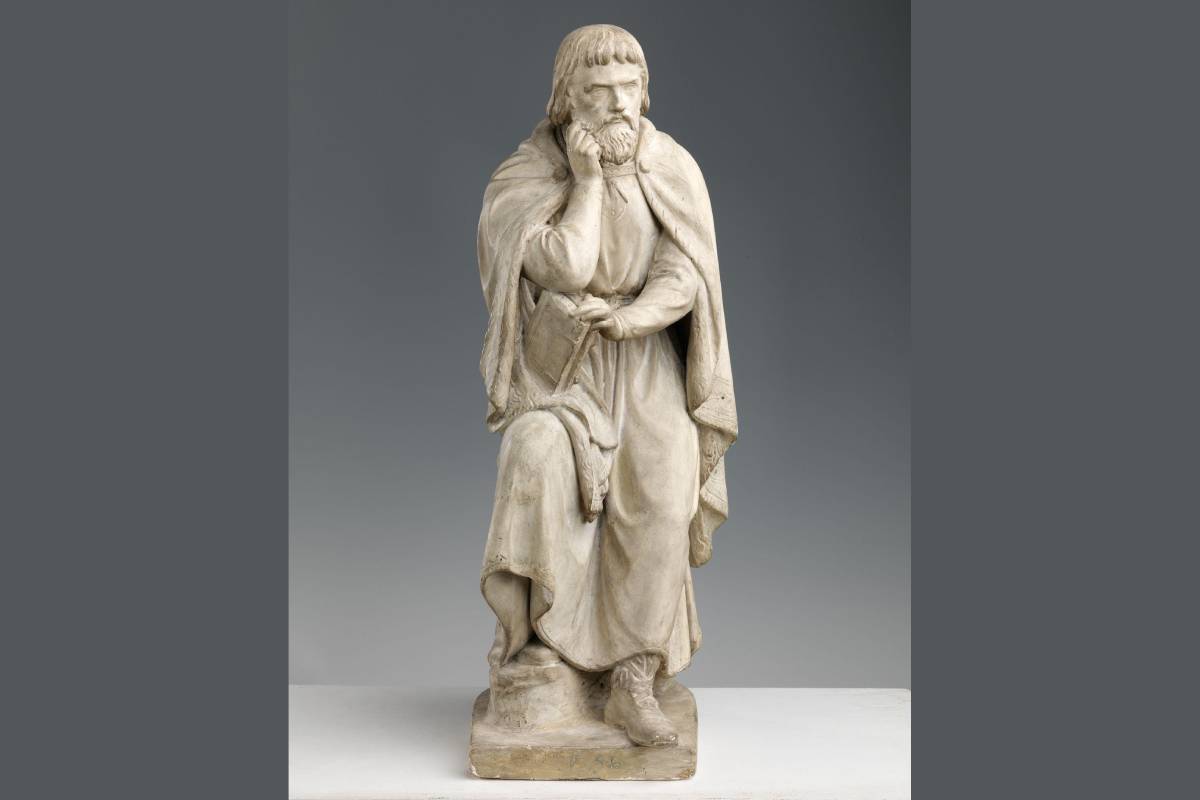
A plaster figure of Snorri Sturluson by Norwegian sculptor Christopher Borch. Source: National Museum of Art, Architecture and Design (CC BY-SA 4.0)
Norse mythology... with a Christian undertone
Whilst Sturluson did not write and/or compile all of the Edda, modern academics generally credit the work to him and believe he completed it sometime around 1220 CE.
So, then, what exactly constitutes the Prose Edda? Well, the book is divided into four sections. We must remember that by the time Snorri sat down to labor over quill and scroll, Iceland was Christian by this point, and much of Scandinavia had been Christian for generations.
It can be tempting to see a parallel between the four sections of the Prose Edda and the Four Gospels contained in the New Testament of the Christian Bible.
The Prose Edda begins with a Prologue, which deals with the origins of Norse mythology. Despite this introduction explaining the origins of the Norse gods, this is a very Christian account.
For example, the first lines of the Prologue state:
"Almighty God created heaven and earth and all things in them, and lastly two humans from whom generations are descended, Adam and Eve..." (found on page 1 in the 1995 Everyman edition of the Prose Edda, edited and translated by Anthony Faulkes)
Even though Snorri was writing about mythological characters, once worshipped as gods, that were centuries old and formed part of an advanced spiritual belief system, it was impossible to separate the religious from the secular during the medieval period.
He had a vested interest in explaining how the ancestors of the Christian monarchs of the Scandinavian kingdoms of Denmark, Norway, and Sweden had once celebrated such pagan deities and gods.
He had to synthesize the mythologies of people in Viking societies with the day-to-day religious beliefs of most of his contemporaries, a tough ask for anyone, but thankfully, Sturluson rose to this enormous challenge.
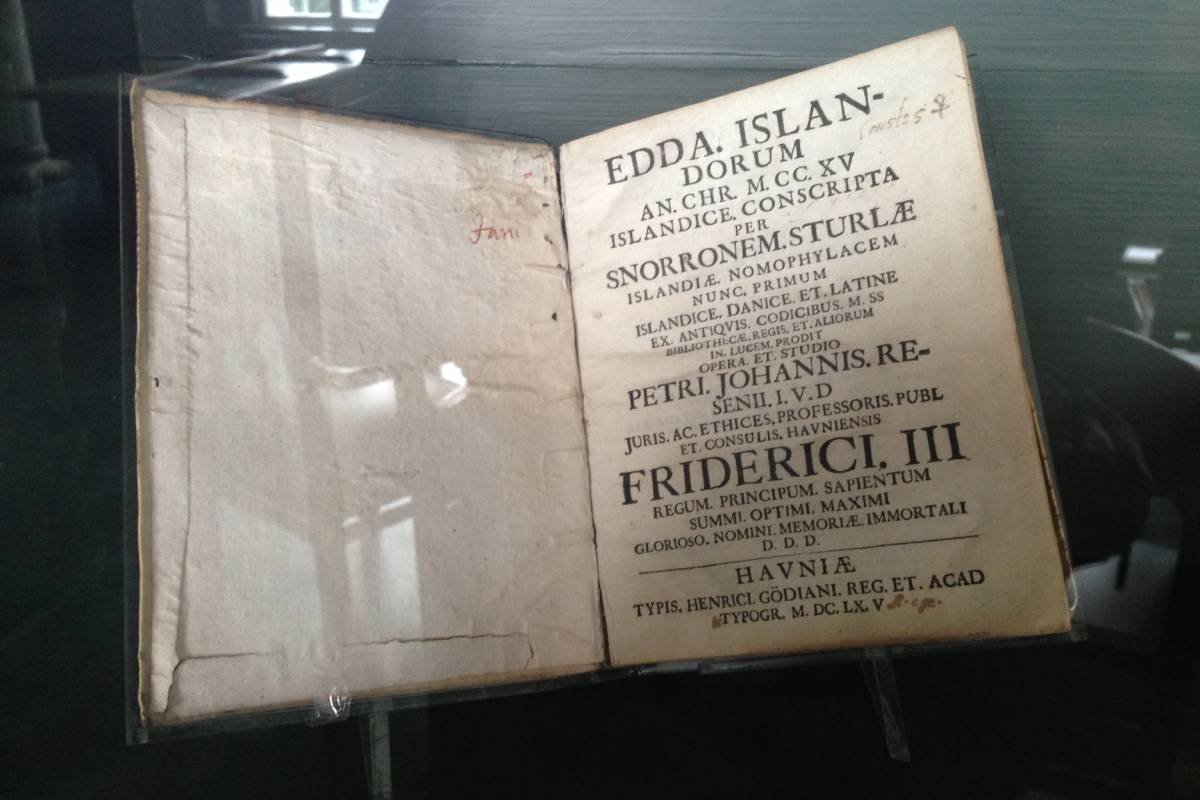
An early printed edition of the Prose Edda on display in a museum in Reykjavik, Iceland. Photo: RG72 (CC BY-SA 4.0)
The four sections of the Prose Edda
So aside from a sometimes subtle and sometimes overt Christian undertone in the Prose Edda, there are four sections.
The first, the Prologue, goes on to explain how the Norse gods are really the descendants of famous Trojan warriors, linking Norse mythology with much older gods, heroes, and myths from classical and Trojan legend.
In Snorri's Prologue, Thor is linked to Trojan legend, and the genealogy places him in the far north, married to Sif.
From their union, all the Norse gods, and various royal lines and nobility in Scandinavia, are descended. If you want to know the origin stories of each and every major Norse god and how they are related, head to the Prologue section.
The next section, Gylfaginning (often translated in English as "The Deluding of Gylfi"), reads like a medieval FAQ on Norse mythology.
This question-and-answer section uses a frame story about a Swedish king, the titular Gylfi, who questions three other kings of Asgard, somewhat mysteriously named High, Just-As-High, and Third – figures some scholars/readers interpret as Odin in disguise.
Through this back-and-forth conversation, we learn much about the birth and creation of the world, its final destruction – the fabled Ragnarök – and many of the customs and cultural practices of the Norse gods.
Skáldskaparmál (translated as the "Language of Poetry") is the third section.
Here, the text takes the form of a conversation between Ægir (one of the jötnar and a personification of the sea) and Bragi, the Norse god associated with skaldic poetry and language.
It is most valuable for those who want to brush up on Old Norse poetry, as it offers not only a philosophical look at what, exactly, constitutes skaldic verse, but also explanations of kennings (with examples).
This part is probably best left to those who want to regale their families and friends with skaldic poetry on a cold winter's night. It offers an interesting insight into the "nuts and bolts" of skaldic poetry.
This brings us, finally, to the final section, Háttatal (The tally of meters), which allows us to bask in the poetic genius of Snorri Sturluson. Not only is this a sort of technical manual on poetry:
"...What kinds of numbers are there in the rule for verse-forms?"
"Two."
"What are they?"
"One kind of number is how many verse-forms are found in the poetry of major poets. The second is how many lines there are in one stanza in each verse form. The third is how many syllables are put in each line in each verse-form..." (p. 165)
Aside from the more mundane technical aspects therein, this section is also dedicated to two powerful rulers, King Hákon Hákonarson (often dubbed King Hakon IV of Norway) and Jarl Skúli.
Hákon IV's reign formed part of the broader process that ended Iceland's Commonwealth period. Much of this section therein praises both of these powerful political figures.
A landmark in literary synthesis
The Prose Edda is often regarded as a high point in medieval Nordic literature. Not only does it hark back to the glorious past, the early medieval Viking world, and preserve the once-oral stories and traditions of this world, but it was also an important source for the preservation of Old Norse.
Countless academics and linguists are indebted to Sturluson, who chose the language of the Vikings to preserve their traditions rather than the Latin lingua franca of the age.
It is a foundational text for those who want to delve into the rich world of Norse mythology, better understand the subtle art of skaldic poetry, or simply bask in the linguistic wizardry that Snorri Sturluson has bequeathed to us from centuries ago.
It is one of the medieval world's greatest examples of literary synthesis, as it combines the mythological and the practical, aspects of Norse mythology and Christian belief, and spans the early to the later medieval period.
Ultimately, though, we must remember that Sturluson wrote in a politically fraught period and produced the Prose Edda in part amid an era of political insecurity in Iceland. It can even read like a piece of political propaganda – surely a lesson to all political speechwriters of the modern age.
For more information on Norse mythology and skaldic poetry, visit the Australian Academy of the Humanities website.
We get to provide readers with original coverage thanks to our loyal supporters. Do you enjoy our work? You can become a PATRON here or via our Patreon page. You'll get access to exclusive content and early access.
Feel free to reach out to discuss potential stories that may be in the public interest. You can reach us via email at [email protected] with the understanding that the information you provide might be used in our reporting and stories.



_-_cropped.png)

