

If you have ever met anyone who comes from the northern English county (don't say country!) of Yorkshire, they will tell you that this part of the world is a paradise on earth.
Nowadays, Yorkshire has a thriving tourist trade thanks to its breathtaking (albeit windswept) landscapes, charming villages, historic castles, and vibrant cities like Leeds and York.
However, Yorkshire isn't all flatcaps, terriers, and cups of Tetley, as it was a large county that saw hordes of Viking warriors trample all over its moors and dales.
Although York was built by the Romans, developed by the Anglo‑Saxons, and reached its heyday in the early medieval period as the Viking capital of Jórvík, what lies beneath the county's divinely blessed soil deserves some of the spotlight too.
It was in this dark Yorkshire soil that a father-and-son, Andrew and David Whelan, went searching one day back in 2007.
Using a metal detector, they soon found what has been dubbed one of the most important (and valuable) archeological discoveries in England over the past century. They unearthed a Viking-era hoard which had been buried centuries before.
Once again, we are indebted to amateur metal detectorists and history enthusiasts who have unearthed figurative and literal treasure. Let us now see what they unearthed that day on the windy Vale of York.
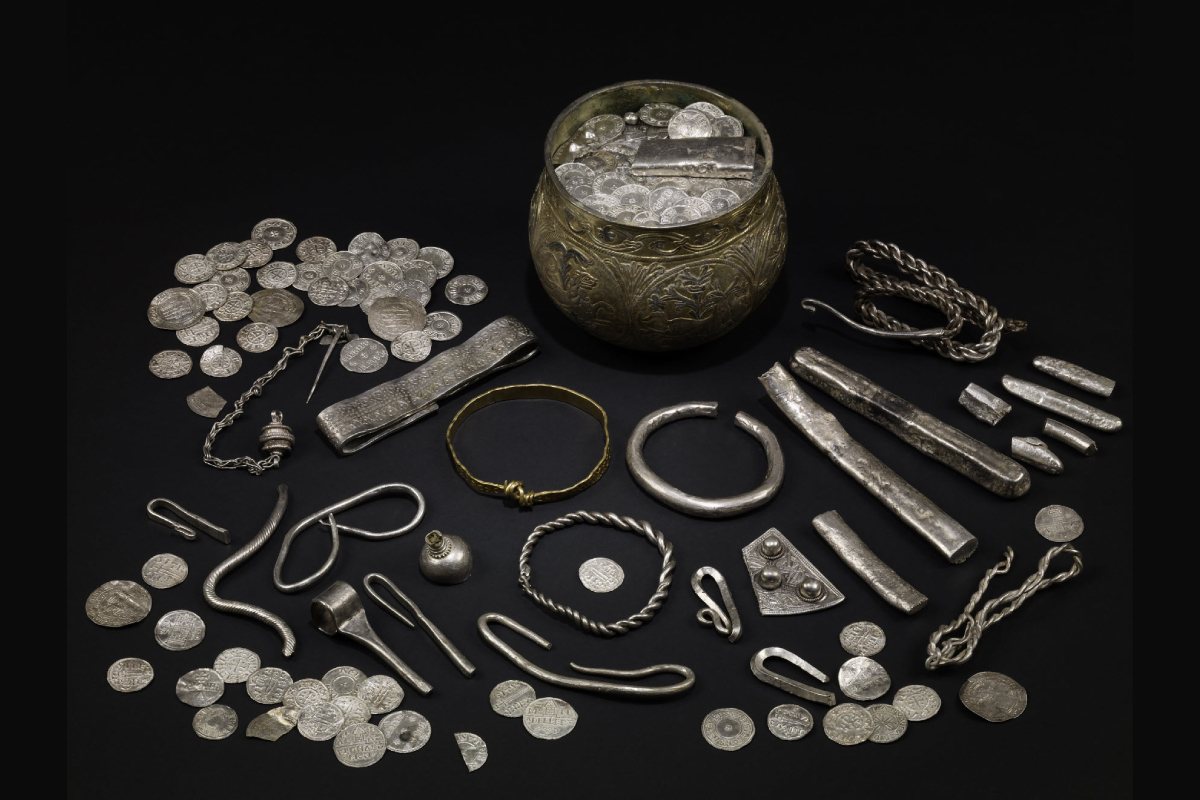
Containing 617 coins and 65 silver and gold objects, the hoard includes arm rings, ingots, and a Carolingian cup. Photo: Portable Antiquities Scheme (CC BY-SA 2.0)
Buried beneath "divinely blessed" soil
The father-and-son team set to work on the windswept Vale of York, a rather flat stretch of land between the River Tees and the Humber estuary that is famed for its agricultural output.
They began searching in a field that had yet to be upturned for its springtime sowing. Soon, they came across a small sliver of the field where their metal detector lit up like a Christmas tree.
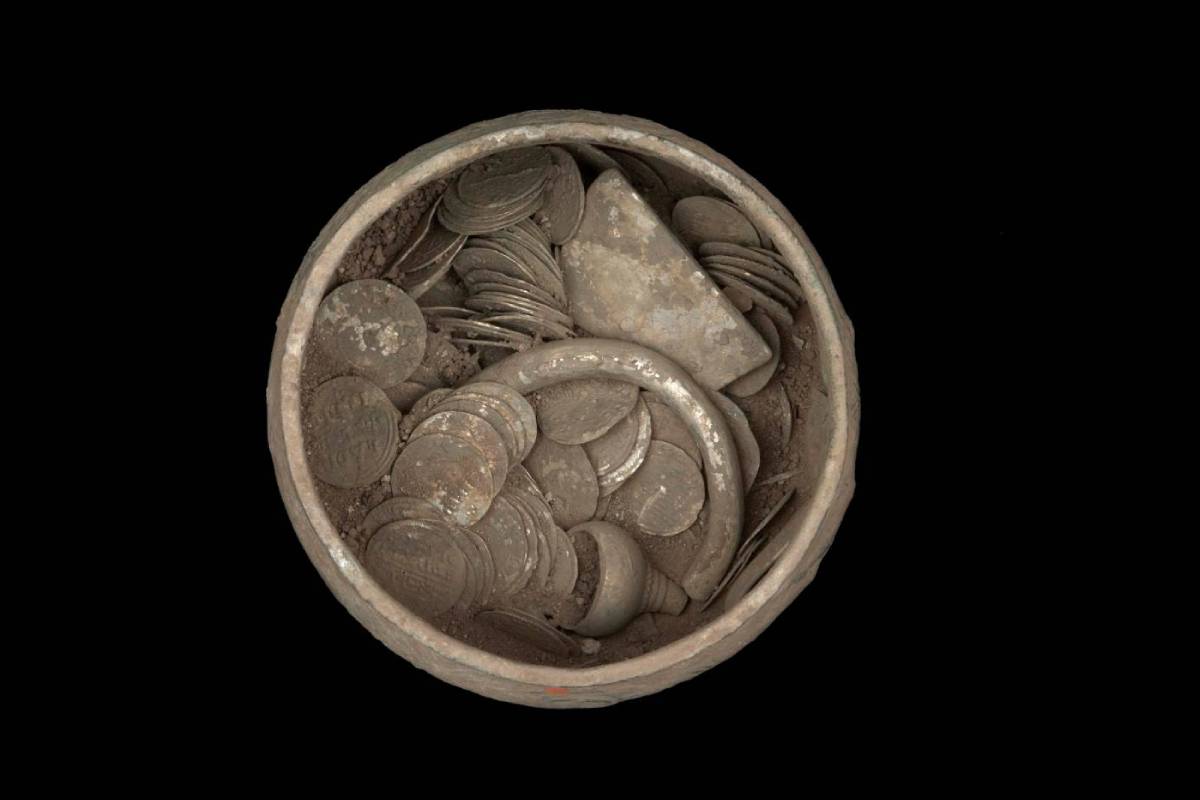
About 30 cm (1 foot) beneath the Yorkshire soil, they uncovered the remains of a lead box containing silver objects. Speaking later to the BBC, David recounted this discovery:
"We set off with our machines. I think Andrew had been out three times and found nothing. This time we were there about 10 minutes, and that's when I got my signal, the big one!"
Next, he recalls:
"...I picked this round thing up and put it on the ploughed land, put my glasses on and looked at it, and I could see all these animals on the cup and all these bits of silver on the top, I crouched down in the soil and you could see the edge of a few coins sticking out of the top of it, there was a coin of Edward the Elder on top, and a small piece of silver chain as well that turned out to have a decorated bead on the end with a pin, and then we saw a couple of small silver ingots."
Both father and son had uncovered one of the most important archeological discoveries in England in recent times.
Now, if you are like me, dear reader, and had found yourself in that Yorkshire field that day, you'd probably want to grab that box and keep digging. However, the father-and-son pair showed much restraint and reported their find to the Portable Antiquities Scheme.
The Portable Antiquities Scheme was established in 1997 to record finds made by metal detectorists and other members of the public and to pass that information to the relevant authorities, ensuring compliance with laws governing cultural artifacts and heritage.
The Whelans kept meticulous records of where the artifacts were unearthed, and this information was then passed on to the British Museum and the Yorkshire Museum. The find was announced on 19 July 2007, and what a find it was.
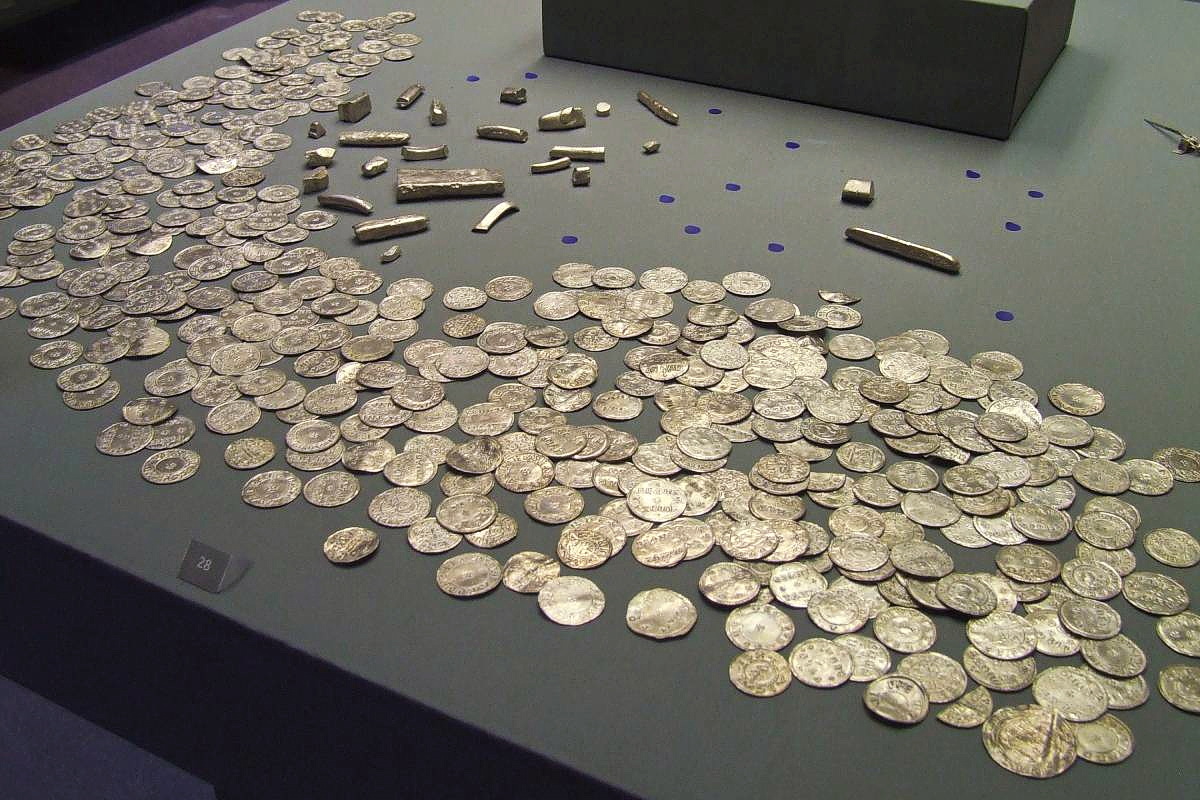
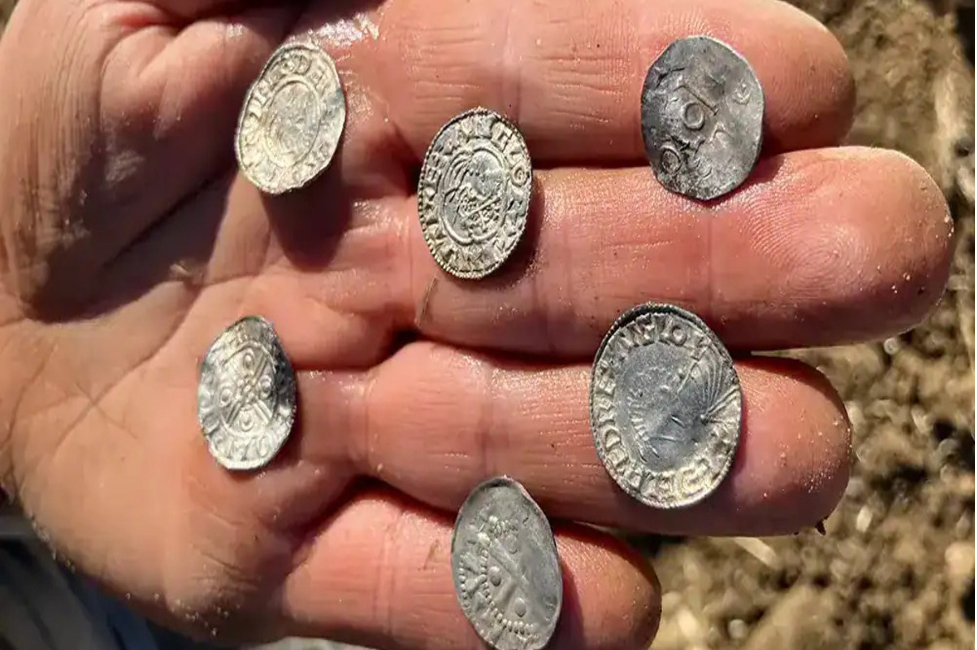
The hoard's coins span a broad geographic range, from England and France to modern-day Iraq and Uzbekistan. Photo: JMiall (CC BY-SA 3.0)
The Vale of York Hoard
What the officials from the British Museum uncovered was one of the most important modern finds of early medieval treasure.
The Vale of York Hoard, as it soon became known, and which is also sometimes referred to as the Harrogate Hoard, consisted of more than 617 silver coins and 65 other items, including precious metals, ingots, and ornaments.
Most of this was encased in what historians believe was a cup used for ecclesiastical purposes, fashioned by Carolingian smiths in the mid-9th century. The cup itself was either seized by the hoard's owner or given in tribute.
This cup was, as Barry Ager discusses in his 2020 article in The Antiquaries Journal, a prime example of cross‑cultural transmission, as there were found, "...Oriental, Central Asian, and classical parallels in both metal and pottery for the cup's form and decoration."
Alongside the coins and vessel, silver and gold arm rings, neck rings, and fragments of brooches were also uncovered. Unlike this cup, the remainder of the hoard appears to be slightly younger.
Numismatists analyzed the coins and confirmed that they derive from the late 9th to early 10th centuries and contain a mix of pre‑Christian Norse, Christian, and Islamic symbols.
Further analysis has shown a wide range of these coins and the other artifacts stemming from what is now Afghanistan and Uzbekistan, all the way to North Africa and up to Scandinavia.
This hoard, more than others, shows just how interconnected the early medieval world was, thanks in part to the trade networks that people from Viking societies helped forge, linking the Silk Roads of Asia to the markets of Europe and North Africa.
The hoard was then valued at more than 1 million GBP and was purchased jointly by the York Museums Trust with support from the British Museum.
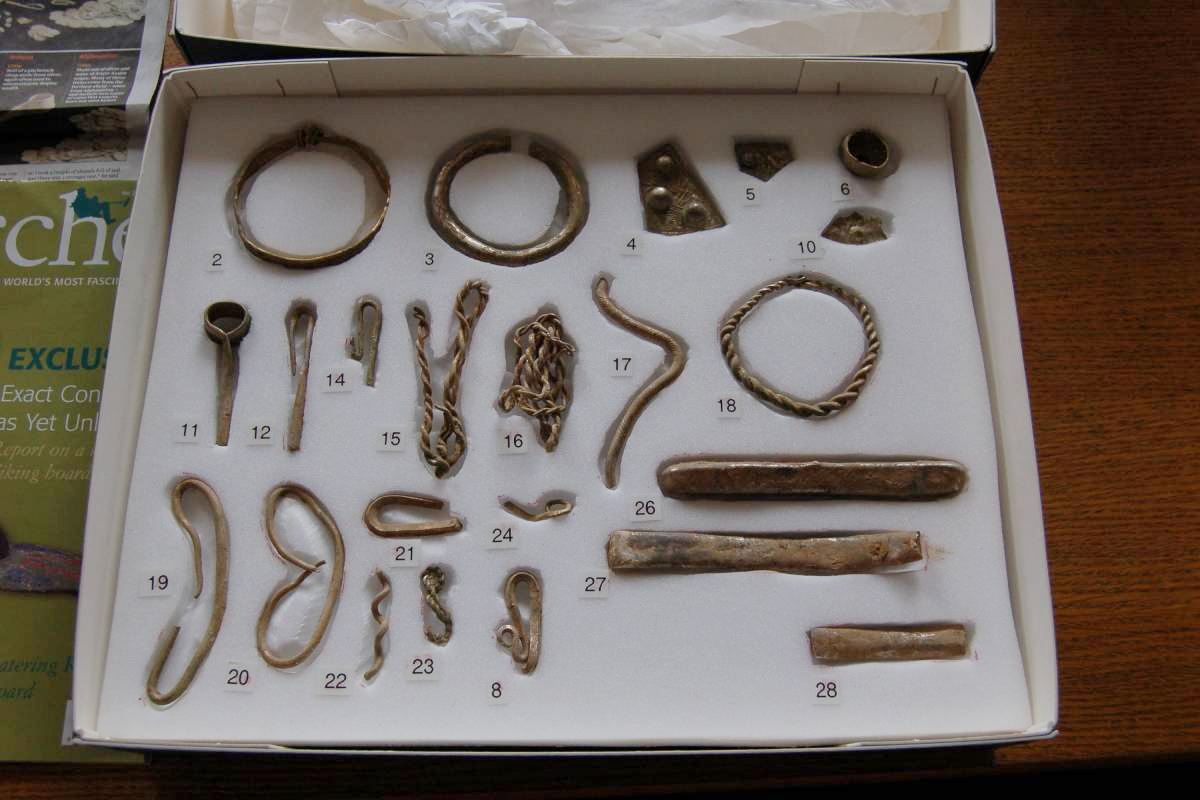
Some pieces, like twisted silver rods and bent bars, show signs of being weighed, traded, or used as bullion. Photo: Portable Antiquities Scheme (CC BY-SA 2.0)
Who buried it?
The burning question remains, dear reader, who exactly buried this treasure that centuries later the Whelans would uncover?
As Gareth Williams discusses in his 2008 article in British Numismatic Journal, the treasures the Whelans uncovered are "what one would expect of a hoard from the Danelaw in the early tenth century."
During the early tenth century CE, Yorkshire was the battleground for an existential fight between Anglo‑Saxon and Viking forces.
What had once been an Anglo‑Saxon kingdom had been invaded and conquered by people from Viking societies and turned into a Viking center of commerce, power, and trade.
However, by the early tenth century CE, the Anglo‑Saxons, under King Æthelstan, were leading a fightback to (use a rather poisonous modern phrase) "take back control of their country."
Given this period of political instability and, let's be honest, widespread violence, whoever owned this hoard probably had some form of terrestrial insurance.
In 927 CE, the Viking kingdom of Jórvík changed hands to the Anglo‑Saxons, only for Eric Bloodaxe to seize control for the Vikings once again following Æthelstan's death.
Eventually, Bloodaxe was kicked out of the kingdom, and it fell back into Anglo‑Saxon hands. Given that this area of England changed hands four times in a generation, it was no wonder that the treasure's owner(s) decided to bury it.
Sadly, however, we will never know who buried this treasure.
Were the items the spoils of a predatory Viking raid, quickly acquired and then put away in a safe place for future use? Or were they the accumulation of a lifetime's worth of toil and trade throughout much of the early medieval world?
Like so many other archeological discoveries, the Vale of York hoard has left us with far more questions than answers.
To see the artifacts uncovered in the Vale of York hoard, visit the Yorkshire Museum website.
We get to provide readers with original coverage thanks to our loyal supporters. Do you enjoy our work? You can become a PATRON here or via our Patreon page. You'll get access to exclusive content and early access.
Feel free to reach out to discuss potential stories that may be in the public interest. You can reach us via email at [email protected] with the understanding that the information you provide might be used in our reporting and stories.