


After locating a 1,000-year-old textile fragment at Lendbreen Pass earlier last week, the glacial archeologists at Secrets of the Ice have now discovered two Iron Age arrows at the same location.
According to co-director Lars Holger Pilø, the first find is the best-preserved arrow ever identified by the team.
"Frozen in time"
Secrets of the Ice is responsible for investigating areas of Norway where the ice is rapidly receding due to climate change.
Last week, the team has been focused on investigating Lendbreen Pass, which has produced a series of artifacts from both the Viking Age and earlier eras over the past few years.
A field team led by Espen Finstad identified the first arrow lying on the surface of the ice on Wednesday, September 4.
The object is almost completely intact and consists of an iron arrowhead, some sinew where the arrowhead enters the shaft, and the complete wooden shaft itself.
"The arrow in question is incredibly well-preserved even for ice finds," Lars tells us.
"The fact that our field team found it lying on the ice is a sign that the melt has reached previously untouched ice layers. So, this arrow has likely not been out of the ice since it was lost 1,300 years ago. It is frozen in time in a very literal sense."
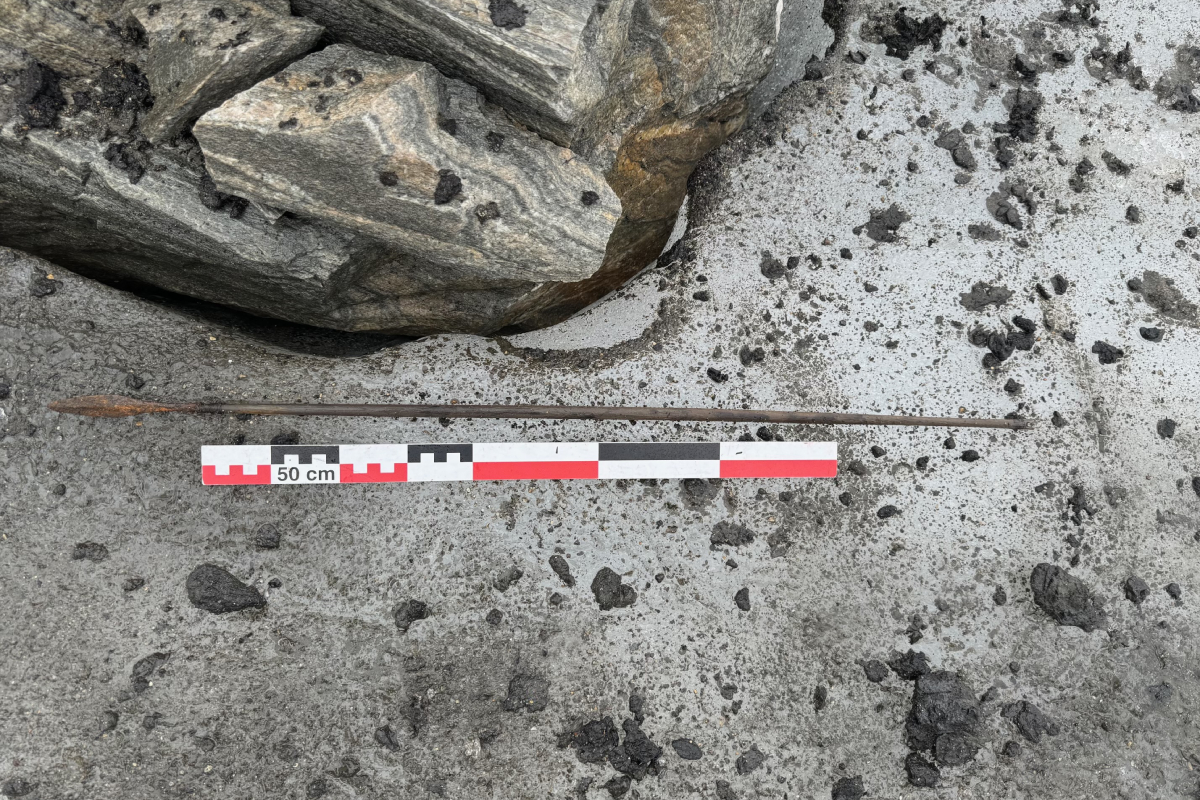
Archeologists discovered a 1,300-year-old arrow with an iron arrowhead, sinew, and a well-preserved wooden shaft. Source: Espen Finstad / Secrets of the Ice
Beyond the Viking Age
The experienced archeologists in the field team were able to swiftly identify the new find due to its similarity to other artifacts.
Although carbon dating will be carried out later, they believe it comes from the period just before the start of the Viking Age.
"The arrow can be dated by the shape of the iron arrowhead, which is a known type found in graves from around the year 700," Lars explains.
"This is the Merovingian Period, which is the Late Iron Age here in Norway."
Although this was not the first arrow found by the Secrets of the Ice team, it is certainly one of the most impressive.
"We have also found a few arrows with similar arrowheads on several occasions. We've had the arrow shafts dated, and they consistently show the same radiocarbon date."
"None, however, have been nearly as well-preserved as the one from yesterday," Lars states. "It is in exceptional condition."
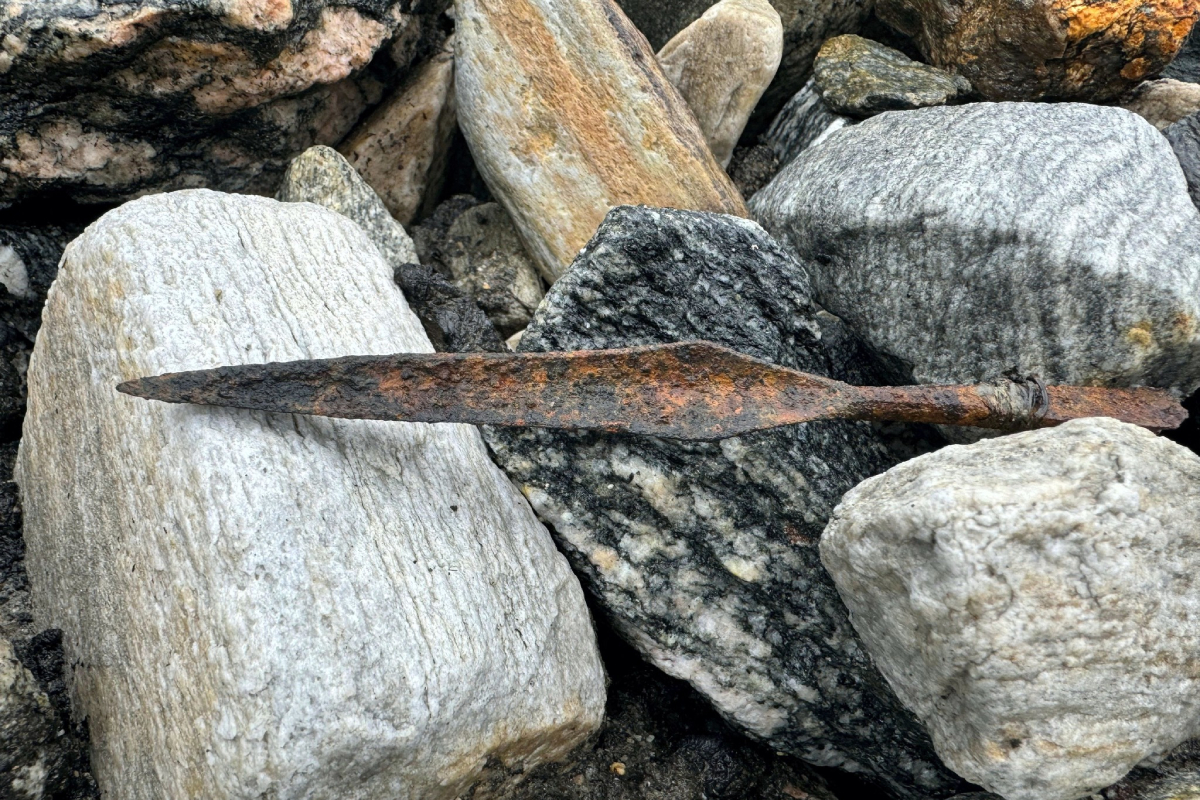
The second arrow, thought to be from the early Iron Age, was discovered with a three-sided iron arrowhead and traces of fletching on the shaft. Source: Espen Finstad / Secrets of the Ice
Another bullseye
Remarkably, soon after the first find, another arrow was discovered only one day later. The second arrow is believed to be even older.
According to the team, the arrowhead's flat tang and the notch's shape indicate it is more likely to come from around 300–600 CE – the early Iron Age.
The arrowhead, which was found approximately one meter away from the shaft, has a distinctive three-sided shape, while the shaft still has remains of the fletching at its base, beautifully preserved by the ice.
Secrets of the Ice has previously identified a number of finds related to reindeer hunting at the pass, including a large collection of "scaring sticks" – used to herd reindeer from one place to another.
Though it is impossible to say for sure, it is possible that the two arrows were both used in reindeer hunting centuries apart.
In the coming days, the field team will continue to explore the area around the pass, while several other locations will also be examined before the season comes to an end.
We get to provide readers with original coverage thanks to our loyal supporters. Do you enjoy our work? You can become a PATRON here or via our Patreon page. You'll get access to exclusive content and early access.
Feel free to reach out to discuss potential stories that may be in the public interest. You can reach us via email at [email protected] with the understanding that the information you provide might be used in our reporting and stories.