

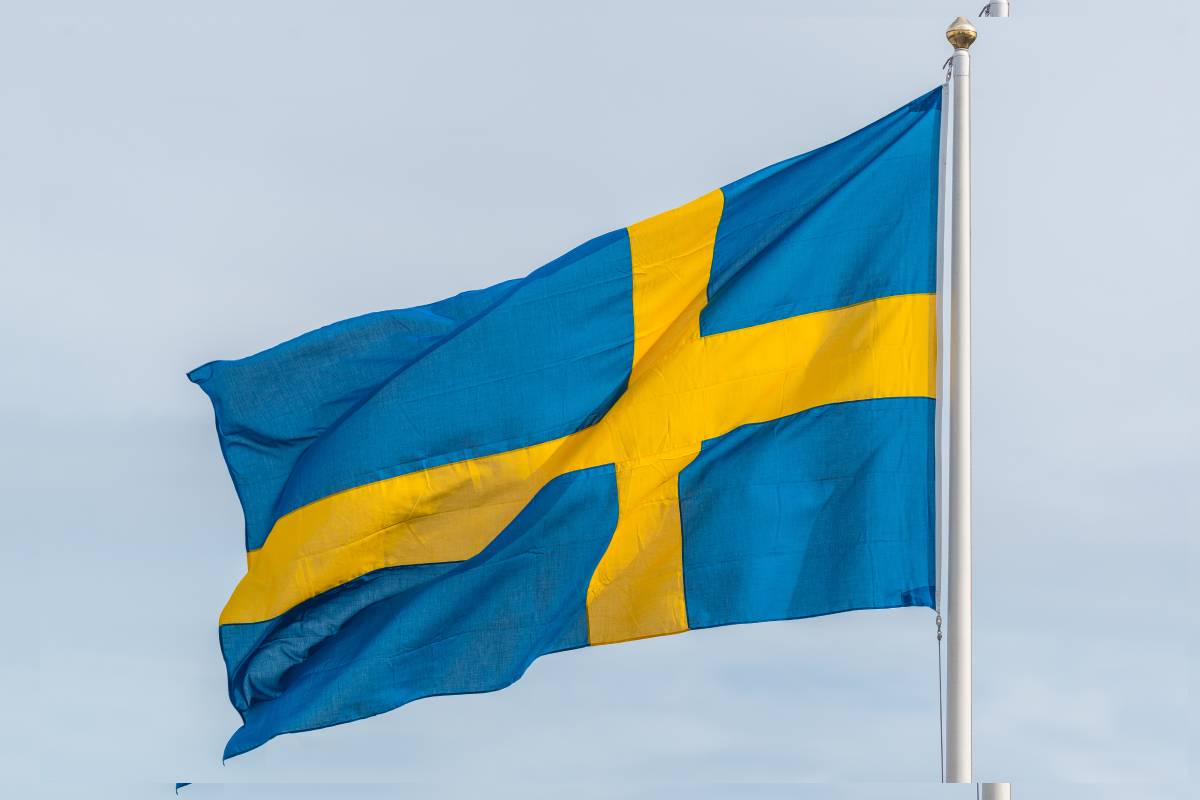
If you are lucky enough to visit Sweden, you will know that this Scandinavian country genuinely loves the blue and gold that are emblazoned on its national flag.
Whilst Sweden is often seen as the epitome of a progressive, open, and modern society, the history of its flag can be traced back to the medieval period, when the nation was the complete antithesis of its current image.
Compared to southern European nations, Sweden, like its Scandinavian, Nordic, and Baltic neighbors, saw the introduction of Christianity occur in the latter part of the early medieval period.
Historians have argued that it was the introduction and influence of Christianity that would signal the end of the Viking Age, as political elites and rulers saw raids, pillaging, and attacks against their fellow Christians, abroad or at home, as going against the word of God.
Furthermore, Christianity was a means for a ruler to achieve prestige and become part of the broader Christian Europe, one which was masterfully exploited by Swedish rulers by the 11th century CE.
By the end of the Viking Age (c. 750–1100 CE), a bishopric had been established in Skara, Sweden, and the nation was on the path of shedding its Viking roots and donning the respectful gowns of a European Christian nation.
However, not everyone nearby was keen on abandoning their pagan roots.
A mythical and Christian origin
By the mid-12th century CE, the Swedish ruling elite had embraced Christianity so wholeheartedly that the king, Eric IX, along with the Bishop of Uppsala, Henry, saw fit to launch what later tradition described as a crusade on the Finns living in what is now southern Finland.
This campaign is often framed as a retaliation against raids and skirmishes involving Christian Swedes and as an effort by Eric to bring the region into the fold of Christianity, through either peaceful or bloody means.
It was during this First Swedish Crusade (as modern historians have dubbed it) that later accounts place the traditional origin story of the Swedish national flag.
When Eric landed in southern Finland, later stories claimed that he saw a golden cross emblazoned in the sky. Seeing this as a sign from God, he was said to have forged a banner with a golden cross against a blue background.
However, modern historians have cast doubt on how reliably the episode can be reconstructed from the medieval written record.
Some historians have also noted the striking similarities between this divine story and the origin of the Danish national flag, the Dannebrog, which was said to have fallen from the sky via an act of God during a military campaign.
The Swedish flag's crusading origin story is sometimes linked to later medieval political storytelling and is often associated with traditions that became prominent by the reign of King Charles VIII in the mid-15th century CE.
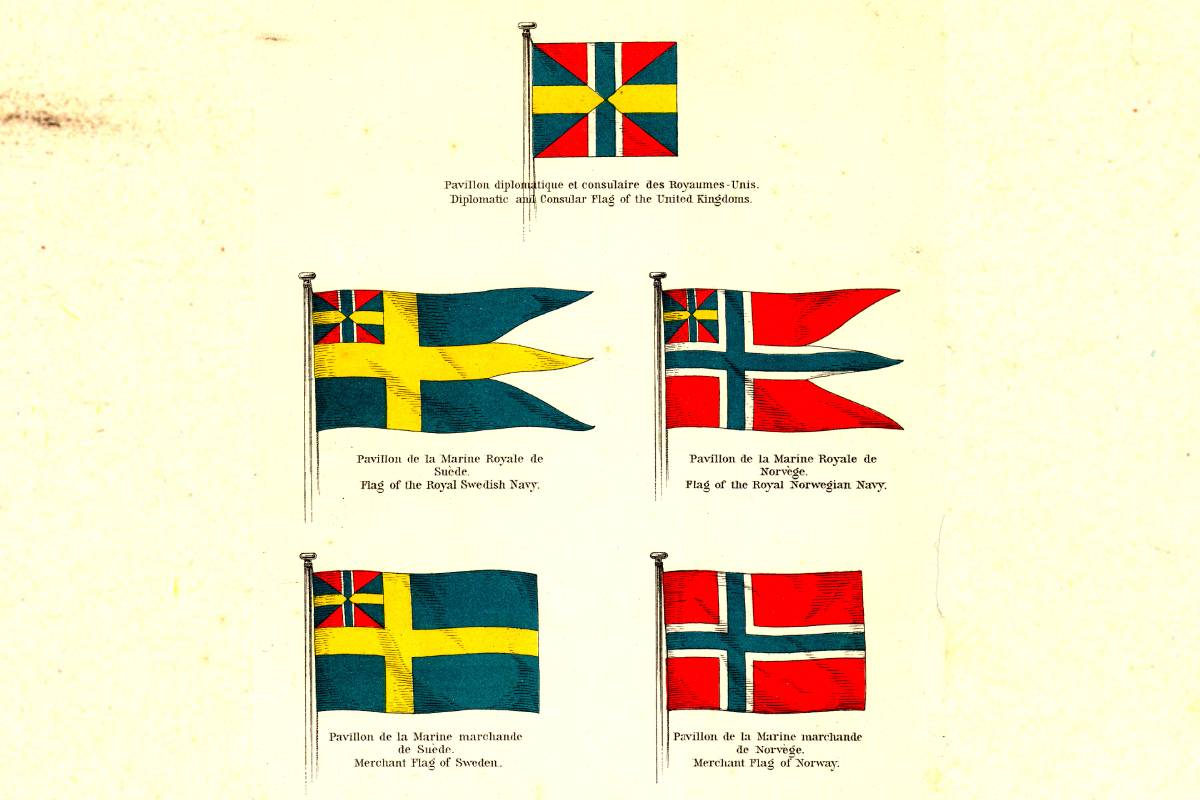
1899 chart showing Swedish and Norwegian flags, including union-era versions with the Union Mark. Source: Public domain
War, peace, union, and dissolution
The Swedish flag, in its modern form, has specifications that are highly regulated. The colors, blue (blå) and yellow (gul), are entered into the Natural Color System as 4055-R95B and 0580-Y109R, respectively.
The use of a yellow Nordic cross against the blue background was said to symbolize the Christian nature of the Swedish nation, similar to the use of the cross on the flags of its Nordic neighbors.
The first official record of the flag as a national symbol of the Swedish nation comes from the reign of King Gustav I in the 16th century CE.
A royal warrant was issued on April 15, 1562, that stipulated the description of a flag with "yellow in a cross fashioned on blue." This was to be used on Swedish banners and flags, especially during battle.
Two centuries later, another royal warrant decreed that the same flag, with a triple tail, be used on all Swedish naval vessels whose job was to patrol and defend the vast Swedish coastline. This flag was in use until the Napoleonic era.
Following the seismic political fallout from the end of the Napoleonic wars, the Kingdom of Sweden was granted Norway and entered into a personal union with its neighbor, in part because Denmark–Norway had been a close ally of Napoleon.
This personal union meant a new flag had to be designed to incorporate the flags of the two kingdoms, resulting in a union flag called the Union Mark that combined Swedish and Norwegian (red, white, and blue) elements.
This was the flag until Norway gained its independence in 1905, and the union was dissolved. The Swedish flag reverted to its pre-union design, though the blue color was lightened through an act of parliament in 1906 to its present form.
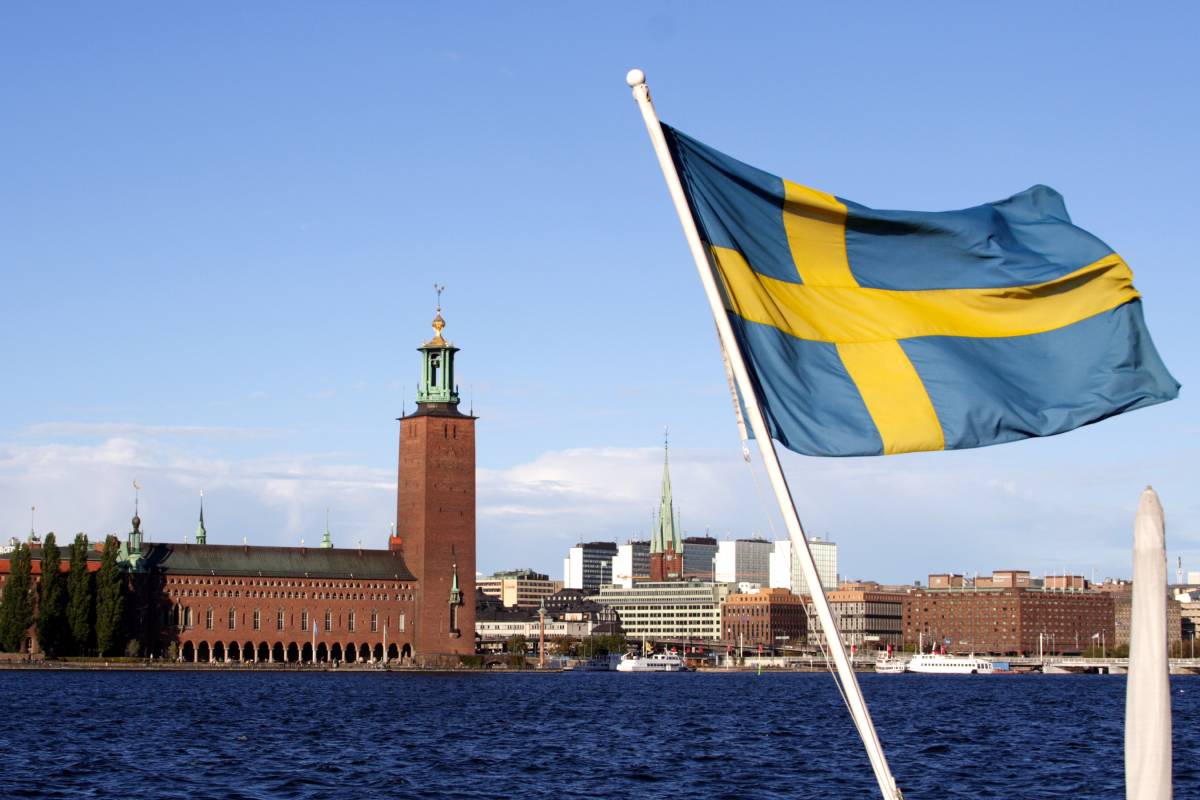
The Swedish flag waves near Stockholm City Hall on an October afternoon. Photo: Stefan Lins (CC BY-SA 2.0)
Regulated
Like most national flags, there are several rules regarding its use. Due to the dark nature of Swedish winters, from November 1 to the end of February, the flag can be raised from 9 a.m., whilst in the warmer months (March 1 to October 31) the flag can be raised an hour earlier.
The flag is then to be taken down either at sunset or 9 p.m., whichever occurs first, regardless of the season. If, however, the flag is properly illuminated by artificial light, it can stay aloft after sunset.
Throughout the year, there are a number of government-sanctioned flag-flying days when private citizens are encouraged to raise Sveriges flagga. These include the name day of the current king (Carl XVI Gustaf) and his heir apparent (his daughter, Crown Princess Victoria).
They also include Sweden's National Day, which is also the flag's national day (June 6), and election day for the Swedish parliament (the second Sunday of September in election years).
The Swedish flag, with its iconic blue and gold design, stands as a proud emblem of the nation's history, tradition, and national unity.
Its simple yet powerful symbolism continues to evoke a sense of pride and identity amongst the Swedish people. It stands as a testament to the nation's storied historical and cultural legacy.
For more information on the recent controversy involving the Swedish flag, visit SBS here.
We get to provide readers with original coverage thanks to our loyal supporters. Do you enjoy our work? You can become a PATRON here or via our Patreon page. You'll get access to exclusive content and early access.
Feel free to reach out to discuss potential stories that may be in the public interest. You can reach us via email at [email protected] with the understanding that the information you provide might be used in our reporting and stories.