

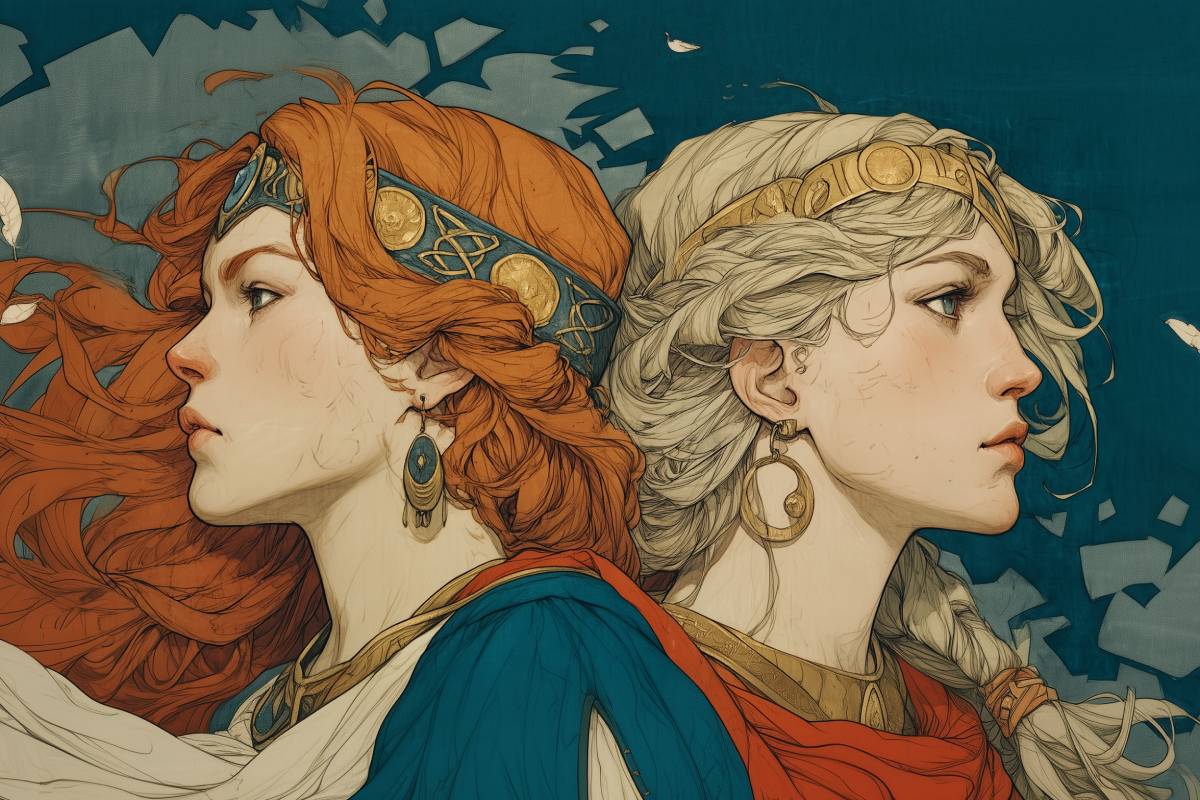
Whilst a rather niche topic, there is an ongoing heated debate in academia about the confusion and occasional blurring of the Norse goddesses Frigg and Freyja.
We know Frigg as a powerful member of the Æsir, associated with heart and home, whilst Freyja, of the Vanir, is more than a mere Norse Aphrodite, associated with magic and sorcery too. Yet there is confusion surrounding these similar deities, which arises from their gender, role, and depictions in the sagas.
Whilst these Norse deities have been passed down to us as characters in the rich tapestry of the Norse sagas, we must never forget that these deities were once worshiped and important parts of the spiritual and religious beliefs of people in Viking societies.
As Stephen Grundy talks about in his chapter in the 1997 book, The Concept of the Goddess (available on Amazon here), these two deities "seem to have little in common" as Frigg is "a relative model of social virtue," whilst Freyja is "the 'wild woman' of Northern myth."
So how then could two important deities become confused and conflated? To understand that, we must first turn to their separate depictions in the sagas.
Frigg
Both Frigg and Freyja were worshiped and revered as important Norse deities, and the best insight into their veneration comes from the rich tapestry of the Norse sagas. We find numerous stories that Frigg features heavily in, contained in both poem and prose, the so-called Prose and Poetic Eddas.
Turning to the Lokasenna, using an online version of the 1936 Henry Adams Bellows English translation, we find Loki confirms that Frigg is the wife and consort of Odin, albeit through insult:
"Be silent, Frigg! thou art Fjorgyn's wife,
But ever lustful in love;
For Vili and Ve, thou wife of Vithrir,
Both in thy bosom have lain." [Stanza 26]
Vithrir here is used as one of Odin's many names. In reply, Frigg laments that:
"If a son like Baldr were by me now,
Here within Ægir's hall,
From the sons of the gods thou shouldst go not forth
Till thy fierceness in fight were tried." [Stanza 27]
Which brings us neatly to the story in which she plays her most prominent, but doomed, role—that of her son Baldr.
Following some disturbing dreams, we find, in the Gylfaginning section of the Prose Edda (we use an online version based on the 1916 English translation by Arthur Gilchrist Brodeur), that Frigg wants to protect her son Baldr:
"...from all kinds of dangers. And Frigg took oaths to this purport, that fire and water should spare Baldr, likewise iron and metal of all kinds, stones, earth, trees, sicknesses, beasts, birds, venom, serpents." [Stanza 49]
Tragically, she does not extract an oath from mistletoe, which, through Loki's shenanigans, ends up being the murder weapon of her son. Sadly, Frigg then fails in this protective role.
Beyond her role as Baldr's mother, Frigg is also associated with foresight and prophecy, said to know the fate of all yet never to reveal it. This aspect further sets her apart from Freyja.
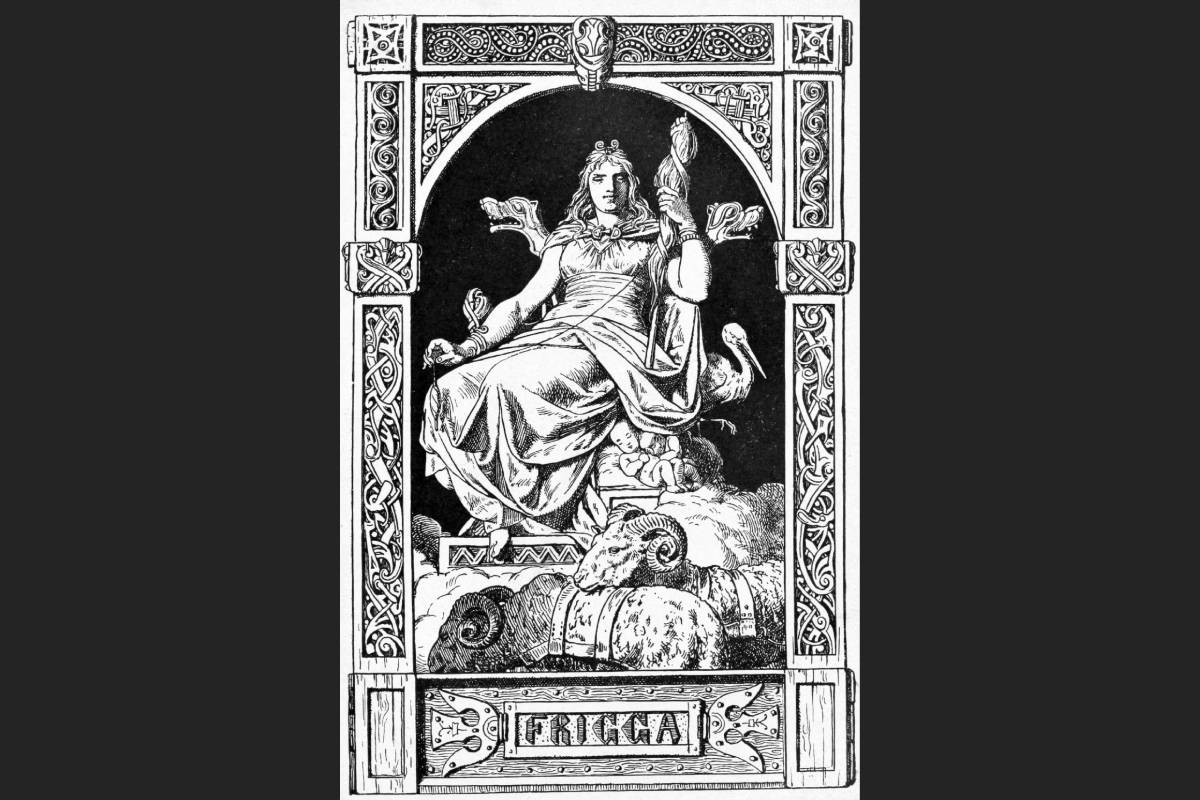
A 19th-century illustration of the Norse goddess Frigg seated on her throne, surrounded by symbolic animals and motifs. Author: Johannes Gehrts (1855–1921)
Freyja
We have written widely about Freyja before, as she is recognized as one of the most important members of the Vanir and, on a personal note, one of our favorite deities in the Norse pantheons.
Following the war between the Æsir and Vanir, Freyja and several other Vanir deities were sent to live among the Æsir, and she became fully integrated into their pantheon.
Aside from her association with seiðr and sorcery, she is even said to have taught the practice of seiðr to Odin himself, a striking reversal of the usual hierarchy between Æsir and Vanir.
She possesses some of the best bling in Norse mythology, with the necklace Brísingamen as well as a magical cloak, Fjaðrhamr. Beyond that, she is closely linked to wealth and prosperity—her tears are said to turn into gold, and she was invoked for riches as well as love.
Her most memorable role, however, is receiving half of those bravely slain in battle into her hall, Fólkvangr. The other half will, of course, join Odin in Valhalla. Ruling over Fólkvangr puts her on equal footing with Odin and highlights her dual role in love and warfare.
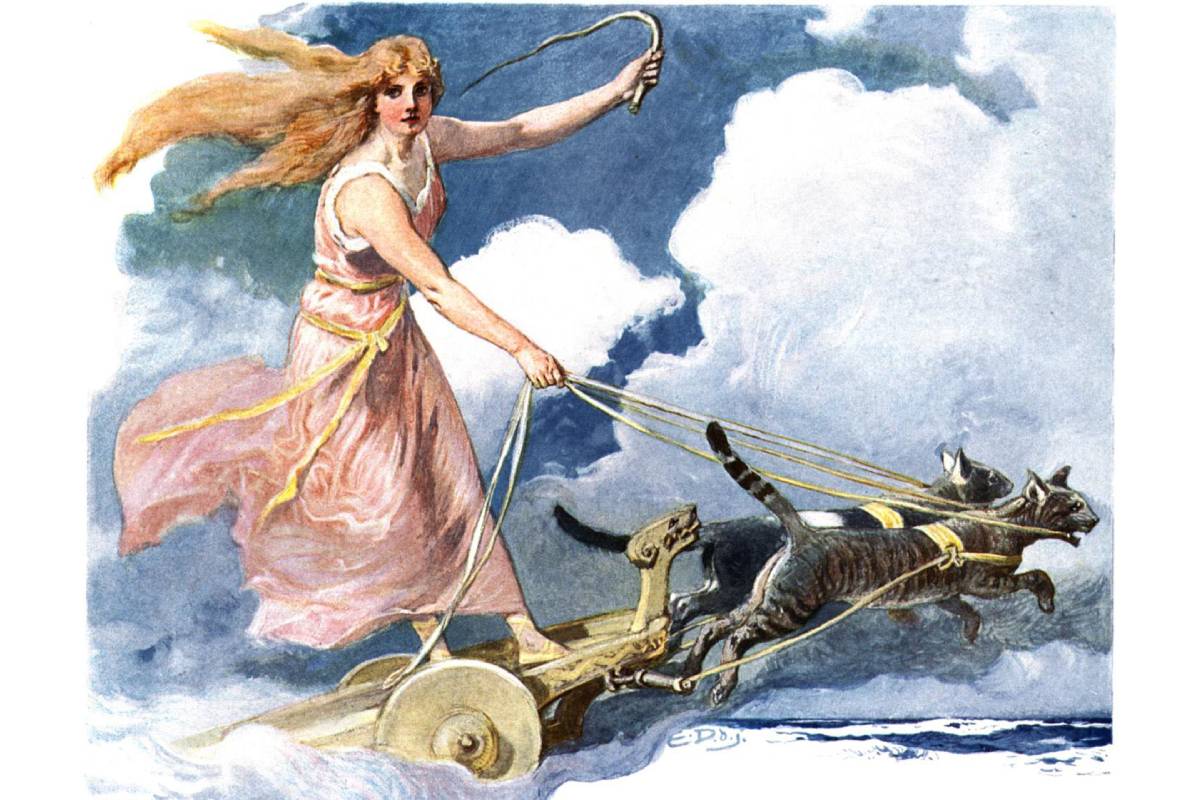
A 1905 depiction of Freyja guiding a chariot pulled by cats, a well-known symbol from Norse mythology. Author: Emil Doepler (1855–1922)
Why the confusion?
So, given their distinct yet equally important roles in the sagas, why do some sources still muddle Frigg and Freyja? How can you confuse Frigg, a maternal protector, with Freyja, a host of slain warriors who knows an incantation or two?
Confusion may arise from their dual association with love. Whilst Freyja embodies fertility and desire, Frigg emphasizes marriage and family.
As Britt-Mari Näsström discusses in her chapter in the 1996 book, Shamanism and Northern Ecology, confusion may be due to the fact that both deities "appear in similar love affairs" and roles.
Despite being two separate deities, their association with love (despite each representing a different aspect of it) has led to confusion and conflation.
Some scholars, particularly in the 19th and early 20th centuries, even suggested that Frigg and Freyja may have originated as a single goddess whose traits later diverged in the surviving sources. While this view is less common today, it shows how blurred their identities can appear in the record.
Further confusion and conflation may occur due to Frigg's relative scarcity in the sagas. Whilst she may have been more widely known and indeed revered by people in Viking societies, we have only a smattering of tales about her in the sagas.
This contrasts with the seemingly ever-present and popular Freyja, who is one of the most important figures in Norse mythology. Frigg's relative obscurity has led to the assumption that she is Freyja in all but name.
Complicating matters further, nearly all our written sources—the Poetic and Prose Eddas, preserved in Christian-era Iceland—were recorded centuries after the Viking Age.
This distance in time, and the perspective of Christian scribes, leaves gaps and ambiguities that contribute to the uncertainty around these goddesses.
Finally, it should be noted that the Old Norse religion, and indeed the sagas and stories derived from it, had a great deal of regional variation.
It is likely that in some oral traditions, the roles of Frigg and Freyja were interchangeable and fluid. This is also another possible explanation for their conflation and confusion.
Scholars have also compared these figures with wider Indo-European traditions, linking Frigg to household or mother goddesses and Freyja to fertility and war deities such as the Mesopotamian Ishtar. In other words, Norse mythology is not unusual in having deities whose roles blur or overlap.
For more information on Norse mythology, visit The Guardian here.
We get to provide readers with original coverage thanks to our loyal supporters. Do you enjoy our work? You can become a PATRON here or via our Patreon page. You'll get access to exclusive content and early access.
Feel free to reach out to discuss potential stories that may be in the public interest. You can reach us via email at [email protected] with the understanding that the information you provide might be used in our reporting and stories.