


Dendrochronological analysis of the logs used for the foundation of what is believed to be the King's Wharf in Oslo has dated them to the exact year 1288.
Last spring, archaeologists from the Norwegian Institute for Cultural Heritage Research (NIKU) uncovered an eight-meter section of the foundation in excellent condition.

Archaeological discoveries, including the King's Wharf, reveal that medieval Oslo was originally centered in a different location, which changed following the 1349 plague and the 1624 fire. Photo: photovideoworld / Shutterstock
1288: The key date
The dating suggests that the king in question was Håkon V, who was then a duke with his power base around Oslo.
After Håkon assumed the Norwegian throne in 1299, following the death of his elder brother Eirik II Magnusson, who left no heirs, he moved his capital from Bergen to Oslo.
Eirik was crowned and buried in Bergen.
After his death in 1319, Håkon was buried in St Mary's Church in Oslo, the ruins of which can still be seen today in Middelalderparken, part of the former royal estate overlooking the waterfront in Old Oslo.
"The wharf ran in a straight line from what was the royal estate in Oslo at that time," says Hegdal, referring to a map of the medieval harbor he and his team have created from their findings.
After 1319, the royal estate was transferred to St Mary's Church. Consequently, dendrochronological dating of the wharf from after this time would not link it to Håkon V.
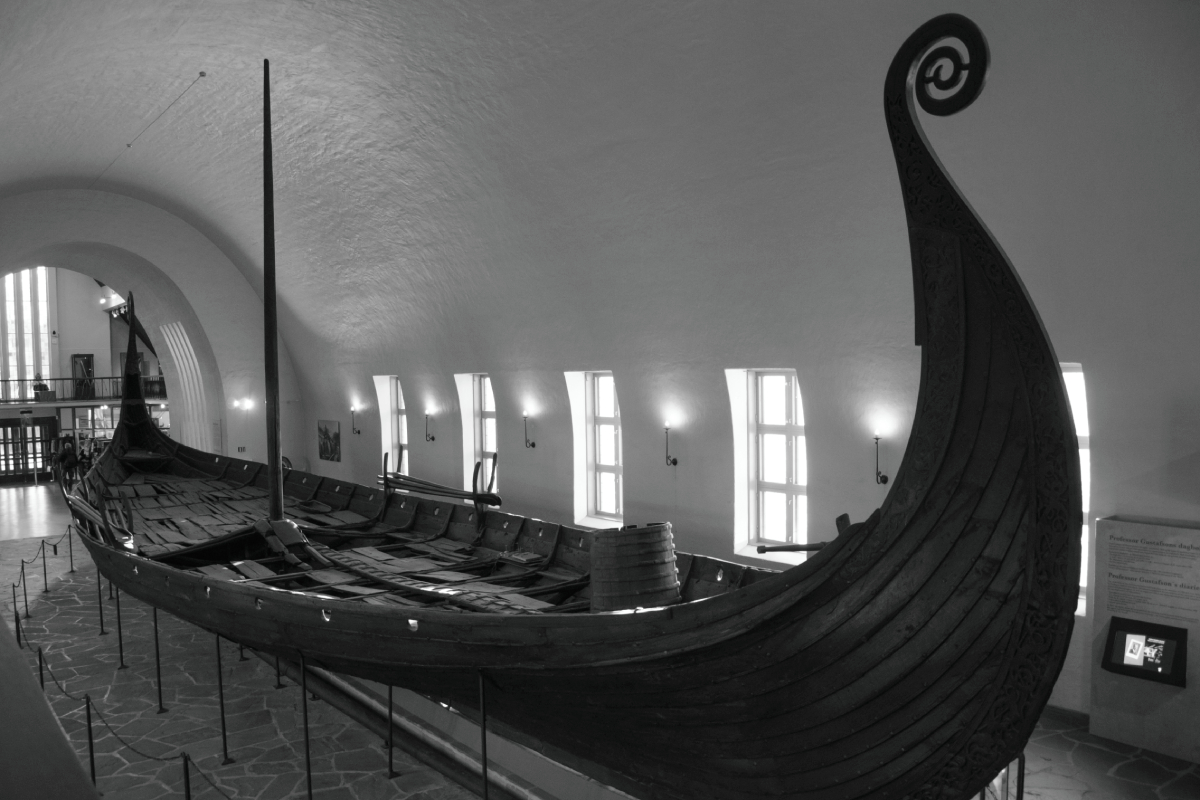
It was Nicolay Nicolaysen, the Norwegian archaeologist best known for his work on the Gokstad ship, who conducted the first excavations of the St Mary's site in 1867.
This area of the wharf was excavated in the 1990s, before advances in dendrochronological analysis could help pinpoint dating to the precision we know today.

The construction plans for apartment blocks in Old Oslo led to a final archaeological exploration by Håvard Hegdal and his NIKU team at the historic site of the King's Wharf. Photo: Norsk institutt for kulturminneforskning (niku.no)
The abandoned capital
Oslo was not always centered around the same location: "After the plague in 1349, ships were abandoned," says Hegdal.
"A new expansion phase began from 1420, with continued expansion during the second half of the 1400s. There were two subsequent short-lived building phases, in 1607 and 1620."
A fire in 1624 swept through medieval Oslo and destroyed all its wooden buildings.
Danish King Christian IV, who ruled over Norway at the time, decided not to rebuild it but to move the city across the bay to the area around Akershus Castle, also built by Håkon V.
The new city was to be named Christiania after the monarch.
In more recent times, plans to build a complex of apartment blocks in Old Oslo prompted the authorities to permit Håvard Hegdal and his NIKU team to conduct one final investigation of what was once the King's Wharf.
Funding limitations prevent the preservation and public display of the huge logs that form the foundation. Yet, one mystery persists.
Hegdal and his team discovered fish waste, feces, and dirt accumulated around the logs. Determining when the wharf area started being used as a rubbish dump remains unclear.
Carbon dating this material could precisely identify the time of the wharf's abandonment.

Among the findings at the wharf excavation by NIKU is an anchor, its presence in a closed foundation presenting a small mystery to the researchers. Photo: Norsk institutt for kulturminneforskning (niku.no)
A new museum?
For the time being, Hegdal and his team have recorded enough to create 3D models of the wharf as it was in Håkon V's time.
The future home for these historical findings is still under discussion – some propose creating a medieval museum in an abandoned railway workshop, last used in the late 1800s."
Should the project proceed, it could also include findings from an earlier excavation of medieval Oslo's main thoroughfare, Bispeallmenningen, dating back 800 years, conducted in 2018.
These excavations occurred prior to the development of Follobanen, a 22-km-long express train line between Oslo and the town of Ski.
The street, also abandoned after 1624, led down to the harbor.
It is now believed that the Oslo waterfront might have been as extensive and busy as that in Bergen. Bryggen, the old wharf of Bergen, has been a UNESCO World Heritage Site since 1979.
We get to provide readers with original coverage thanks to our loyal supporters. Do you enjoy our work? You can become a PATRON here or via our Patreon page. You'll get access to exclusive content and early access.
Feel free to reach out to discuss potential stories that may be in the public interest. You can reach us via email at [email protected] with the understanding that the information you provide might be used in our reporting and stories.