

A research project in Norway has shed new light on an intricate defense system first developed in the Viking Age.
Aided by a citizen-science database, an international team of academics has mapped out the presence of a large number of beacons in Norway, used to warn people of possible threats and attacks.
A system of defense
When it comes to violence in the Viking Age, most people tend to think of the Viking warriors who ventured overseas to carry out raids and wars of expansion. The Norse, however, were just as concerned with how to defend their own territory.
As a recently completed project from the University of Stavanger, Viking beacons – Militarism in northern Europe, has discovered, an intricate system of beacons was a key feature of defense in Norway in this period. This system survived in one form or another for nearly 900 years.
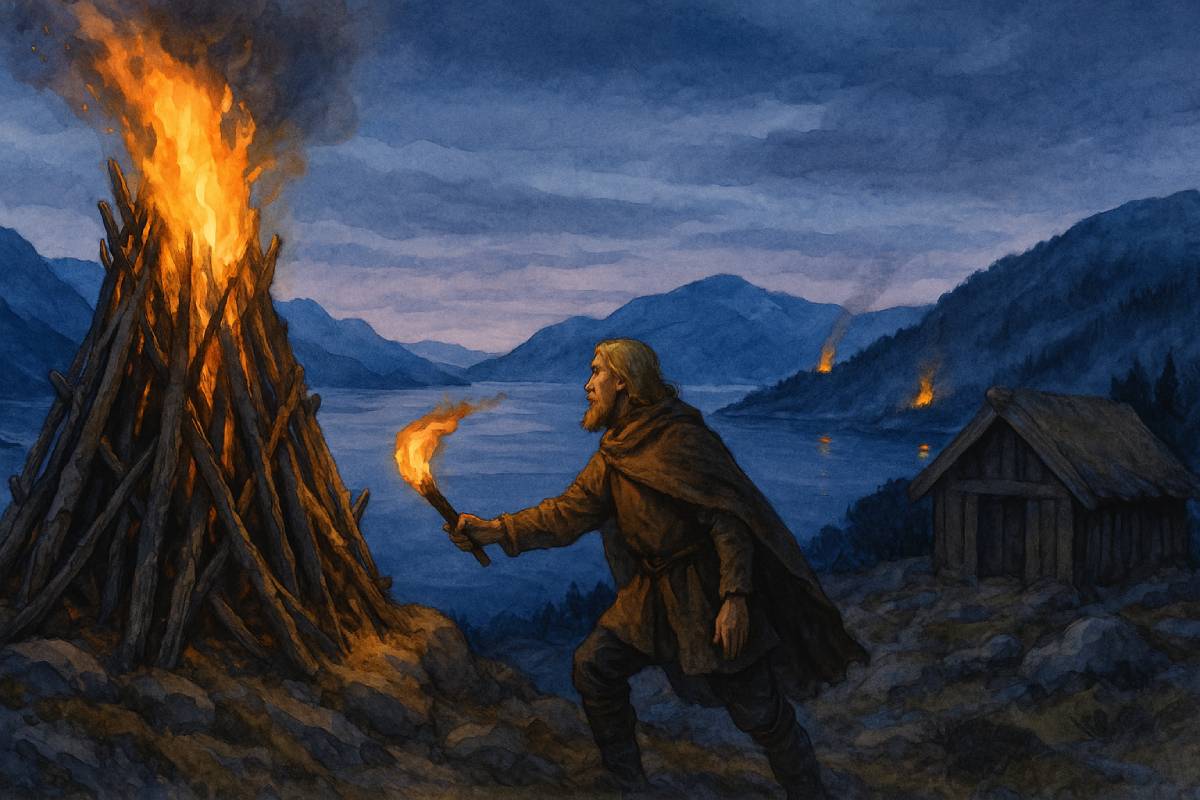
According to a recent report published in Science Norway, the beacons consisted of fires placed at strategic high points throughout the country.
If somebody spotted any potential danger, such as enemy ships on the horizon, they would light the beacon to signal to others in the area to come and provide assistance.
Speaking to Science Norway, project leader Marie Ødegaard argues that the sheer extent of the beacons demonstrates that the defense of territory was a primary concern for the people of Norway in this period.
"The traditional perception is that it was a one-sided warrior society focused on outward attacks and violence," Ødegaard commented. "Our findings show that Viking society was also concerned with protection, safety, and community."
- READ MORE: A Viking history of Norway (Part 1)

Many of these sites were found on coastal headlands and inland hills, chosen for visibility across long distances. Photo: Gorodenkoff / Shutterstock
Aided by the general public
The researchers from the University of Stavanger have worked for several years to identify and map beacon sites throughout Norway.
Their efforts in this area have led to the discovery of hundreds of different sites that stretch the entire length of the country and have been found in both coastal and inland areas. Many of these sites have been carbon-dated, and their use ranges from approximately 950 to 1814 CE.
In their research, the experts have been aided by a special scheme – an online citizen-science database was created to enable people in Norway to share evidence of potentially interesting sites in the country.
If someone found an old structure that could conceivably be a stone beacon or a guardhouse, they were asked to complete a form online to notify the researchers. If the lead seemed promising, the site was then investigated.
The archeological materials have also been compared with written sources and place names in an attempt to create a more comprehensive understanding of how the beacon system worked.
In many cases, it is thought that the sites contained a beacon alongside a guardhouse, where the guards could shelter when not on active duty. The research team has also uncovered possible administrative districts and boathouses that likely contained warships.
Fires lit at strategic high points could quickly signal danger and summon nearby warriors. Photo: Alex_Maryna / Shutterstock
More central power
The initial system of beacons and guardhouses has been dated to the 10th century. It is at this time that greater centralization of power was beginning to emerge in both Norway and throughout Scandinavia.
This kind of early warning system would have enabled leaders to mobilize warriors and defense capabilities in a relatively short space of time, providing protection against potential large-scale invasions.
As Marie Ødegaard indicated to Science Norway, this trend became more marked over time. "From the end of the Viking Age onward, we see the king increasingly taking control of the defense organization."
"Despite occasional dissatisfaction among farmers, decisions to participate were influenced by fear – especially fear of invading armies and contending groups."
Although the main part of the project has now been completed, the citizen-science database remains open, and the research team will continue to work to understand this crucial aspect of military life in the Viking Age.
In the meantime, a new exhibition, Ablaze: The Viking Defense System, has opened at the University of Stavanger's Museum of Archaeology to present the findings of the research.
We get to provide readers with original coverage thanks to our loyal supporters. Do you enjoy our work? You can become a PATRON here or via our Patreon page. You'll get access to exclusive content and early access.
Feel free to reach out to discuss potential stories that may be in the public interest. You can reach us via email at [email protected] with the understanding that the information you provide might be used in our reporting and stories.