

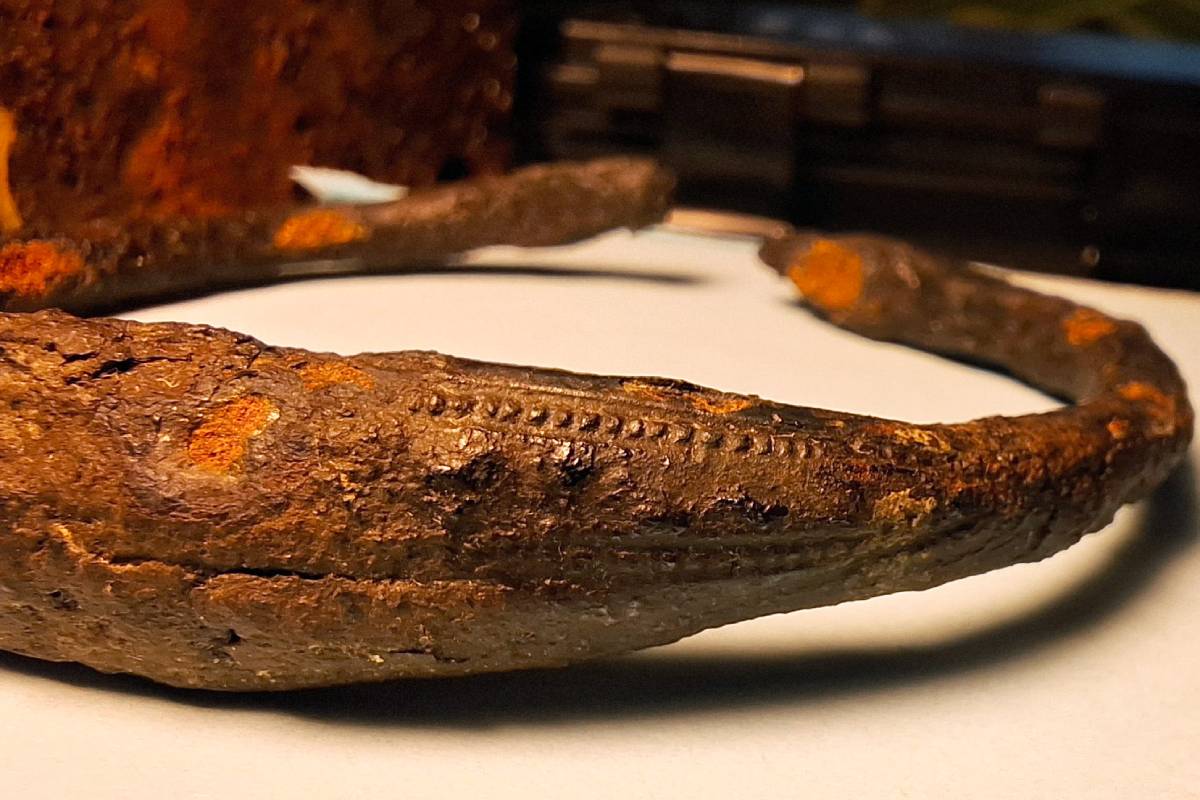
A citizen has unearthed an arm ring from the Viking Age on the Swedish island of Öland. The artifact is decorated with a series of dots and animal heads and is one of the very few arm rings found from the era made from iron.
The Viking Herald speaks exclusively to Karl-Oskar Erlandsson, an archeologist at the Kalmar County Administrative Board, about the discovery.
A chance encounter
The arm ring, or armlet, was identified by chance in the wetlands of Löts parish on the island of Öland, which lies just off the southeast coast of Sweden.
"The armlet was found last autumn by an observant private individual," Karl-Oskar tells The Viking Herald. "He saw the ring in a marsh next to a test pit for a planned water pipe. At first, he thought it was part of some kind of tool."
The individual, who has asked to remain anonymous, soon cleaned the object off and examined it further. At this point, it became clear the find could have more ancient origins.
"He contacted a known archeologist on Öland," Karl-Oskar explains. "The archeologist realized it might be older and advised the man to contact the county administrative board. He did so in March this year."
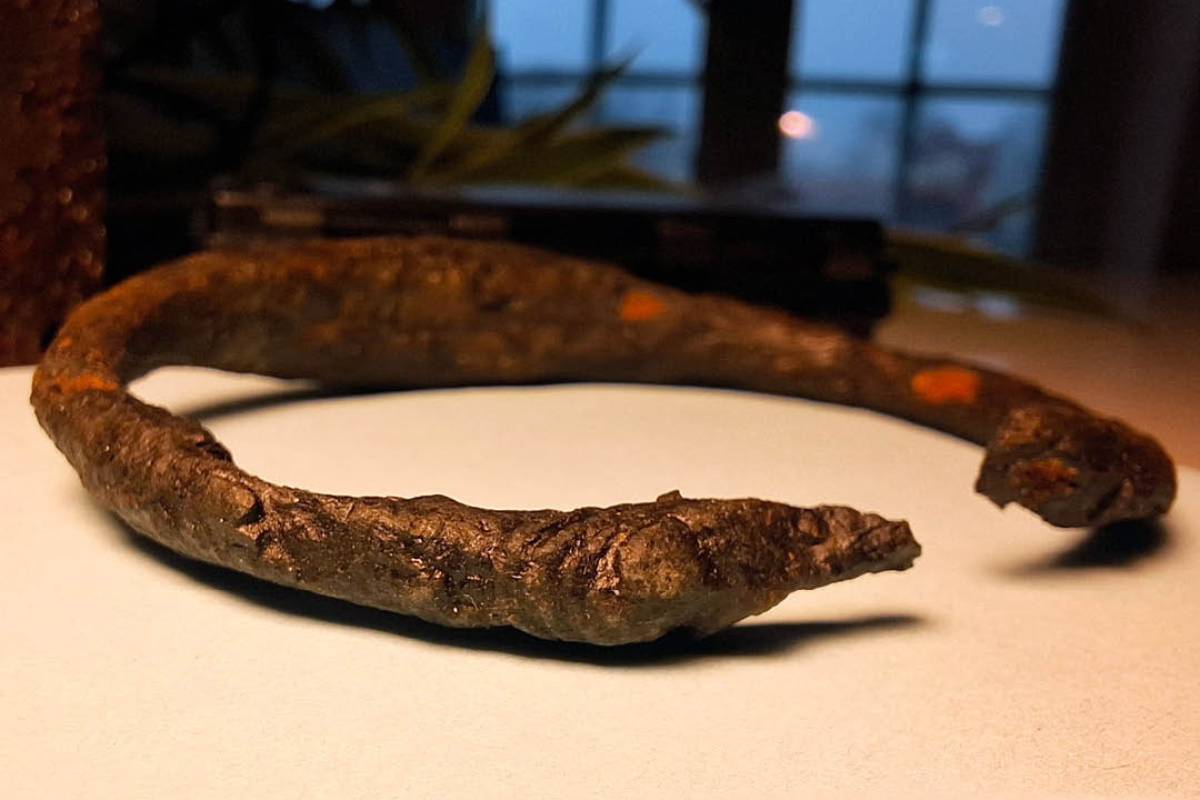
Although iron arm rings were likely common in the Viking Age, very few have survived due to corrosion. Photo: Kalmar County Administrative Board
Common yet unusual
Karl-Oskar was part of the team responsible for analyzing the find. It was clear the artifact was an arm ring or bracelet of some kind – a piece of jewelry typically worn for ornamental purposes.
The experts carried out a comparative analysis with similar objects from the Swedish History Museum that confirmed the arm ring was indeed far older than originally believed.
"From the ornamentation, we were able to date it to the Swedish Viking Age, somewhere between 800 and 1050 CE," Karl-Oskar confirms.
The material used to make the arm ring was also notable – though the museum houses approximately 1,000 arm rings, only three are made from iron.
However, this does not necessarily mean that iron arm rings were unusual in the Viking Age.
"Actually, they were more common than it seems," Karl-Oskar admits. "Instead, their rarity today is probably partly because iron arm rings rust more easily, which makes them harder to spot."
"There is also no obligation to contact authorities when you find an object made of iron."
In other words, people are less likely to find an intact arm ring made of iron, and even if they do, they are not legally obligated to report it, as they would be required to do if it were made of silver or gold.
- READ MORE: What type of jewelry did the Vikings wear?

The arm ring was found on Öland, an island known for its Iron Age ringforts, including the well-excavated site of Eketorp. Photo: trabantos / Shutterstock
A long past
Öland, which is Sweden's second-largest island, arguably enjoyed its heyday in the Middle Ages, when the parishes of Ottenby and Halltorp were selected as royal game reserves by the Swedish crown.
Its history, however, dates back much further, with evidence of settlement as far back as 8000 BCE, in the Mesolithic Era.
Previous archeological investigations have also uncovered a series of 19 Iron Age ringforts on the island.
The most notable, Eketorp, was excavated in the 1970s, eventually revealing some 26,000 artifacts.
The fort is believed to have been founded around 400 CE. It was then abandoned in 600 CE for several centuries before being used again in the 11th century.
Other digs on the island have also revealed a number of graves, including from the Viking Age. However, the fact that the arm ring was found in wetlands suggests it is unlikely it was part of a grave burial.
An uncertain future
As Karl-Oskar tells us, there may be opportunities for further explorations or analysis.
"There are plans to survey the area around the find spot to see if there are more objects and to understand the context of the find better," he confirms.
At the time of going to press, however, it is not clear if the team will have the chance to analyze the find itself in greater detail – under Swedish law, the final decision currently rests with the person who found it.
"Other than possibly some kind of preservation, there is no more work planned on the object for the moment," Karl-Oskar tells The Viking Herald.
"If there are more objects in the vicinity of the find, it counts as a protected heritage site and will go to a museum. If it proves to be just a stray find, then it is up to the finder to decide what to do with it."
We get to provide readers with original coverage thanks to our loyal supporters. Do you enjoy our work? You can become a PATRON here or via our Patreon page. You'll get access to exclusive content and early access.
Feel free to reach out to discuss potential stories that may be in the public interest. You can reach us via email at [email protected] with the understanding that the information you provide might be used in our reporting and stories.