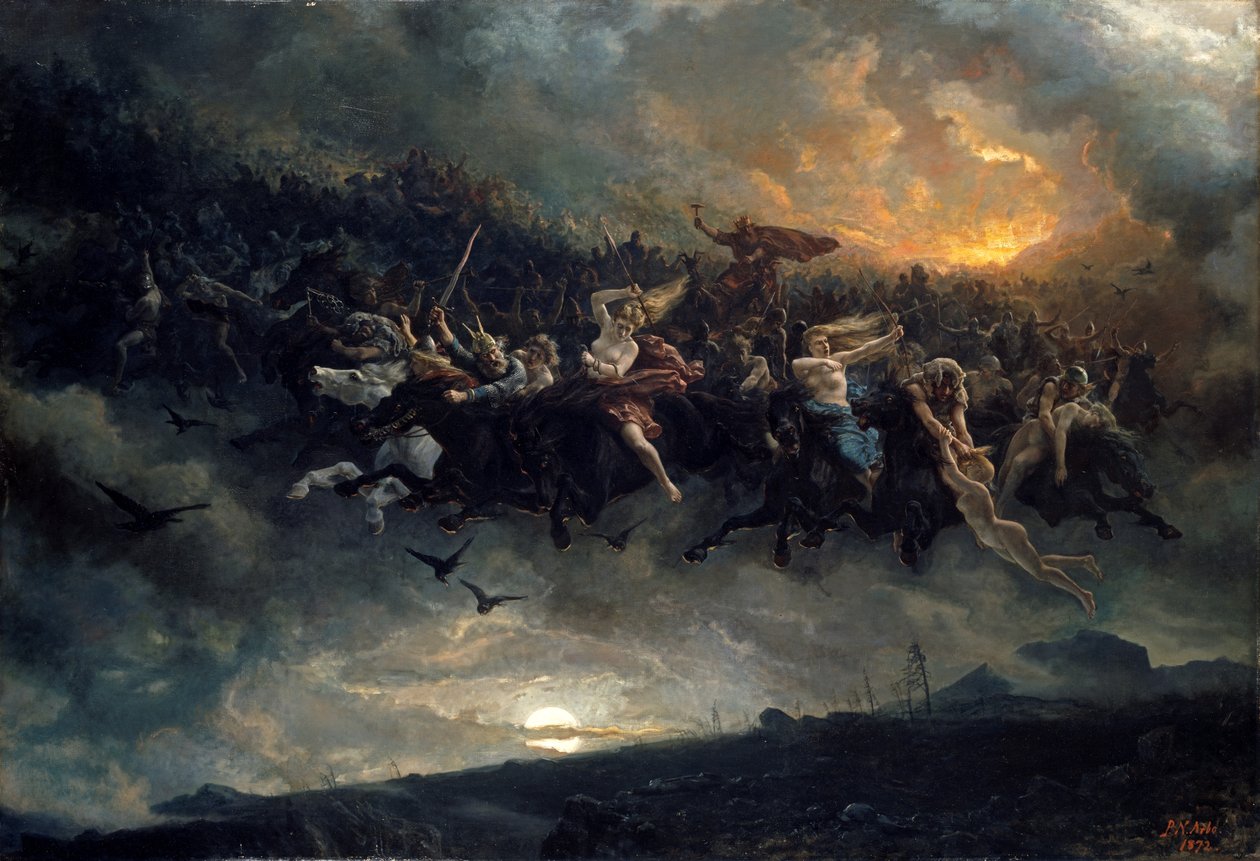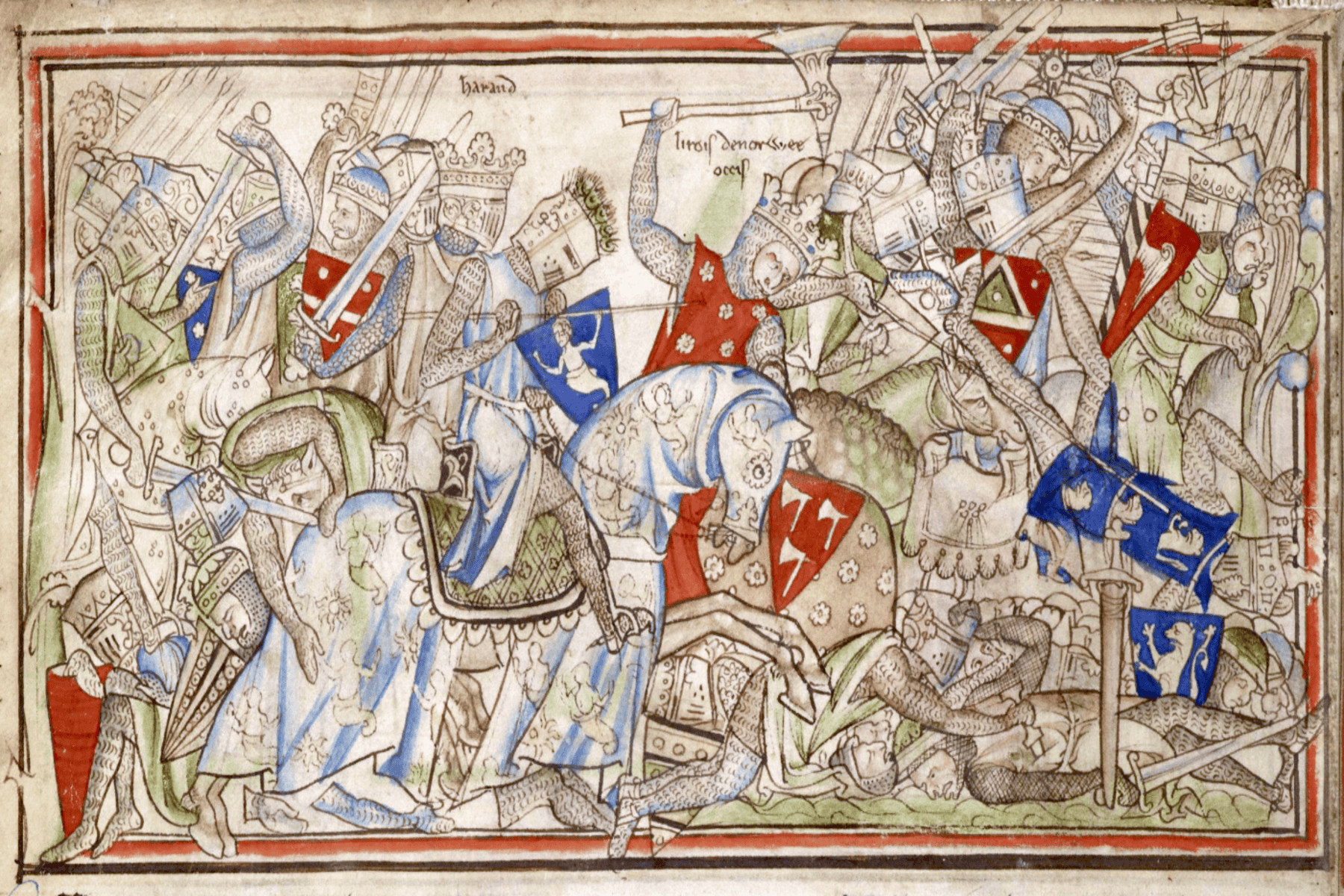


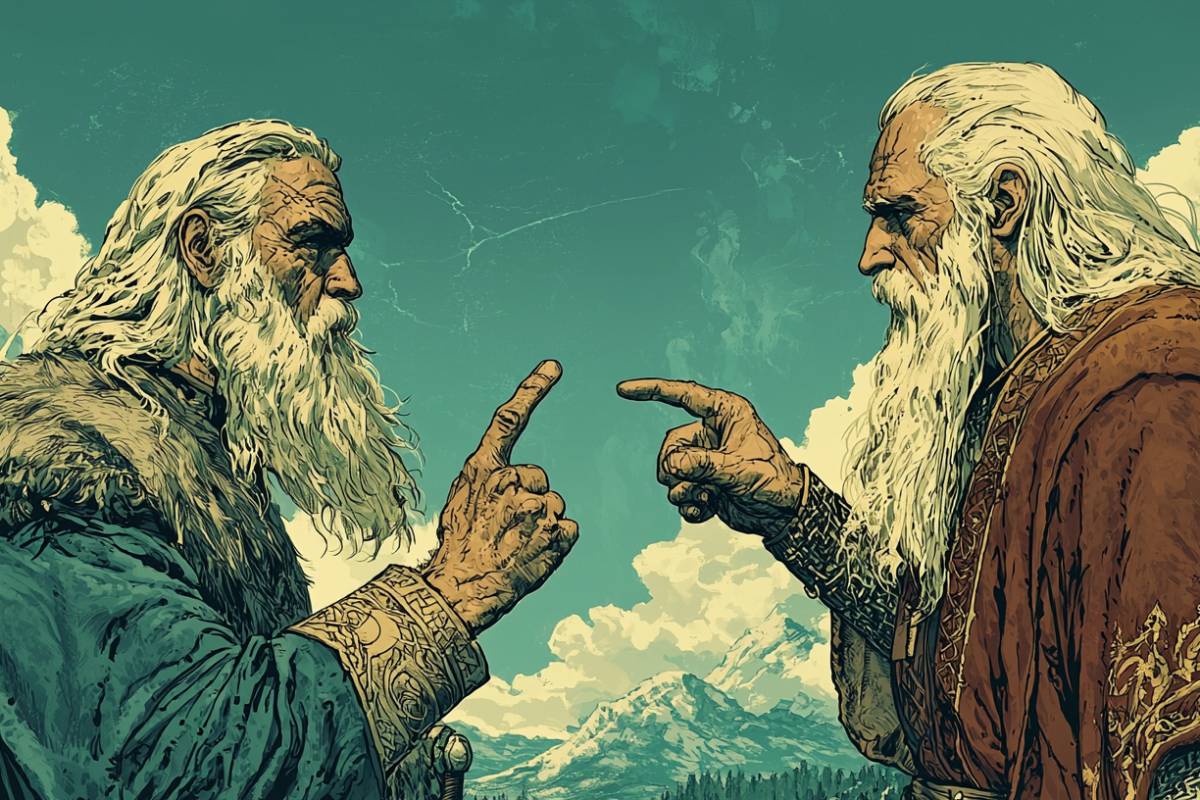
Glance at any depiction of a Viking on the small or silver screen, and they'll no doubt be throwing spears, not verbal barbs.
Yet despite a small warrior minority of Viking societies stealing all the historical prestige and book or website space, Viking societies were just as renowned for their poetic and oratorical skills as they were for anything achieved on the battlefield.
The true history of the poetic achievements of people from Viking societies has never quite fit into popular histories, often recorded and regaled by societies and people who felt the full force of a Viking raid.
From Anglo-Saxon England to Arabia and everywhere in between, the poetic achievements of people from Viking societies have often been shrouded by the violence of their warrior minority.
For too long, the clash of swords dominated the history pages rather than the sounds of a skald.
Not any longer. We at The Viking Herald take up the (metaphorical) banner and forge ahead to shed light on the long-lost art of flyting.
This form of verbal sparring revealed the sharp humor, quick wits, and power of language highly valued by people in Viking societies, proving that the word is mightier than any sword.
If we scan the rich tapestry of Norse literature, we can find many biting examples of this medieval mastery of language.
Nowhere do these flytings leap off the page more vividly than in the poem Lokasenna (Loki's Flyting).
A quarrel with Loki
We are indebted to the likes of the 13th-century Icelandic poet and politician Snorri Sturluson.
Thanks to this medieval man of letters' academic endeavors – one can imagine him toiling over scrolls for countless hours with quill in hand – we have a written record of the poems that once echoed throughout Viking chieftains' halls during the early medieval period.
Yet despite Snorri receiving all the praise, other scholars in the medieval period also worked to transcribe the rich oral traditions of people from Viking societies and commit them to the written form.
Sadly, however, unlike Sturluson, their names have been lost to the tides of history.
A collection of 31 poems from the Viking period has been given the modern name Poetic Edda.
One of the most striking of these ancient poems is Lokasenna, which deals with one of the most annoying things when having a good time at a party: an unwelcome houseguest.
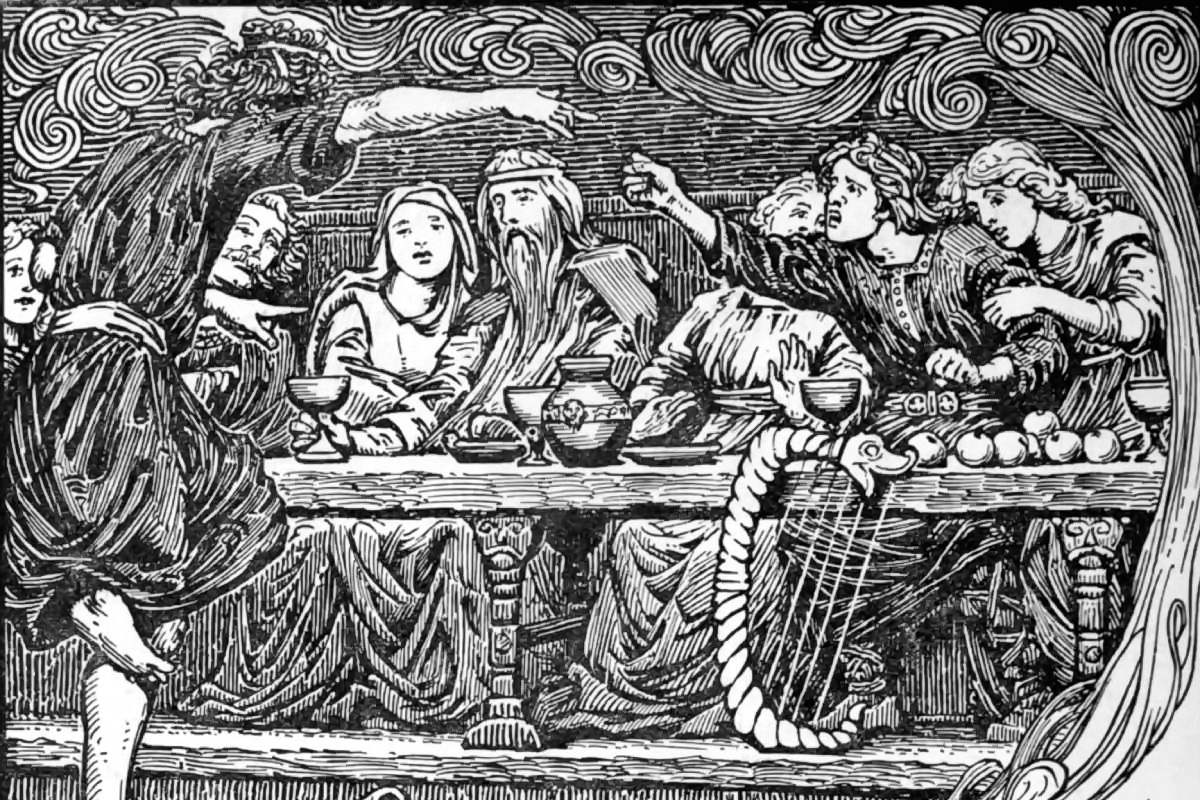
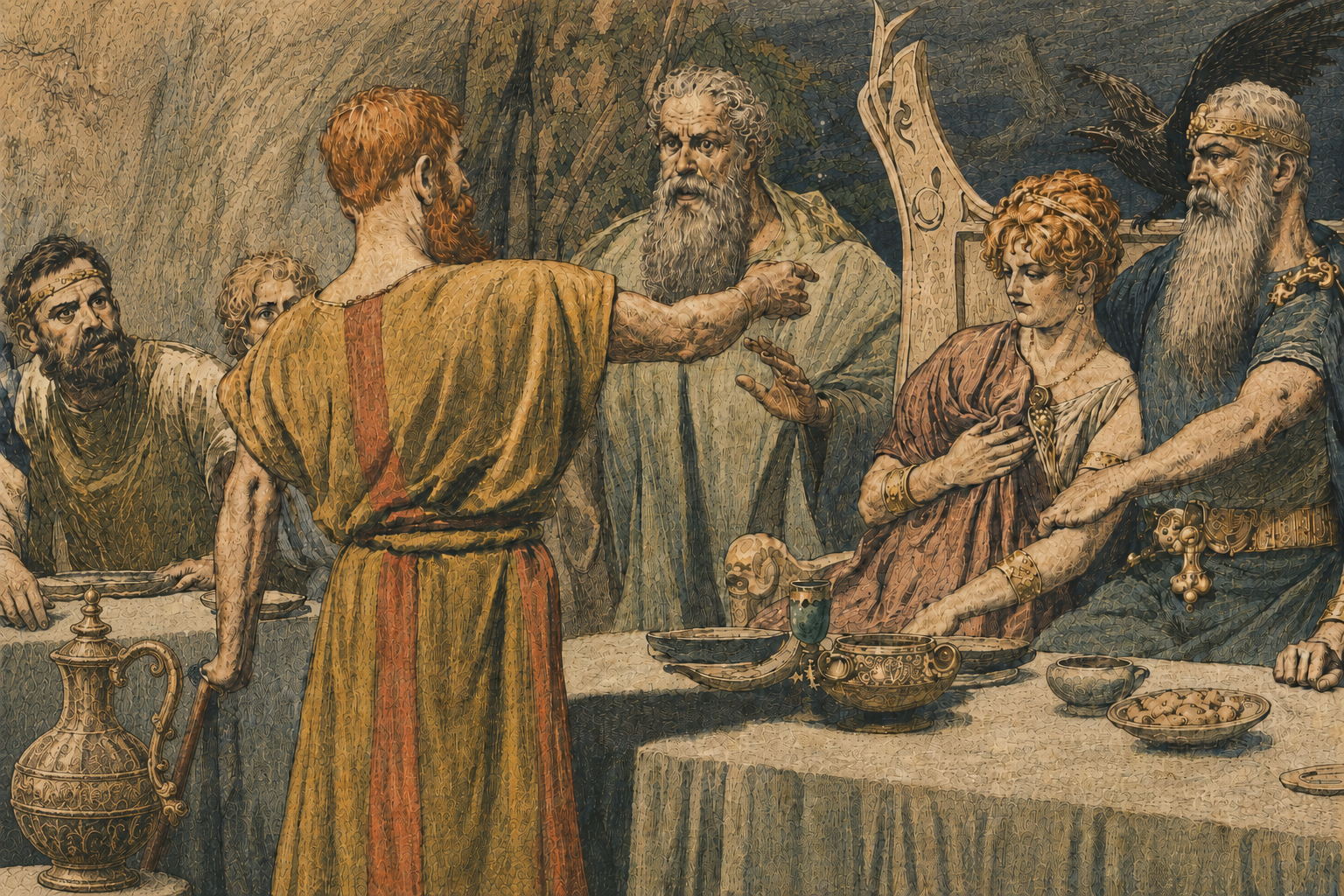
The illustration "Loki Taunts Bragi" depicts a moment from Lokasenna in which Loki engages in verbal sparring with Bragi. Source: W. G. Collingwood (1908)
A most unwelcome guest
All the gods are throwing a party in honor of Ægir, with the beer and mead flowing freely.
Loki comes barging in and proceeds to insult pretty much everyone there with a series of acerbic flytings after being told he is unwelcome.
To the mighty All-Father of Norse mythology, Odin – with whom Loki was irate for not being afforded the proper rules of hospitality and allowed to drink alongside him – Loki chides his masculinity. He quips:
They say that with spells in Samsey once
Like witches with charms didst thou work;
And in witch's guise among men didst thou go;
Unmanly thy soul must seem.
(Lokasenna, stanza 24, translated by Henry Adams Bellows)
Loki is accusing Odin of practicing seiðr, a mystical magic believed in by people from Viking societies.
Now, this might not quite seem like a dirty diss, but this was a feminine practice, and thus, Loki was questioning Odin's masculinity.
As you can probably tell, Viking societies were, by our modern standards, deeply misogynistic.
Bragi is one of the Norse gods Loki targets with his insults.
Earlier in the poem, Bragi bluntly states – one can imagine through gritted teeth – that if he, like his fellow revelers, weren't all good hosts, he would probably knock the proverbial lights out of Loki:
Now were I without, as I am within,
And here in Ægir's hall,
Thine head would I bear in mine hands away,
And pay thee the price of thy lies.
(Lokasenna, stanza 14, translated by Henry Adams Bellows)
Here, the power of language and the language of power become intertwined. The blurring of violence and the spoken word is perfectly encapsulated in this biting flyting.
Of course, it sounds even more impactful in the Old Norse tongue that was widely spoken in Viking societies, so better hop onto Duolingo now and start practicing!
Loki has the perfect response to Bragi's embattled bravado:
In thy seat art thou bold, not so are thy deeds,
Bragi, adorner of benches!
Go out and fight if angered thou feelest,
No hero such forethought has.
(Lokasenna, stanza 15, translated by Henry Adams Bellows)
For we moderns, this is something akin to "You're all talk and no action, Bragi!" mic drop.
Iðunn, the Norse protector of the magical apples that grant the gods eternal youth, defends her husband and begs him to be quiet.
Loki then serves a red-hot bowl full of (to our modern ideals) misogyny. He uses all the standard sexist tropes that men have used against women who speak up throughout time and labels her promiscuous:
Be silent, Iðunn! Thou art, I say,
Of women most lustful in love,
Since thou thy washed-bright arms didst wind
About thy brother's slayer.
(Lokasenna, stanza 17, translated by Henry Adams Bellows)
This is where things get heated, and the gods lose their cool.
Unluckily for Loki, the presently absent Thor (you know, he with the magical hammer) enters the party. After a lot of shouting and more dissing, Thor ends the verbal barbs by telling Loki:
Unmanly one, cease, or the mighty hammer,
Mjollnir, shall close thy mouth;
Thy shoulder-cliff shall I cleave from thy neck,
And so shall thy life be lost.
(Lokasenna, stanza 57, translated by Henry Adams Bellows)
Even in a boozy party full of Norse gods, when Thor mentions his hammer raining blows on their bodies, people tend to shut up.
Thus ends what some scholars, like Margaret Clunies Ross, in her 2005 book, A History of Old Norse Poetry and Poetics (available on Amazon here), call one of the best poetic illustrations of flyting found in the rich tapestry of Norse sagas.
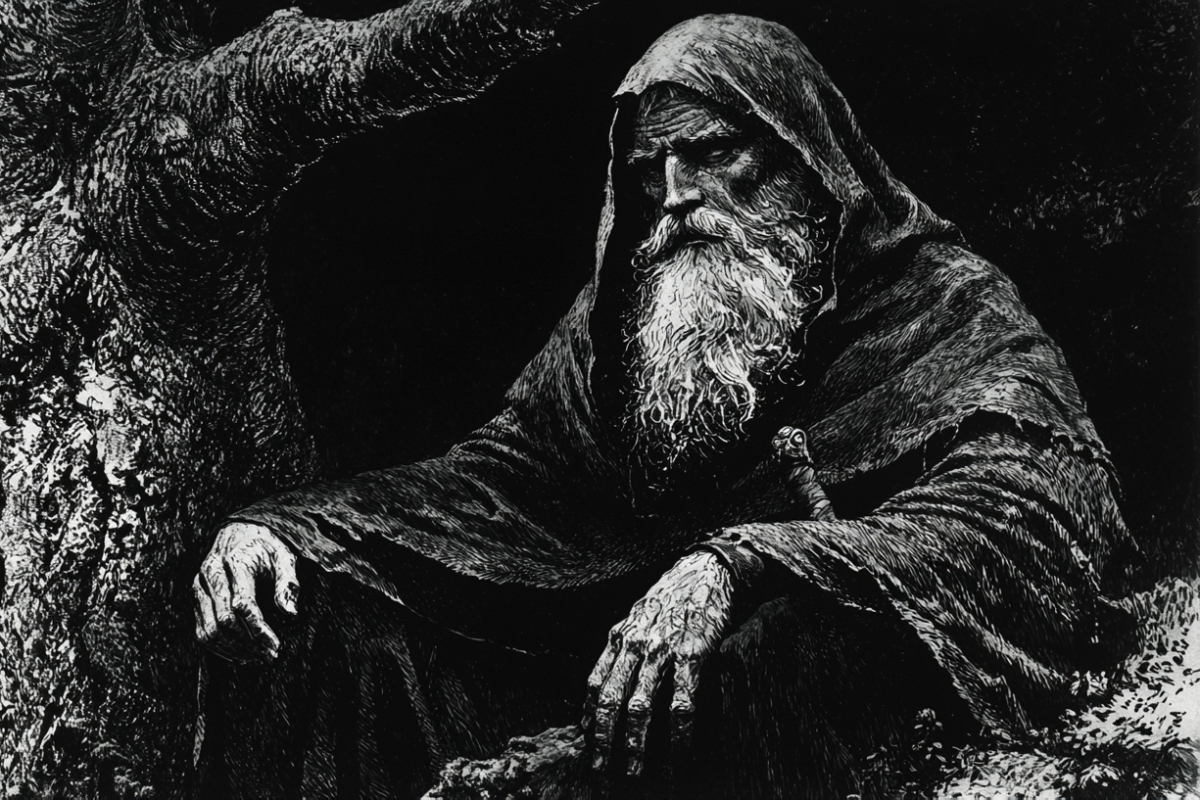
In Hárbarðsljóð, Odin, masquerading as Hárbarðr, denies Thor passage across a river, leading to a flyting. Source: The Viking Herald
What are some other examples?
Leaving aside Loki's quarrel, what are some other examples of good old-fashioned Viking-style verbal barbs found in Norse poems?
In the Hárbarðsljóð poem, there is another verbal stoush involving Thor. However, his sparring partner this time is not Loki, but a mysterious ferryman named Hárbarðr – who, as it turns out, is actually Odin in one of his many disguises.
Now, we know that in contemporary times, rap stars and wannabe gangsters place a high importance on their aesthetics and clothes.
Similarly, in this poem, Harbar dismisses Thor's fashion sense as being little more than a beggar's. He then also goes on to goad Thor by saying:
Eastward I was, and spake with a certain one,
I played with the linen-white maid, and met her by stealth;
I gladdened the gold-decked one, and she granted me joy.
(Hárbarðsljóð, stanza 30, translated by Henry Adams Bellows)
Not only does Odin undermine Thor's perceived power on the battlefield, but he also brags about his own sexual proclivities.
Finally, thanks to recent adaptations of the J.R.R. Tolkien book The Hobbit, we all know of the mythological dragon Fafnir. Few know, however, that he is the subject of his own Viking poem, Fáfnismál (Fafnir's Sayings).
Essentially a dialogue between the Germanic hero Sigurd and the dragon Fafnir, the poem features a number of witty flytings.
The poem starts with Sigurd having sneakily stabbed Fafnir in the heart. Fafnir asks:
Youth, oh, youth! of whom then, youth, art thou born?
Say whose son thou art,
Who in Fafnir's blood thy bright blade reddened,
And struck thy sword to my heart.
(Fáfnismál, stanza 1, translated by Henry Adams Bellows)
Sigurd here, the literal dragon slayer, is reluctant to state his name despite the fact he has smitten this great dragon.
There was a widespread belief among Viking societies that a dying foe could utter a curse on the name of their killer, which is why our mighty Sigurd is reluctant to reveal his identity. Sigurd utters:
The Noble Hart my name, and I go
A motherless man abroad;
Father, I had not, as others have,
And lonely ever I live.
(Fáfnismál, stanza 2, translated by Henry Adams Bellows)
The rest of the poem is a conversation between the dying Fafnir, Sigurd, and Regin (confusingly both the brother of Fafnir and the foster father of Sigurd).
The conversation takes on almost philosophical overtones. Fafnir, in his dying moments, offers great advice:
...In the water shalt drown if thou row 'gainst the wind,
All danger is near to death...
(Fáfnismál, stanza 11, translated by Henry Adams Bellows)
Given the maritime and nautical skills of people in Viking societies, the first section of this line was to be a serious piece of advice. More metaphorically, it can also be seen as a sort of medieval version of "go with the flow."
And for those of you that are adrenaline junkies and thrill seekers, just remember the second part of the line next time you go bungee jumping or abseiling.
Sigurd also has a sage piece of advice when he states:
Better is heart than a mighty blade
For him who shall fiercely fight;
The brave man well shall fight and win,
Though dull his blade may be.
(Fáfnismál, stanza 28, translated by Henry Adams Bellows)
In other words, it doesn't matter how tough you may look; what makes a warrior a great warrior (and Sigurd should know, as he has just slain Fafnir) is the courage therein and not the shiniest sword.

Viking flytings share a thematic connection with rap battles and diss tracks as forms of lyrical competition. Source: The Viking Herald
A modern legacy?
Now, if you think this idea of artistic dissing and verbal feuds sounds familiar, you'd be right.
While so-called "diss tracks" became a popular trope in 1980s rap music and onwards, their roots cast a long shadow stretching back through the 20th century.
From Bob Dylan's 1965 song "Positively 4th Street" – slamming elements of the Greenwich Village milieu in New York City who thought he had sold out when he moved away from folk music – to Carly Simon's 1972 hit "You're So Vain" (aren't you Warren Beatty…?), to the ongoing musical feud between Kendrick Lamar and Drake, these artists tap into a history of combining wit and using words as weapons.
As Heather O'Donoghue discusses in her 2014 book, English Poetry and Old Norse Myth: A History, these modern artists, along with many poets throughout history, stand on the shoulders of the people in Viking societies who crafted and performed flytings for a beer hall crowd.
More information on Viking poetry can be found on the University of York's website.
We get to provide readers with original coverage thanks to our loyal supporters. Do you enjoy our work? You can become a PATRON here or via our Patreon page. You'll get access to exclusive content and early access.
Feel free to reach out to discuss potential stories that may be in the public interest. You can reach us via email at [email protected] with the understanding that the information you provide might be used in our reporting and stories.