


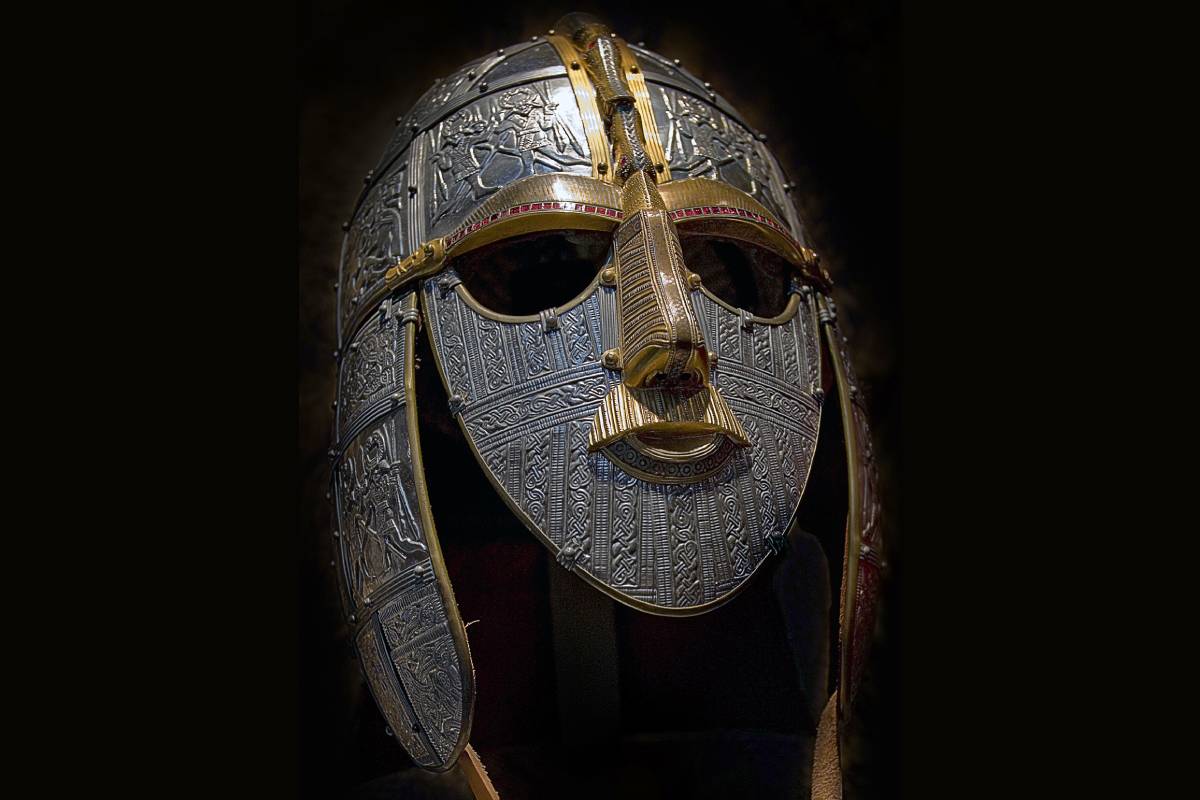
A metal detectorist has unearthed an artifact that suggests the famous helmet found at Sutton Hoo in England may have come from Denmark, not Sweden.
One archeologist involved in analyzing the find believes the discovery could alter our perceptions about the balance of power in the era leading up to the Viking Age.
A British icon
Sutton Hoo is one of the most famous ship burials in the world. Discovered and excavated in a field near the coastal town of Woodbridge in Suffolk, England, in 1939, the site revealed more than 260 artifacts from the 6th and 7th centuries.
Many historians believe the grave belonged to Rædwald, the Anglo-Saxon king of East Anglia.
In terms of their origin, however, the finds were remarkably wide-ranging. Notable items from the collection included silverware from the Byzantine Empire and garnets thought to have been made in Sri Lanka.
There were also several artifacts that suggested a Scandinavian connection, including an ornate shield and Norse-style drinking horns.
The most iconic piece, however, is arguably an iron and copper-clad helmet that many historians believe functioned as a kind of crown for the Anglo-Saxon ruler.
Again, most experts believe the helmet was not made in England, however. Instead, the motifs in its design, including a depiction of warriors on horseback, suggest the helmet may have been produced in Uppland, Sweden.

The reconstructed ship burial chamber at The Sutton Hoo Exhibition Hall. Photo: Gernot Keller (CC BY-SA 2.5)
A revealing clue?
Two years ago, however, the archeologist and metal detectorist Jan Hjort discovered a small copper alloy stamp in a field on the Danish island of Taasinge with a series of inscriptions.
Hjort immediately handed the stamp, which measures 5 cm by 4 cm, to a local museum, but it has only recently been analyzed.
Researchers at the National Museum of Denmark found the motifs on the stamp possess notable similarities to those on the helmet.
In particular, the stamp features a horse that bears a remarkable likeness to those depicted on the helmet. Peter Pentz, a curator at the museum, notes that the details of the nose, mane, ear, and tail are the same on each artifact.
"The stylistic similarities are so significant," Pentz commented to the BBC. "This is the closest link we've ever seen."
Although comparable motifs have previously been uncovered in Germany, it is thought to be the first time this specific design has been found in Denmark.

Evidence of metalworking on Taasinge suggests the Sutton Hoo helmet could have been crafted there and later brought to England. Photo: Paul Hudson (CC BY-SA 2.5)
Of uncertain origin
Again speaking to the BBC, Pentz indicates there may have been a metal workshop at Taasinge in the 7th century, with several scraps of metal found on the island in the past.
It is possible that the Sutton Hoo helmet may have been produced on the island and made its way to England via trade routes or even as a gift from a Danish-born visitor to the British Isles.
Although the initial development of major family and trading links between Scandinavia and the British Isles is traditionally associated with the Viking Age, it is also known that some of these connections were already present in the 7th century.
Pentz believes these apparent relations between England and Denmark could suggest the latter was more powerful in this era than previously supposed.
At this point in time, however, it is not possible to say with any certainty that there is a direct link between the stamp found in Taasinge and the helmet from Sutton Hoo.
There remains a chance, however, that further investigations on the Danish island could reveal additional examples of the motifs in question.
We get to provide readers with original coverage thanks to our loyal supporters. Do you enjoy our work? You can become a PATRON here or via our Patreon page. You'll get access to exclusive content and early access.
Feel free to reach out to discuss potential stories that may be in the public interest. You can reach us via email at [email protected] with the understanding that the information you provide might be used in our reporting and stories.




.jpg)