

As reported by The Viking Herald, recent analysis of a tiny metal die uncovered in Denmark has raised new questions about the origins of the iconic Sutton Hoo helmet.
But how much can we read into the similarities between the artifact's design and those found on the helmet? The Viking Herald explores this question with the help of Peter Pentz, a curator at the National Museum of Denmark who helped inspect the die.
A unique collection
The Sutton Hoo helmet is part of a remarkable collection of grave goods from a 6th–7th-century ship burial discovered in the English county of Suffolk in 1938.
Suffolk is part of the region of East Anglia, and many scholars believe the grave belongs to King Rædwald, who ruled over the kingdom of East Anglia for around a quarter of a century.
Although Sutton Hoo is generally described as an Anglo-Saxon burial, the grave goods were international, with artifacts from as far afield as the Byzantine Empire, Syria, and Sri Lanka.
The ship burial itself, on the other hand, is a typical feature of Germanic culture.
While there are some isolated examples of ship burials in the early Anglo-Saxon era, the practice is most commonly associated with the Norse, with notable examples including Gokstad and Oseberg in Norway, and Salme in Estonia.
The burial site also revealed other potential links to the Norse world, including drinking horns and a shield whose design closely resembles others from the Vendel Period (6th to 8th century) in Sweden.
Most notable, however, is the Sutton Hoo helmet, a supremely ornate piece of armor that has achieved iconic status in Britain and around the world.
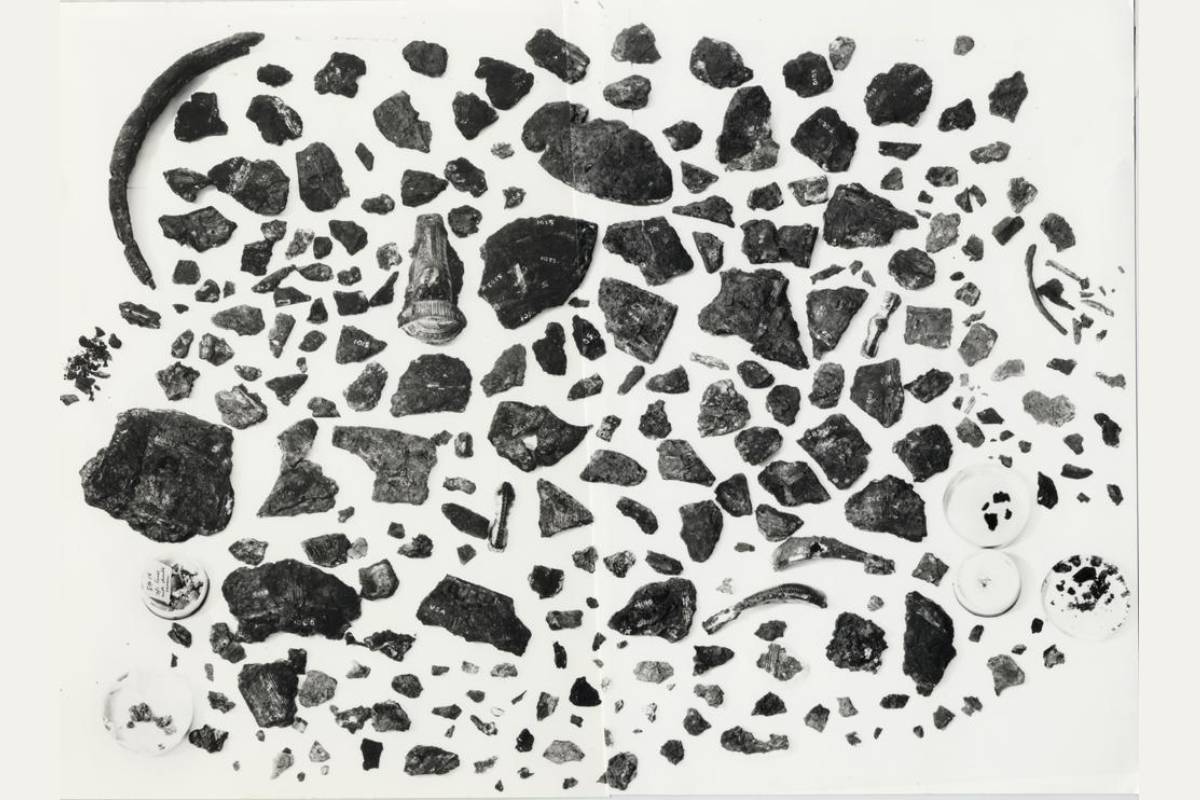
The Sutton Hoo helmet was unearthed in pieces and reassembled through years of meticulous conservation work. Photo: The British Museum (CC BY-SA 4.0)
The celebrated helmet
Crushed by the collapse of the burial chamber, the Sutton Hoo helmet was found in hundreds of pieces and had to be painstakingly reconstructed over a number of years.
The restorers found that the original helmet was adorned with a number of beautifully inscribed bronze panels. These panels feature a total of five separate designs, some of which recur in several panels.
The designs include interlaced patterns that recall Norse handiwork and two dancing warriors that resemble another scene depicted in the Valsgärde 7 helmet, found in Uppland, Sweden.
Central to the debate around the Tåsinge die, however, is a panel that depicts a horse, its rider, and a fallen warrior.
Artifacts containing some elements of this particular design have been found in England, Sweden, and Germany, and several experts have used the panel to argue that the helmet likely originated in Sweden during the Vendel Period.
Now, the analysis of the Tåsinge die has questioned this assumption.
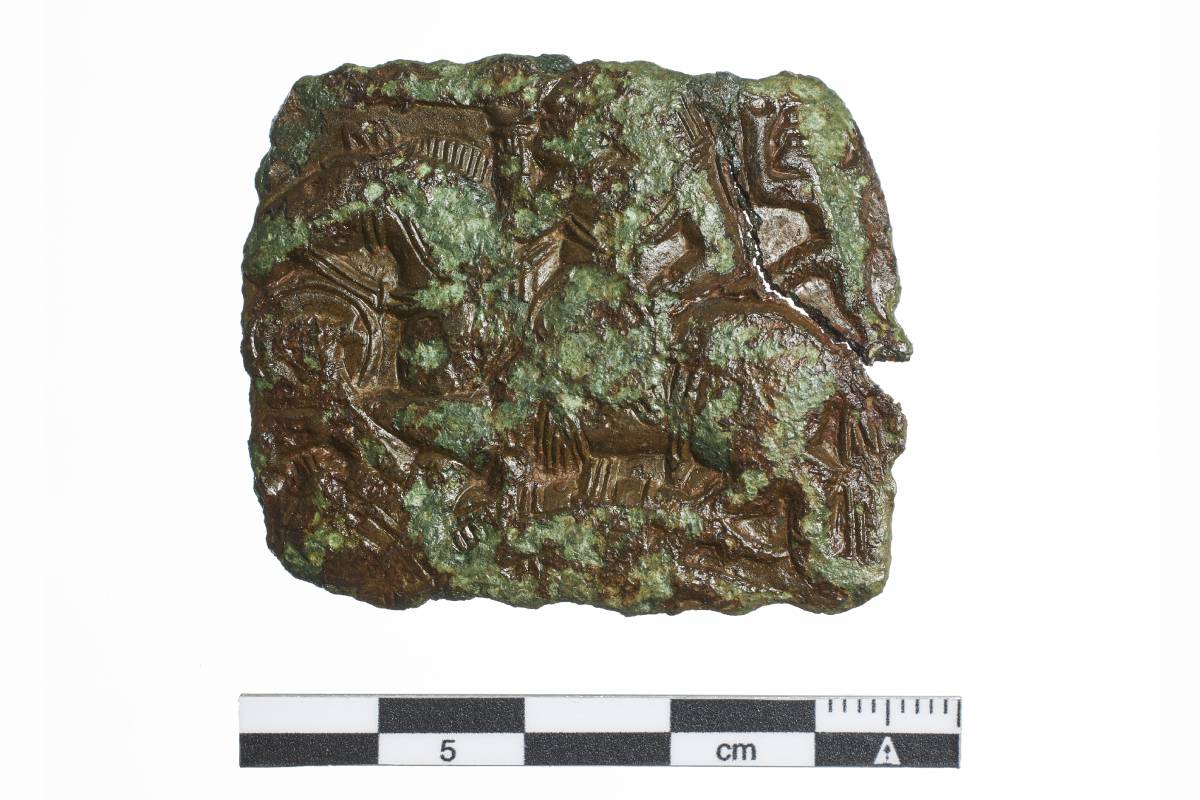
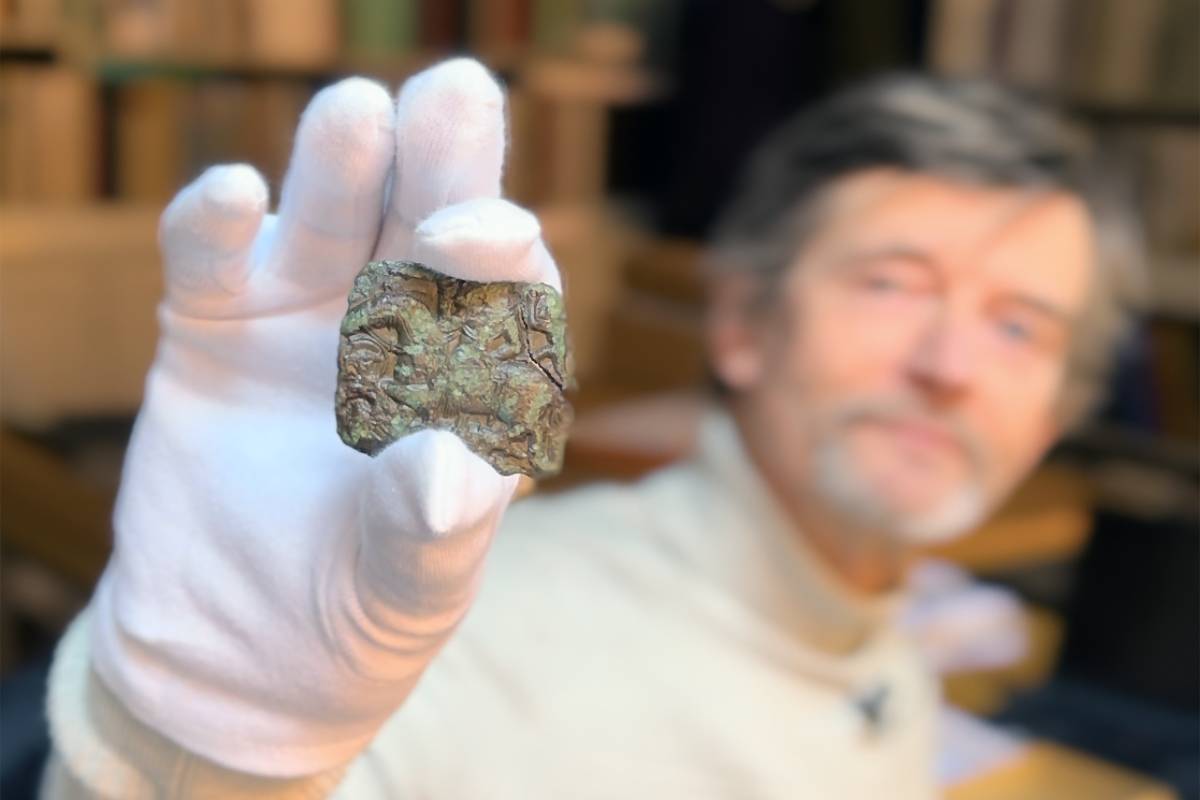
Found in a Danish field, the die remained unrecognized for its importance for nearly two years. Photo: The National Museum of Denmark
One find among many
"The die was found in 2023 by the metal detectorist Jan Hjort," Peter Pentz tells The Viking Herald.
"He was walking through a field on the small island of Tåsinge, which is southeast of Funen island. He had walked with his metal detector on the field many times over the last decade and found scraps of metal, including a foil and brooches."
This time, however, Hjort unearthed a curious metal object with a faded inscription.
Although he immediately sent the piece to the museum for analysis, it took nearly two years for the experts to carry out a complete analysis. Naturally, they had no notion this unassuming object could be of such potential significance.
"It can be a long process," Peter admits. "We receive more than 10,000 objects each year, so there is definitely a queue!"
"Usually, the finder presents it to the local museum, and the museum functions as the first 'filter.' The museum then sends the finds to us, and we decide if the finds are important enough to be declared as 'Danefæ'—objects of special historical value."
"If they are, we pay a reward to the finder, and the artifacts in question become part of our collection."
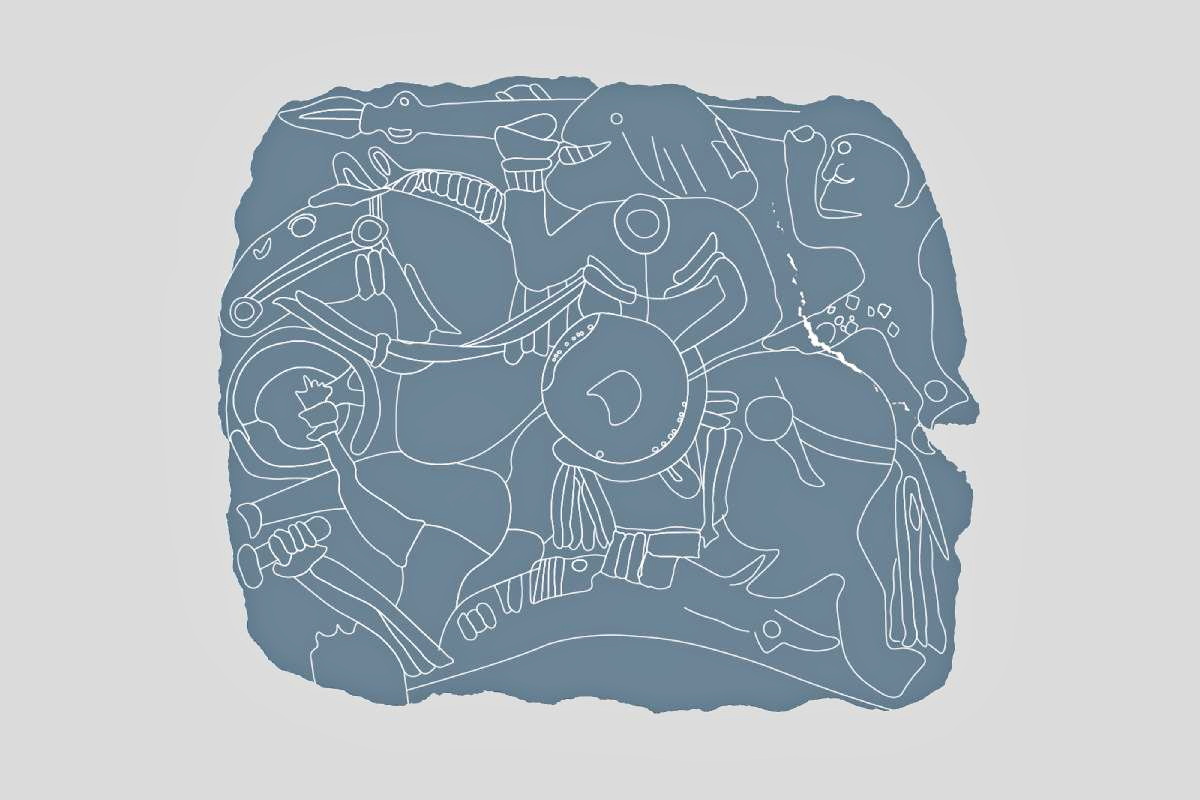
The die shows a horseman and fallen warrior motif also seen on helmets from England and Sweden. Illustration: Mads Lou Bendtsen / The National Museum of Denmark
The die is cast
The "die," in this instance, is not an object used for playing dice. Instead, it is a special kind of stamp, known as a "patrice," which bears a motif that has been carved into the metal.
The motif can then be recreated by hammering a thin sheet of metal placed on top of the die. "The die is 4.5 x 3.7 cm in size and shows a worn design for producing decorated foils," Peter informs The Viking Herald.
"The edge of the die is partly broken, which complicates the full identification of the size of the stamp's motif," Peter adds.
"Nevertheless, we can see the central figure shows a horseman that brings to mind the motifs of the stamped foils of the Vendel-type helmets."
"It soon becomes obvious that the depiction presents the so-called 'Rider and fallen warrior' motif, known from both the Sutton Hoo and Valsgärde helmets," Peter tells us.
"The size of the die, together with the 'fallen warrior' representation, reveals the die was for making decorated foils, most likely for helmets of the Vendel or Sutton Hoo type."
The team found that certain details on the Danish die appeared to bear a much closer resemblance to those found on the Sutton Hoo helmet than the examples from Sweden.
In particular, the warrior's hair, an almond-shaped harness fitting on the horse's head, and the warrior's shield all closely fit the design on the Sutton Hoo helmet.
The team also believes the fragments of a second panel could indicate an even stronger similarity. Might the helmet and the die have been made by the same hand?
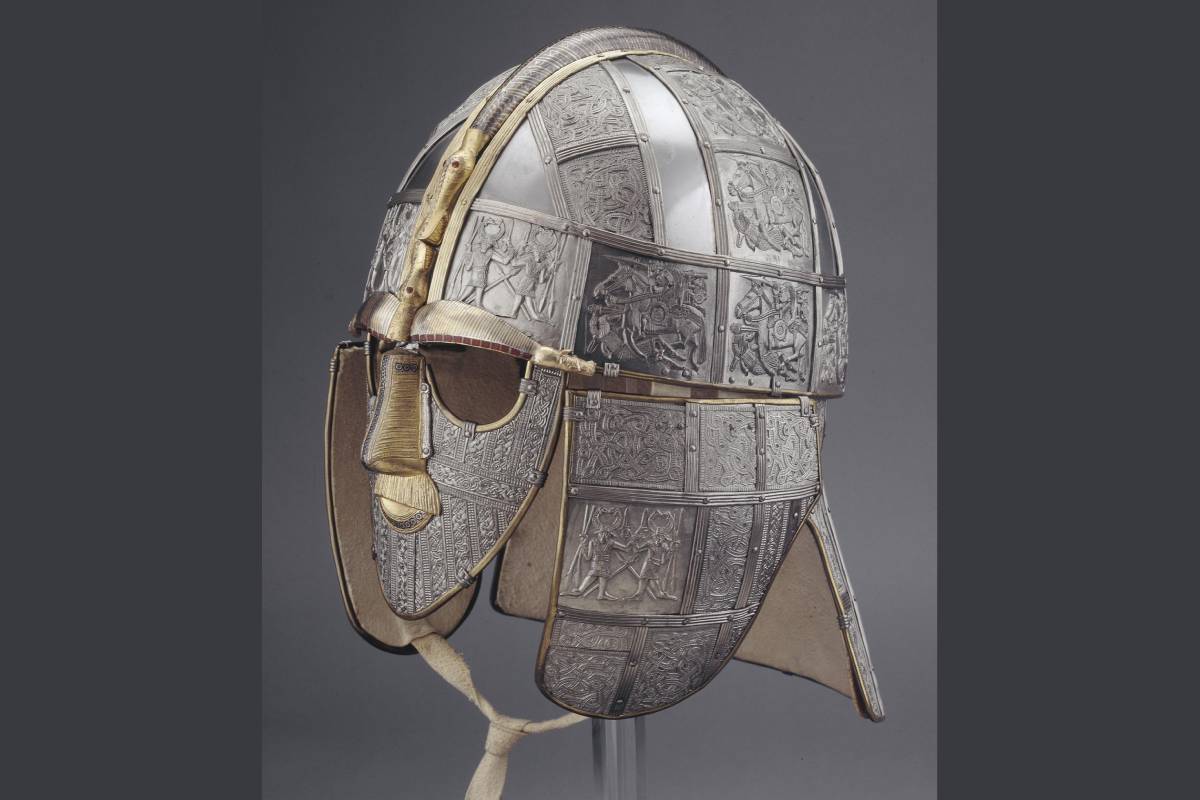
A side view of the helmet replica shows the decorated panels that once adorned the original helmet. Photo: The Trustees of the British Museum (CC BY-NC-SA 4.0)
Ancient links
As Peter explains to The Viking Herald, the Sutton Hoo finds have often stirred debate about relations between the British Isles and Scandinavia prior to the Viking Age.
"The apparent connection between the Sutton Hoo burial in Suffolk and the Vendel and Valsgärde boat graves of Uppland has given rise to many different speculations about the geopolitical situation of 7th-century England and Scandinavia," Peter tells us.
"Uppland was the preferred link, based on the motifs of the helmet and the decorations of the shield. There has also been speculation about whether the Sutton Hoo helmet was an heirloom and perhaps predated King Rædwald."
As Peter points out, many of the people of England in this era had Germanic ancestry, just like the Norse.
"The 8th-century monk and scholar Bede the Venerable stated that the Saxons came from northern Germany, the Jutes from Jutland in Denmark, and the Angles from the areas at Jutland's root."
"If one dares to look at the Old English poem Beowulf as a kind of historical source, we can see this," Peter informs The Viking Herald.
"Although composed in Anglo-Saxon England, the actions in the poem take place in Denmark, Sweden, and Frisia. Most of the figures mentioned in Beowulf have Scandinavian names that reoccur in Scandinavian sources."
"Some researchers have even suggested that Beowulf was first composed in the 7th century at Rendlesham in East Anglia, near Sutton Hoo."
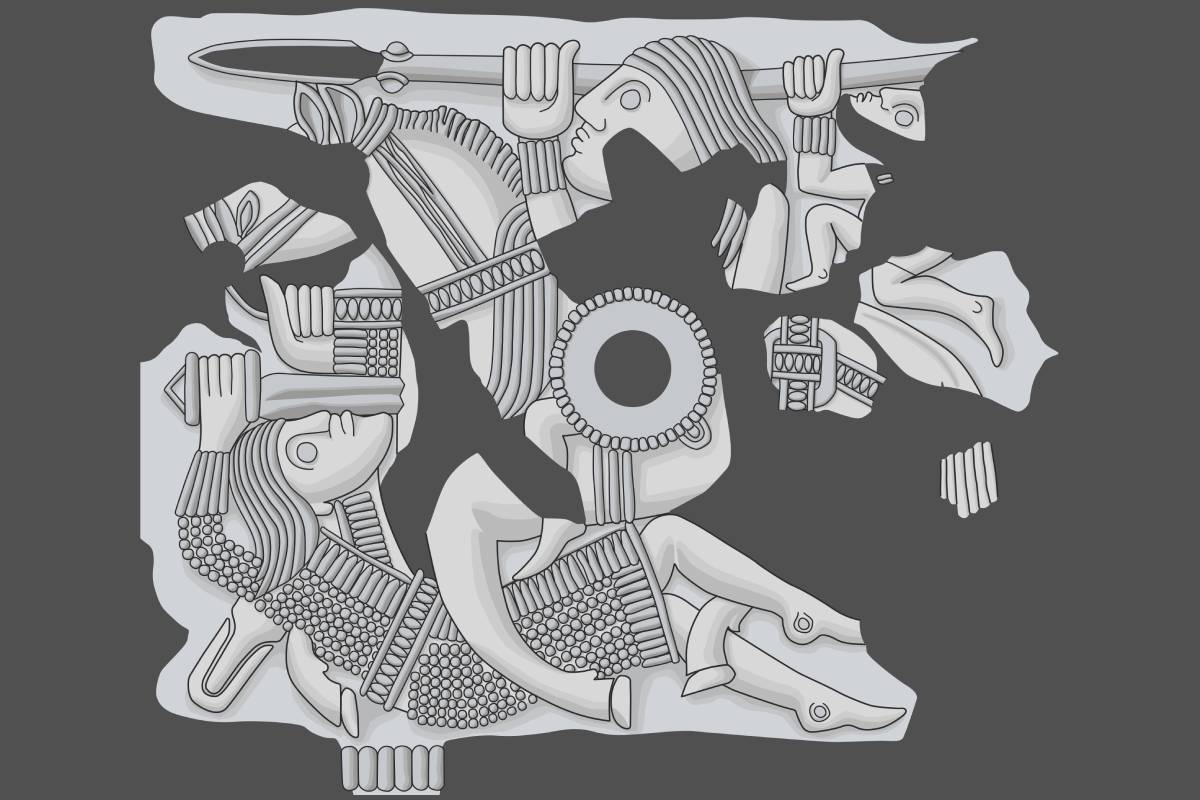
The Sutton Hoo helmet features a motif of a mounted warrior, seen here in detail. Illustration: Goran tek-en (CC BY-SA 4.0)
Still connecting the dots
So, while there was no extensive integration in this era that could compare to that of the Viking Age, it seems possible, or even likely, that there were some important connections between East Anglia and Scandinavia, including Denmark.
"Some cultural links certainly existed, though we have no evidence of extensive trade between East Anglia and the Danish areas," Peter says.
"And no burials have been excavated in Denmark that resemble Sutton Hoo or Valsgärde."
"At the same time, various helmet parts and dies found by metal detecting here provide evidence that these kinds of helmets were probably produced and worn in Denmark, too."
"The die found at Tåsinge does not necessarily mean that helmet production took place on this particular spot—a small die is easily transported."
"An 'eyebrow' from a helmet of the type has also been found on the neighboring island of Ærø. Gudme, a site around 25 kilometers from Tåsinge, has also yielded many weapons, weapon fragments, and gold."
In other words, it seems probable that there was some metalwork and helmet production either on the island of Tåsinge or in the surrounding area.
Even so, further finds or analysis will be needed to reach a definitive conclusion on whether the craftsmen who made the Tåsinge die also worked on the Sutton Hoo helmet.
"At the moment, there are no further plans for excavation or surveying the site, and the stamp itself is now exhibited in the National Museum," Peter admits.
"However, the die has been scanned, and further comparisons to the Sutton Hoo fragments in the future might strengthen the case for similarity—or the opposite."
We get to provide readers with original coverage thanks to our loyal supporters. Do you enjoy our work? You can become a PATRON here or via our Patreon page. You'll get access to exclusive content and early access.
Feel free to reach out to discuss potential stories that may be in the public interest. You can reach us via email at [email protected] with the understanding that the information you provide might be used in our reporting and stories.