

Why do we here at The Viking Herald love the Norse sagas?
Well, part of the reason is the colorful characters and their delightful stories—think mighty Thor going in drag to fool a giant or that eternal trickster Loki and his constant scheming.
Ragnar Lothbrok's mighty exploits laid waste to Paris, but he could not win over a wife, while Harald Fairhair's harsh economic policies forced a bunch of Scandinavian tax exiles to settle in Iceland.
Yes, there is a rich tapestry of memorable characters that echo down to us through the ages with their oversized personalities, dry wit, and, above all, their incredible feats of derring-do.
There are other reasons to love the sagas, though.
We must remember that these tales, though entertainment for us from the comfort of the 21st century, were not just a way to while away those long and cold Nordic winters; they were told as true histories, oral records of the ancient past.
However, people from Viking societies were not only backward-looking, even though to us now, they might seem that way. They also had a cataclysmic tale to spin about the end of times, which they called in their own Old Norse tongue, Ragnarök.
This was, as A.S. Byatt writes about in her 2011 book Ragnarök: The End of the Gods (available on Amazon here), "a tale of the destruction of life on this planet and the end of the gods themselves."
We would certainly agree with the first part of this description, but we will see if the second part rings true.
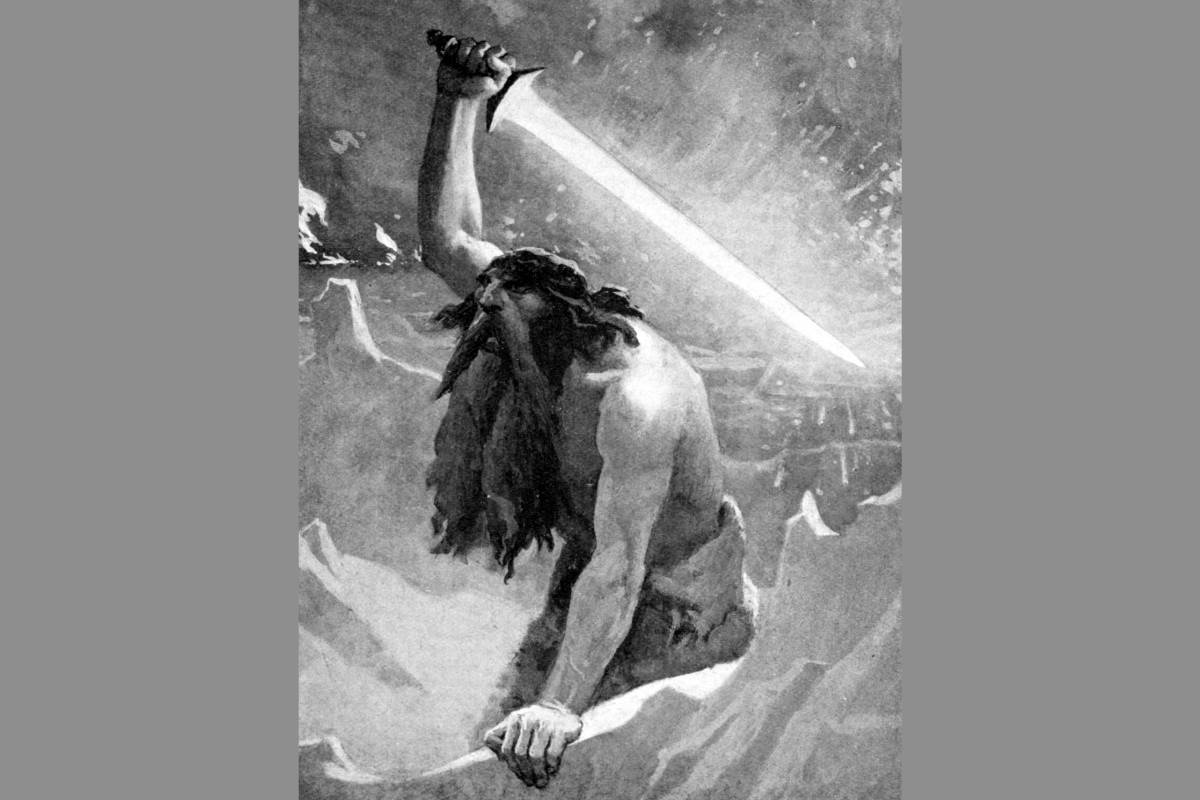
According to the Völuspá, Surtr wields a flaming sword that sets the world on fire during Ragnarök. Illustration: John Charles Dollman (1851–1934)
The final destiny of the Gods
Nothing occurs in a vacuum, and the Norse end of times is certainly no exception. Scouring the rich tapestry of Norse literature, we can see certain precursors to the "Twilight of the Gods."
Our best guide to these events, which are best translated as the "final destiny of the Gods," is the Völuspá (sometimes translated in English as The Prophecy of the Seeress).
This poem (we are using an online version of the 2019 English translation by Olive Kay & Kevin Young) is found in the collection of poems known as the Poetic Edda, which was compiled in 13th-century Iceland and includes mythological and heroic lays from earlier oral tradition.
It is a prophetic vision of the Norse cosmos, a cosmological chronology of the early beginnings of the world right through to Ragnarök.
In it, the poem's narrator, the Völva, describes how Ragnarök is a time when,
"Brothers will struggle and slaughter each other, and sisters' sons spoil kinship's bonds. It's hard on earth: great whoredom; axe-age, blade-age, shields are split; wind-age, wolf-age, before the world crumbles: no one shall spare another." [Stanza 45]
Aside from mere mortals, gods will suffer as well. The death of the golden god Baldur, which sparks off the cataclysmic events, is followed by a devastating winter, Fimbulwinter, that will last for three years.
If things weren't bad enough, then Surtr, the ominous fire giant, appears:
"...comes from the South with what damages branches, damages branches fire there shines from his sword the sun of corpse-gods; rock-cliffs clash, troll-wives crash, warriors tread Hel-roads, and heaven is rent." [Stanza 52]
We then have mentions of Odin fighting the giant wolf Fenrir, and Thor fighting the giant world serpent Jörmungandr.
For those fans of American wrestling, think of this part as a sort of Norse deity version of a "Royal Rumble," a fight pitting seemingly every Norse deity and mythological creature against each other.
Further on, the Völva paints a grim picture whereby the world will be engulfed in fire, and the sun will,
"...black, land sinks into sea; the bright stars scatter from the sky. The flame flickers up against the world tree; fireflies high against heaven itself." [Stanza 57]
Yes, even the great World Tree is engulfed in flames. The literal and figurative center of the Norse cosmos, Yggdrasil, does not escape this fiery fate of the Norse end times.
However, whilst this may be a memorable way for the Norse cosmos to end, I can hear you, dear reader, scratching your head and asking the question, "What happens next?"
Fire, flames, and fights are all well and good, but, as we know, people from Viking societies loved to tell a good story, and Ragnarök isn't the end of one, simply the beginning.

Yggdrasil, the cosmic tree in Norse myth, endures the fires of Ragnarök and assures us that life goes on. Illustration: The Viking Herald
Rebirth, renewal, and regeneration
The key to understanding the events that follow Ragnarök begins with the image of Yggdrasil in flames.
Sure, the great world tree, the center of the Norse cosmos and life itself, may very well be engulfed in flames, but, like all good Viking warriors, though it may be embattled, it does not yield.
The great tree survives fiery Ragnarök and still stands. Hope springs eternal, and despite these cataclysmic events, life still goes on.
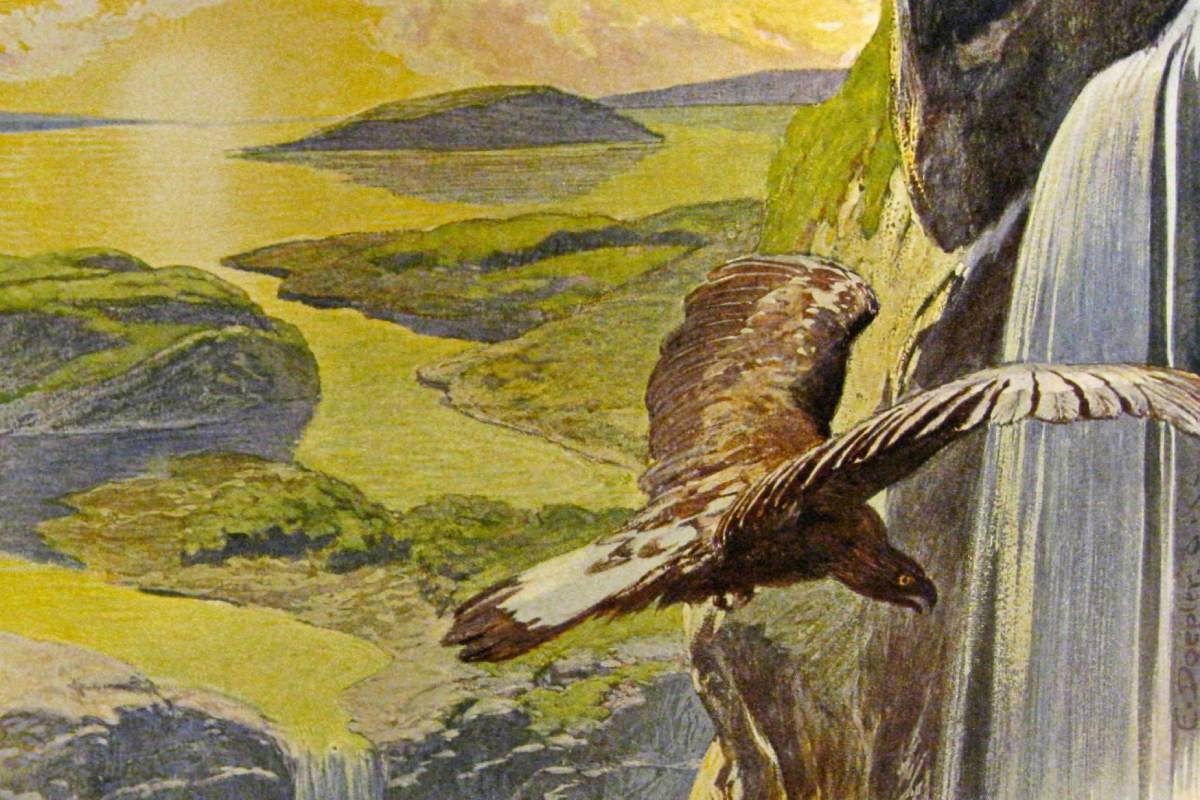
Turning to Stanza 59 now, we see that Earth, Midgard—the realm of we mere mortals—is reborn, emerging from the floodwaters that were said to have submerged our planet during Ragnarök. We have an incredible image of rebirth,
"...rising up a second time the earth from the ocean, ever-green; cataracts tumble, an eagle flies above, hunting fish along the fell."
A peaceful image of not only the rebirth of the earth itself but the natural world harmoniously going about life as normal.
The people from Viking societies, despite their lack of scientific knowledge compared to we moderns, were remarkably astute in realizing that however we humans (or Norse gods) attempt to destroy our world through malice or accident, the earth is remarkably regenerative.
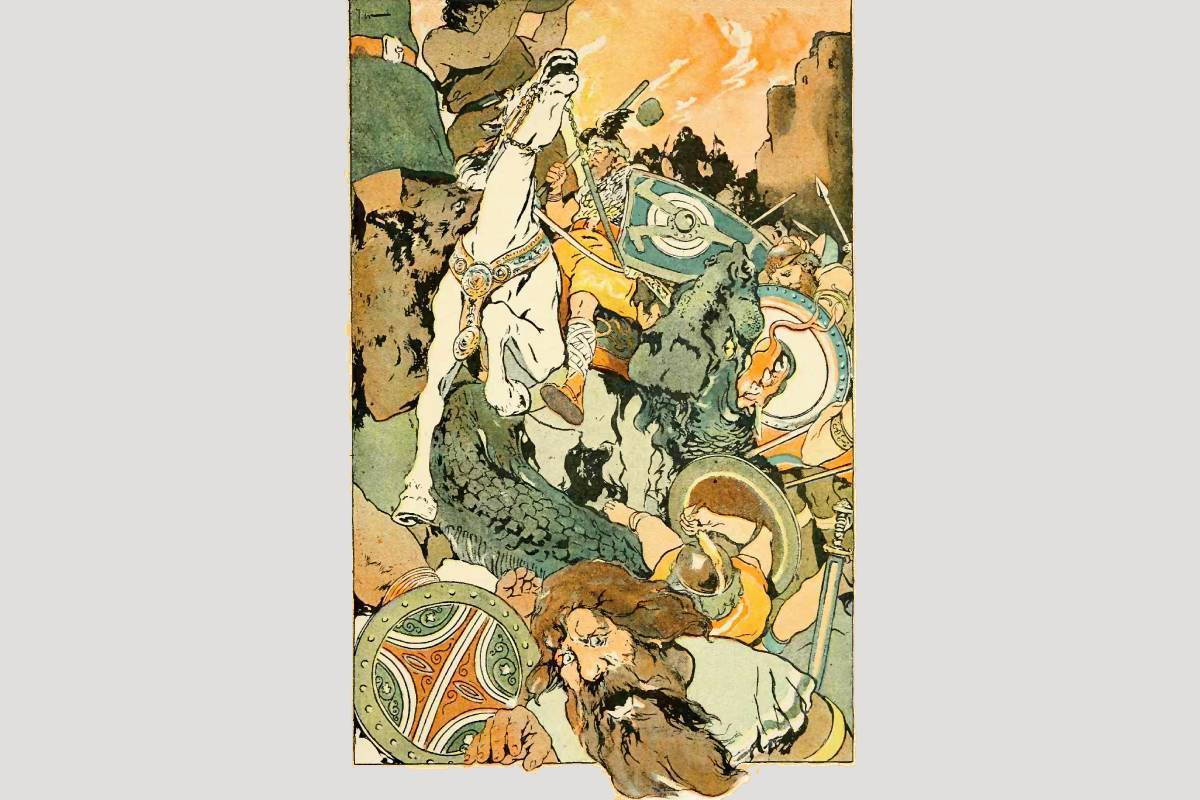
This 1908 illustration shows the Æsir's last stand against the forces of destruction at Ragnarök. Illustration: George Wright (1872–1951)
Christian overtones?
Yet, it is not just the natural world that is part of this new phase. Further down in the poem, we find that much of the Æsir—well, the ones that did not get slain or killed—will,
"...come together on Action-field, and pass judgment on the powerful earth-coil, earth-coil World-serpent and commemorate there the mighty events, and the ancient runes of Potent-god." [Stanza 60]
What is interesting is the inclusion of the fact that the gods will "pass judgment."
We know that the Poetic Edda, which includes the Völuspá, was compiled anonymously in 13th-century Iceland—long after the conversion to Christianity.
Snorri Sturluson, who wrote the Prose Edda, was very much a product of his times, and the general academic consensus is that he may have added Christian symbolism, motifs, and themes into what were "pagan" legends, myths, and stories.
The compilation of the "pagan" sagas themselves, whether by Snorri or others, was, as John Lindow writes about in his 2001 article in the journal Scandinavian Studies, actually "intended for...the needs of the Church."
This classic example of gods passing judgment following the end of times bears more than a striking similarity to Christian beliefs as specifically laid out in the "Book of Judgement."
Here, following the "rapture" (where all good people—alive or dead—get whisked up to Heaven), God and Jesus will then judge the remainder and cast most of them downward into Hell.
The best visual representation of this, known as The Last Judgement, is found on the ceiling of the Sistine Chapel, masterfully painted by Michelangelo.
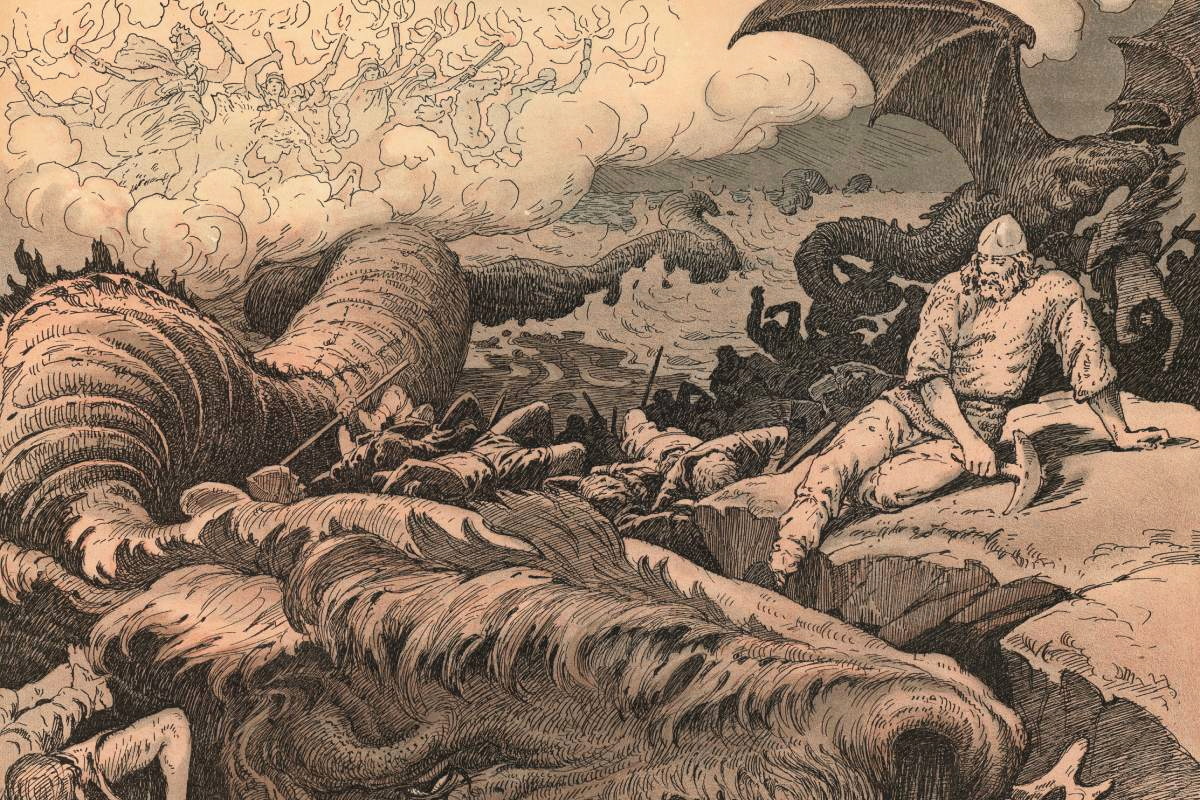
This illustration of Ragnarök comes from a Danish series of educational prints created in the late 19th century. Illustration: Louis Moe (1857–1945)
Vindication and hope for us all
Finally, spare a thought for the god whose death sparked all this fire, flame, and rebirth: Baldur. Despite his tragic death, he remains Lazarus-like in his ability to bounce back from being slain. Stanza 62 recounts how,
"...all harm will be healed, Baldr will come; Höd and Baldr will inhabit Hropt's victory, Hropt Odin halls, sanctuaries of the slain gods"
So not only does Baldur come back to life, but he also gets cushy new digs in the form of the halls of Odin. It's good enough to come back from the other side, but to also be given new housing—well, surely Baldur is the real winner of the events following Ragnarök.
Furthermore, given the tragic nature of his death, it is nice to see this golden god's luck change. This is something of a vindication for that golden god and hope for any of you, dear readers, who, you know, should get accidentally killed, triggering the end of times.
The events after Ragnarök show that this cosmic reset is part of the philosophical outlook of people from Viking societies. Death and destruction are not final and are followed by rebirth and renewal.
This outlook saw time as cyclical, with death and renewal entwined in a cosmic and eternal dance, and not in the strictly linear way we think today in the modern period.
For more information on the possible science behind Ragnarök, visit Popular Mechanics here.
We get to provide readers with original coverage thanks to our loyal supporters. Do you enjoy our work? You can become a PATRON here or via our Patreon page. You'll get access to exclusive content and early access.
Feel free to reach out to discuss potential stories that may be in the public interest. You can reach us via email at [email protected] with the understanding that the information you provide might be used in our reporting and stories.