

His life story, if the historical chronicles are indeed true, is a microcosm of what was going on in Anglo-Saxon England, the different societal, political, and religious forces pulling and pushing the local population following the arrivals of the Vikings and their usurpation of power.
York: Capital of the North?
The history of the Vikings in the British Isles starts as early as 789 CE, a raid on the Isle of Portland in the English Channel, there is no escalation in the size and scope of these predatory raids until about 865 CE.
What modern historians have dubbed "The Great Heathen Army" (never one but a series of differing Viking armies and invaders) sailed across the North Sea and began marching up and down the length and breadth of England, laying waste to all they could see.
These coalitions of Viking warriors (mostly but not exclusively comprised of Scandinavian warriors) would go on to battle, defeat, and then occupy all but one of the Anglo-Saxon kingdoms, Wessex.
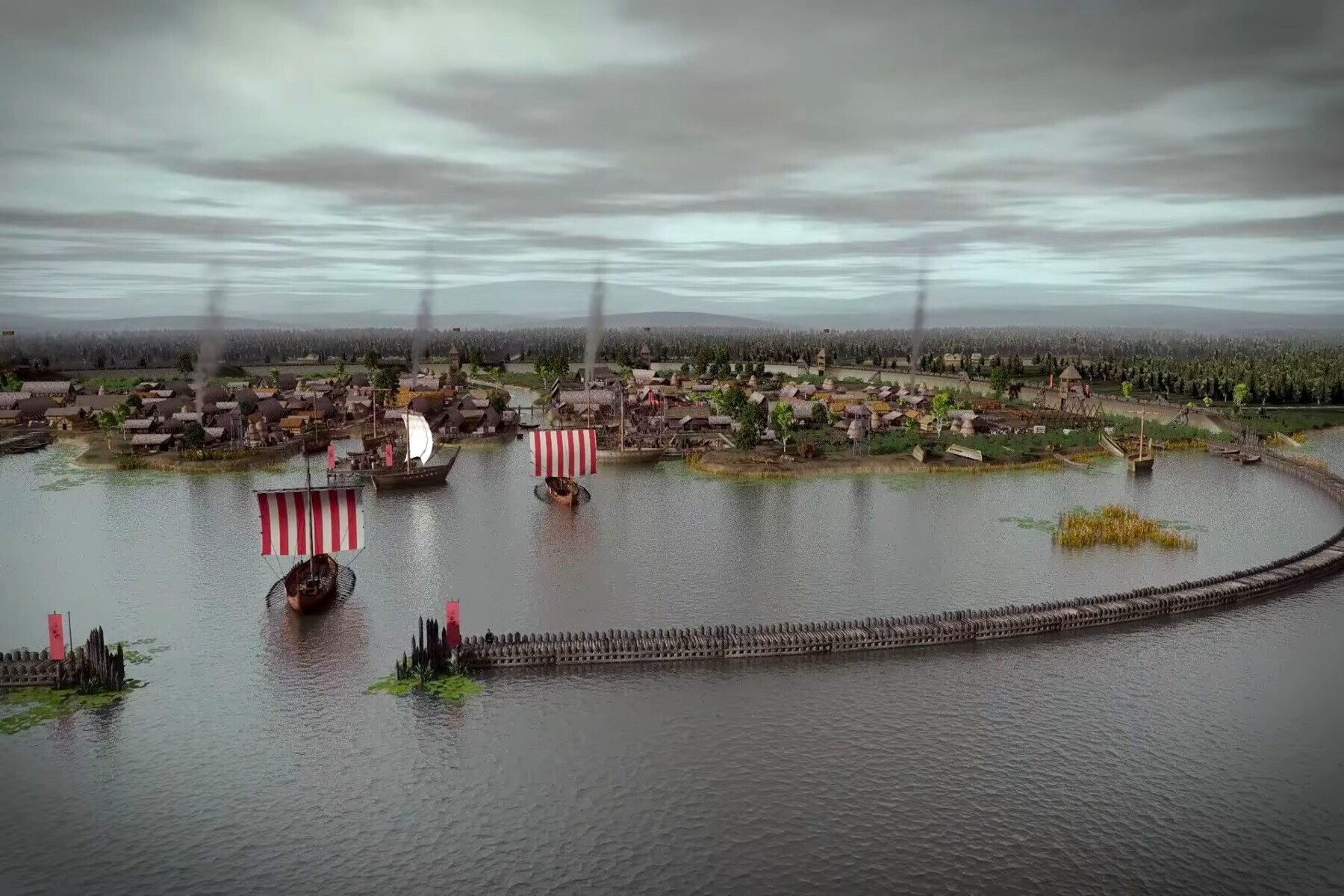
The Anglo-Saxon Kingdom of Northumbria, centered at the old Roman town of Eboracum (modern-day York), had been transformed into a bustling Anglo-Saxon trading port and renamed Eoforwic.
It was captured by Viking warriors in late 866 CE and was renamed (again) to Jórvik, the new capital of Viking control, stretching from the modern-day borders of Scotland all the way down to Cornwall.
This area became known as the Danelaw, the area where "Dane" (Viking) laws were followed on pain of death.
Slaving away
Much of what we know about the life of Guthred comes from the quill (a pen wouldn't be invented for almost another millennium!) of an English monk, Simeon / Symeon of Durham. Writing in the late 9th century CE, he chronicled the recent regal history – both Anglo-Saxon and Viking – of this northern area of England.
Simeon chronicled how, though the Vikings had indeed captured much of the Anglo-Saxon kingdom of Northumbria with much ease, holding it was another problem altogether.
The first Viking ruler of Northumbria was Halfdan Ragnarsson, a warrior about whom we have little information. What we know, unfortunately, is not flattering as Simeon recounted how the local Anglo-Saxon population chased out their new overlord.
The local population clearly did not enjoy being ruled by Halfdan, but they liked being leaderless even less.
Simeon wrote that a local abbot was visited, in a vision, by Cuthbert, an Anglo-Saxon Saint (who had once resided at the monastery on Lindisfarne). Holy Cuthbert advised the monk to seek out a slave who had been sold to a widow.
Let us pause our story here for a moment to remember that slavery was a huge part of Viking culture and society, and slave trading was one of the most significant economic motives that spurred the Viking expansion.
We have known the historically verifiable record of Guthred's birth, but this rather inglorious entry into the historical record would not be the last. It appears that he was of Norse (something akin to Nordic in today's sense) origin and sold into slavery as a child.
Guthred the slave
What can be historically verified, thanks in part to financial records, was that a Guthred was acquired by what appears to be an Anglo-Saxon nobleman named Æthelstan. Legend has it that this nobleman recognized young Guthred's leadership potential and set him free.
Whether Æthelstan had received any visits from a monk with a bizarre tale of a saintly vision, or if we take Æthelstan's kindness at face value is hard to gauge centuries after the fact, but it appears that Guthred was indeed set free coinciding (coincidentally or not, we may never know) with the toppling of Halfdan from the throne of Northumbria.
Aside from gaining his freedom, Guthred soon, through a combination of his apparent charisma and hard work, gained the trust and support of the local community. In fact, in little more than a year, he had filled the large void in the kingdom by ascending to the throne.
It seems that Cuthbert's foreshadowing had come to fruition, and a former slave became the second Viking King of Northumbria.

Though these Benedictine ruins are from a later period, Lindisfarne Island was the site of pivotal Viking raids during King Guthred's reign in Northumbria. Photo: givi585 / Shutterstock
Coronation conversion
Unfortunately, we have little of the coronation proceedings (unlike a contemporary English king) that Guthred underwent other than his supposed conversion to Christianity.
Like many of his Viking ancestors, especially in the 10th and 11th centuries CE, conversion to Christianity was a quick route to plug into a Europe-wide network of power and legitimacy.
Whilst he may indeed have had a change of heart, it is more probable that Guthred sought further legitimacy from the powerful Church structure, one of the few leftover remnants of Roman rule in Britain.
Guthred's coronation conversion – whether it was a genuine change of conscience or something more malign and Machiavellian – seems to have won him favor within the Church.
He sought closer ties, which ensured a powerful partnership that led to more than a decade of peace and prosperity. Strong alliances were pursued with religious and political leaders, who were brought in for advice and consultations, further ensuring Guthred's popularity.
Yet his Viking brethren posed to be his most significant existential threat.
A skilled warrior and negotiator
Whilst Guthred may have been a popular ruler, it appears that he ruled in an era of high instability.
Invasion by the Scots from the north, and other Viking warriors in England, from the south, saw him have to constantly fend off wave after wave of predatory invasions and expeditionary forces.
In fact, Saint Cuthbert enters the story again as he is said to have warned Guthred about the direction of the invasion of the Scots, vital information for their repellence.
He was also said to be as skilled off the battlefield as on it as he forged political and military alliances with Alfred the Great, King of Wessex, as well as his nemesis, a possible leader of the Great Heathen Army, Guthrum.
We know little of his downfall other than he died in 894 CE and secured a Viking legacy for the Kingdom of Northumbria for more than half a century after his death.
Today, he is best remembered as a fictional character in the Netflix series, The Last Kingdom, but his rag-to-riches story should perhaps be better known.
BBC History Extra has written more on the history behind the hit Netflix series, The Last Kingdom, available to read here.
We get to provide readers with original coverage thanks to our loyal supporters. Do you enjoy our work? You can become a PATRON here or via our Patreon page. You'll get access to exclusive content and early access.
Feel free to reach out to discuss potential stories that may be in the public interest. You can reach us via email at [email protected] with the understanding that the information you provide might be used in our reporting and stories.