

Being forced to flee his home in Norway, a royal exile on the run, after that fateful battle, he took up refuge and employment in the Kievan Rus. By the early 1030s CE, however, Hardrada was perhaps one of the most skillful and successful killing machines in the Viking world.
His employer, Yaroslav the Wise, a distant relation through marriage, had used Hardrada and his band of motley men in border campaigns against several enemies, including the Poles, the Pechenegs (a steppe people from Eurasia), and the Byzantines.
Whilst there is little record of how Hardrada fared against the Byzantines, he must have made an impression as he next appears in 1033 in Byzantine court records. With a horde of 500 men, he is noted to have emigrated to Europe's largest and grandest city, the new Rome, Constantinople.

The Hagia Sophia, an emblem of Harald Hardrada's early years as a Varangian guard, sets the stage for a saga that journeys through conquests and kingdoms. Photo: RauL C7 / Shutterstock
Miklagård
Though Hardrada was of blue blood and, in his youth, used to the privileged life of a European court, nothing could have prepared him for Constantinople.
This great city that straddled the Bosphorus was literally and metaphorically at the crossroads between Europe and Asia. Though it had been settled by Greek colonists in the 7th century BCE, the Roman Emperor Constantine had rebuilt, remade, and renamed the city in his image in 330 CE.
It was he who moved the Roman Empire's capital from Rome to this second Rome, strategically situated between Europe and Asia and between the Mediterranean and Black Seas.
When the Western Roman Empire fragmented into a series of successor states during the late 5th century CE, the Eastern part, with Constantinople as its center, went about business as usual.
The scale of everything in the city was impressive, from its population, estimated between 300,000 and 400,000 citizens, to its architecture.
This grandeur was encapsulated by the Church of Heavenly Wisdom, now known as the Hagia Sophia Mosque, which was built in 537 CE and held the title of the world's largest cathedral for nearly a millennium.
Its construction was said to have changed the course, and history, of architecture. The majesty of Constantinople and the Byzantine court made Kiev no doubt look like a backwater "Hicksville," with Norway being so insignificant as to be virtually unknown in this new second Rome.
Battling his way around the Byzantine world, Hardrada wasn't in Constantinople for mere sightseeing. Emigrating down to Constantinople, Hardrada was joining in a long Viking tradition of heading for Miklagard (Old Norse for The Great City) to make his fortune.
If there was one thing that the Byzantine Emperor needed, it was skilled warriors, as his empire always seemed to have a rotating array of enemies at the gates, be they Franks, the Huns, Goths, Arabs, Slavs, or the Rus.
Based on the multitude of skaldic poems and sagas chronicling the life of Hardrada, it is believed that he entered Constantinople under a cloak of anonymity and became a sworn soldier for the Varangian Guard.
This elite group served as the Emperor's personal bodyguards, but their loyalty could be somewhat questionable, given their frequent involvement in the political maneuverings and bloody disputes of the Byzantine court.
However, it is hard to imagine that Hardrada, already a great warrior, entered the service of the Byzantine Emperor unnoticed. Especially given the fact that he was said to have arrived in Constantinople, from Kiev, with a small retune of 500 men.
Yet Hardrada did indeed serve and serve well in the Varangian Guard. He rose through the ranks and was said to become the overall leader, the captain of this prestigious set of warriors.
In the first four years of the reign of Byzantine Emperor Michael IV (also known as Michael IV the Paphlagonian, a name shortened here for brevity and to avoid incorrect Greek pronunciation by the author), Hardrada is said to have fought across the Mediterranean basin.
He reportedly battled pirates, Bulgars, and Arab armies as distant as far away as the River Tigris. Furthermore, he participated in a campaign in Sicily against the Normans and was part of a Byzantine political mission to Jerusalem, combating bandits who targeted Christian pilgrims.
While we may never know if he "loved" fighting or what impact the trauma of taking part in an early medieval battle as a teenager had on his psyche, Hardrada remained an effective and efficient warrior and leader of men. He was, it seemed, born to battle.
The lure of the north
Though he may well lay claim to being one of the early medieval period's most ferocious, skillful, and successful warriors, navigating the intrigues of the Byzantine court was beyond even Hardrada.
Mirroring contemporary economic migrants to the "developed" world, Hardrada had sent a considerable amount of his accumulated wealth back to his adopted home, the Kievan Rus. Perhaps he felt that his treasure would be safer there because he had a familial connection to the ruling class.
We have no way of knowing how rich Hardrada's time in Constantinople made him, but if we are to believe the sagas, he raided the stores of the Byzantine exchequer three times.
Whilst Hardrada was accumulating a small fortune, he became entangled in Byzantine court politics as the death of Michael IV saw the ascension of his exiled enemy, who became Constantine IX.
A change in the regime saw Hardrada's patron's enemy become his enemy, and he just managed to escape to the Kievan Rus with his life and wealth.
Arriving back in his old stomping ground in 1042 CE, he married Elisabeth, the daughter of his old patron Yaroslav the Wise. The Viking connection was further solidified as Elisabeth's mother was the daughter of Swedish King Olaf Skötkonung.
The match appears to be one filled with love, as contemporary stories state that Harald had initially tried to marry Elisabeth before he made his name, and wealth, in Constantinople. Having married, Harald's next move was to acquire a kingdom, Norway. This was, he believed, his birthright.
Return of a king
Harald returned to Norway after almost 30 years abroad. Upon his return, the throne of Norway had been occupied by Magnus the Good, who was said to be an illegitimate child of Harald's half-brother Olaf.
After a long and complex series of negotiations and fights, Harald and Magnus agreed to a joint ruling of the kingdom. However, Hardrada always had his eyes on the bigger prize and was waiting for the perfect opportunity to outmaneuver his younger step-nephew.
From his return to Norway to his invasion of England (see below), roughly a two-decade period, Harald, though one of Europe's premier warriors, was very much an outsider in circles of Viking power.
This era, from the 1040s to 1060s CE, was the epoch of Viking power, with the "North Sea Empire" established by Cnut the Great having unified the thrones of Denmark, England, and Norway under his rule.
Harald, though technically the king of Norway for some of this period, could never transform the power and influence he had on the battlefield to the acquisition of power.
Between 1048 and 1066 CE, Harald was said to have tried to invade Denmark multiple times, every time winning a battle but ultimately failing to subjugate all of Denmark.
However, all was not lost, as events across the North Sea presented a perfect opportunity for the seizure of more power.
Securing his flank and keeping his eyes on the (English) prize
The next phase of Harald's life involved what has been called the "unification" of Norway, in which he gained his epithet, Hardrada (Old Norse for "Stern Ruler"). The powerful northern Norwegian barons, the Earls of Lade, were a constant thorn in many a king's side as they controlled the profitable northern trade routes.
To gain their loyalty, he married Tora Torabergsdatter, the scion of a powerful northern baronial family. With his northern flank and domestic opposition secured, Harald turned his gaze across the North Sea to Anglo-Saxon England.
By 1066 CE, the throne of Anglo-Saxon England was precariously in danger. The last king of the House of Wessex, Edward the Confessor, had died in January, and the throne was then passed to Harold Godwinson, who came from a prominent Anglo-Saxon family with links to the Danish king, Cnut the Great.
Not everyone was happy with Harold's succession. On his deathbed, a series of promises were supposedly made to different rivals for his throne, including William, Duke of Normandy, and Harold Godwinson.
Throwing his hat (or, more likely, sword) into the ring was Hardrada, who claimed the English throne through a 1038 CE agreement between Magnus the Good (his familial relation) and former Anglo-Saxon King Harthacnut, the son of Cnut the Great.
With Harold Godwinson now ruling as Harold II, this triggered Hardrada into action. He assembled a huge force of men, proclaimed himself the sole king of Norway, and sailed to the Viking outposts of the Orkney Islands, then part of Norway.
He ventured to Scotland, where the Scottish king provided him with 2,000 battle-hardened soldiers. Eventually, he landed in Tynemouth, in northern England, in early September 1066 CE, where his 200 ships unloaded more than 15,000 warriors.
He planned to march on London and seize the English throne.
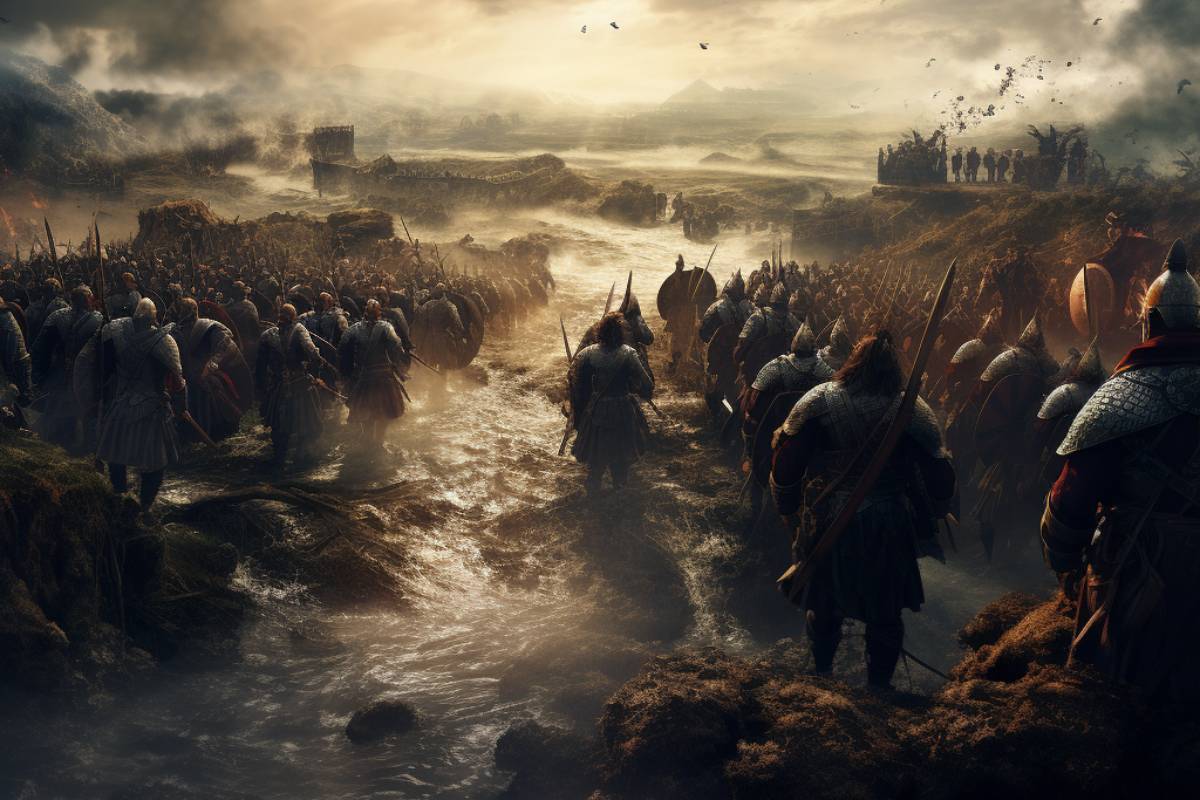
Harald Hardrada's final blaze at Stamford Bridge in 1066 CE marks the poignant end of the Viking Age, with the question of "what if" lingering through history... Illustration: The Viking Herald
Going out in a blaze of glory
Harald set about raiding and pillaging the northern areas of what had been once the Viking realm of Northumbria.
By September 20, the news of these latest Viking invaders had reached the ears of the local Earls of Northumbria, Morcar of Northumbria, and Edwin of Mercia, Harold's men in the north.
Assembling local troops, they met Hardrada's immense force just outside of the old Viking capital of Jorvik (York).
The battle was easily won by the Viking forces with Harold's estranged brother, Tostig, who won back the earldom that Morcar had been given upon his exile.
On the day York surrendered to the Vikings, King Harold II quickly assembled a force and sailed his men northward to land at what is now Tadcaster, some 10 kilometers / 6 miles north of York.
On September 25, Hardrada journeyed from his encampment with only a third of his vast force.
With the help of hindsight, we can speculate that Hardrada must have been unaware that an army under Harold was so nearby because not only was the Viking force that left their encampment that day small, but it was also lightly armored.
Probably Hardrada was leading a reconnaissance mission, expecting to meet only the pitchfork-armed citizens of York. He had agreed to meet a delegation at a town called Stamford Bridge. What he met, however, was between 10,000 and 15,000 of the finest warriors that Anglo-Saxon England could muster.
The epicenter of the battle, as one needn't be Sherlock Holmes to guess, was a bridge with the Viking forces on one side and the Anglo-Saxons on the other.
When Hardrada realized he was meeting more than slack-jawed yokels, he went about securing the small bridge with a shield wall. Legend has it that before the battle commenced, an unknown warrior on a white steed rode up to talk with Hardrada and Tostig.
The unknown warrior promised Tostig the return of his earldom if he sided against Hardrada on that day. Tostig declined and asked what his offer was for his companion, to which the unknown warrior cooly replied, "About six feet of English ground."
This warrior was said to be Harold II himself. Whoever said it, it was a marvelous retort, but, unfortunately, the historical jury is still out on whether it was the last crowned Anglo-Saxon King of England.
According to The Anglo-Saxon Chronicle, the Anglo-Saxons charged at the Viking shield wall that was providing a chokepoint on the bridge but were rebuffed countless times. Apparently, a huge Viking with a battle-axe was doing most of the damage, but his death proved to be a turning point.
The relentless attacks of Harold's men against a lightly armored Viking shield wall eventually saw the Vikings break. In true warrior style, Hardrada was said to have fought like a berserker and, as the Anglo-Saxon force flooded across the bridge, died with an arrow to the windpipe.
The Viking army routed and was mowed down so much that the field was said to be bleached for 50 years afterward from all the decomposed bones.
Harold II had secured his throne but would ultimately lose it just weeks later when another invader, William, Duke of Normandy, forced his tired warriors to rush down the length of England to meet on a battlefield near Hastings.
Hardrada's death at Stamford Bridge has traditionally been dated as the end of the Viking Age (initially dated between 793 – 1066 CE). His victory at Fulford, just days before Stamford Bridge, was the last time a Viking force defeated the English.
For a man who had escaped death on so many battlefields, it is unfortunate that his luck ran out on that day in 1066 CE. Had Harald won the day, could he have defeated William, Duke of Normandy?
Based upon their personal experience and martial skills, one may assume yes.
However, William had a considerable force, and even if Harald won an initial skirmish, William's supply chain was far less stretched than Harald's.
Harald Hardrada's life ended rather ingloriously with an arrow through the neck at Stamford Bridge. Yet for the era's most impressive warrior, he probably wouldn't have had it any other way, going out, with style, in a blaze of glory still luminescent almost a millennium later.
For more information on the Battle of Stamford Bridge, who better to turn to than the British Monarchy's official website here.
We get to provide readers with original coverage thanks to our loyal supporters. Do you enjoy our work? You can become a PATRON here or via our Patreon page. You'll get access to exclusive content and early access.
Feel free to reach out to discuss potential stories that may be in the public interest. You can reach us via email at [email protected] with the understanding that the information you provide might be used in our reporting and stories.