

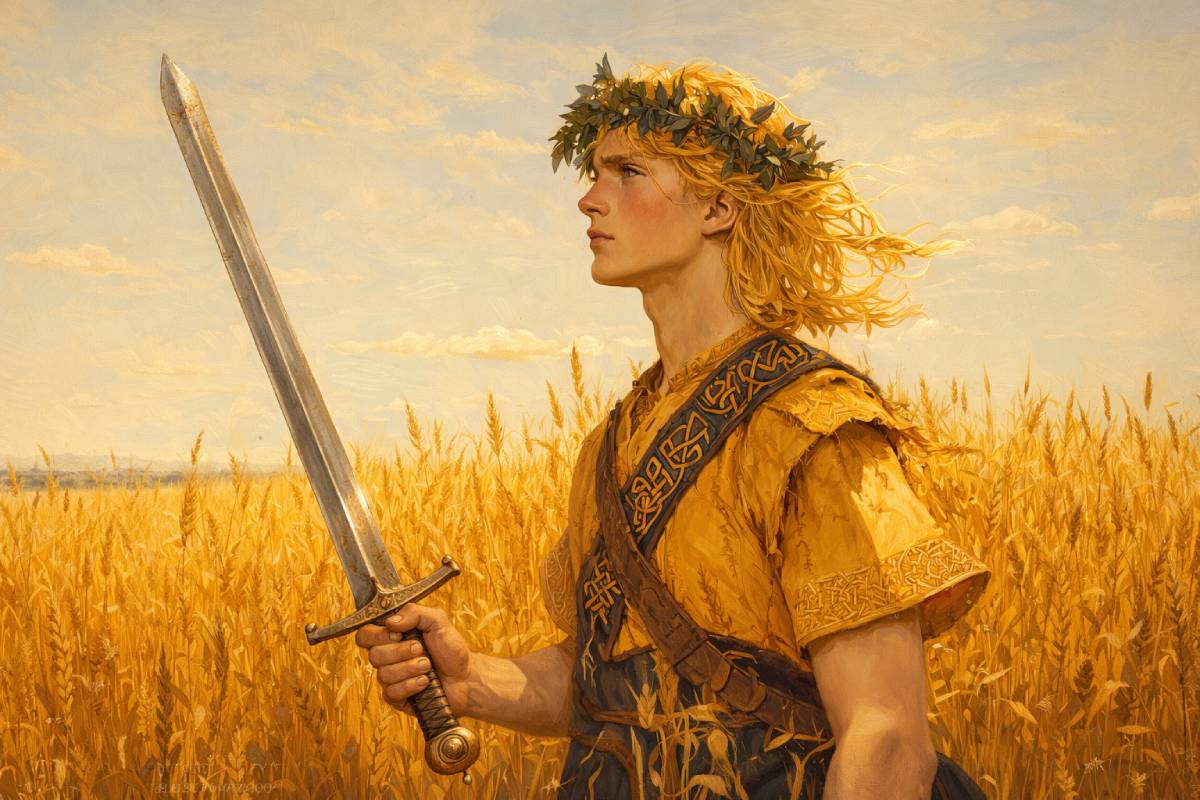
What is the stupidest thing you've done for love?
A quick scroll on Netflix tonight and you'll see a plethora of romantic comedies where hilarity ensues when stupidity acts.
At some point in our younger lives (or presently if, unlike the current author, you do not have any gray hairs and general lower back soreness), we've all been awkward teenagers trying to navigate love and life.
Yet whatever romantic faux pas or foot-in-the-mouth moments we've committed, they've seldom led to our own downfall and death.
This is exactly what happens to Freyr in Eddic and Edda-related tradition, especially Skírnismál, as he gives away a magical sword that would ultimately cause his tragic death.
Not only does Freyr eventually lose his life with this doomed deal, but it casts a dark shadow on his supposedly godly nature. Like many teenagers, he chooses love and lust over responsibility.
Let us delve into this tragic tale and the deal that doomed the Norse God of fertility and prosperity.
Love and sex
We know the Norse God Freyr was one of the most important deities in the two pantheons of Norse mythology. Said to be responsible for fertility, good weather, and thus prosperity, he was also associated with ruling, kingship, power, and the Swedish royal line.
As Jens Peter Schjødt writes about in his chapter, in the 2011 book News from Other Worlds: Studies in Nordic Folklore, Mythology and Culture, Freyr:
"...is connected to fertility, especially the sexual nature of it because it is through sex he bestows fertility...like sexual relations with produce fertility, the crops will flourish when fertilized."
And it is his sexual nature that we will come to later.
Aside from bedroom matters, Freyr also had more than a few cool toys, including a handy ship and a golden boar. However, for people in Viking societies, none was more impressive than a sword that was capable of fighting on its own.
So, why would Freyr be silly enough to give this awesome weapon? The answer is love.
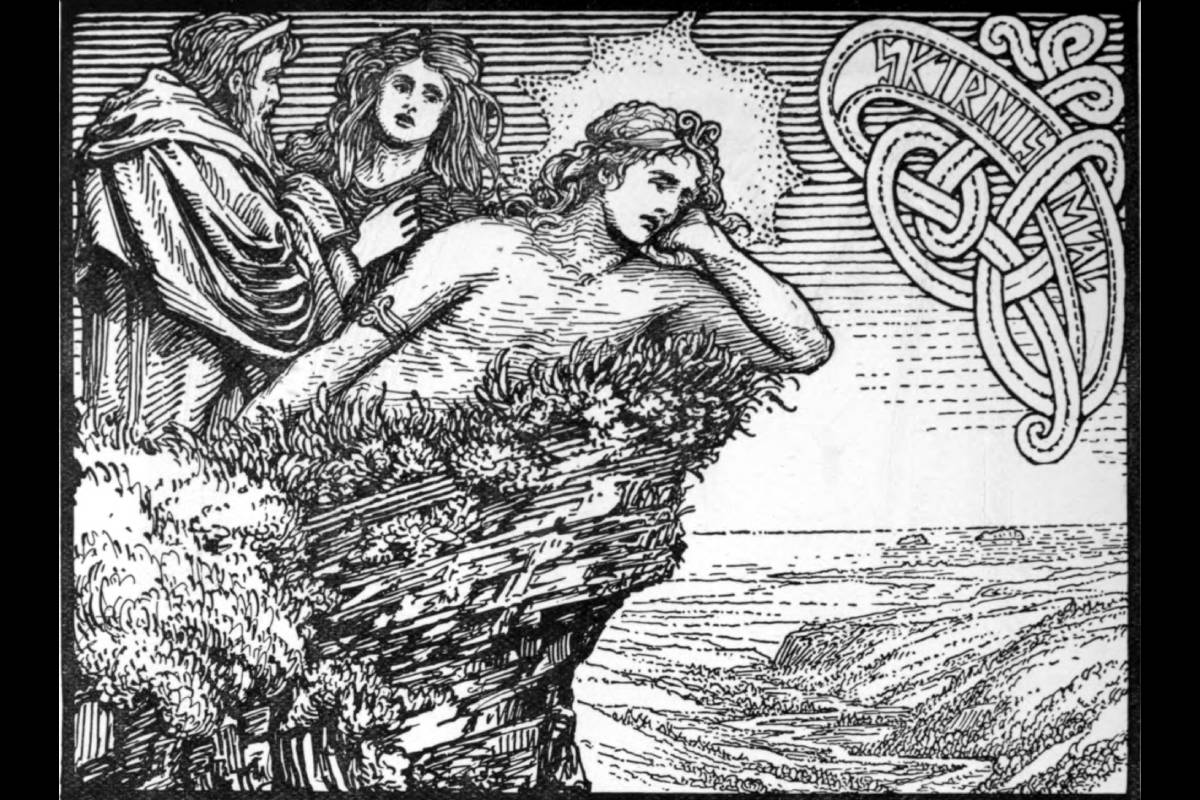
Freyr lies in lovesick despair as Skírnir stands nearby in this 1908 illustration from the Poetic Edda. Author: W.G. Collingwood (1854–1932)
Freyr and Skírnir
To track this episode back to its source, we begin with the Poetic Edda. In the Skírnismál (The Lay of Skírnir, we use an online version of the 1936 English translation by Henry Adams Bellows), one of the major poems contained in the Poetic Edda, we find that Freyr:
"...sat one day in Hlithskjolf, and looked over all the worlds.
He looked into Jotunheim, and saw there a fair maiden...
he felt a mighty love-sickness." [Introduction]
His servant, Skírnir, comes to see his forlorn master, and the two start conversing about the "fair maiden" that Freyr spied. It appears that Freyr is unable to do anything other than fawn over this maiden, named Gerðr, who he describes rather poetically as:
"A maiden dear to me; her arms glittered, and from their gleam. Shone all the sea and sky..." [Stanza 6]
Now, Skírnir, being a good servant, wants to help his lovesick master. He intends to bring this fair maiden to Freyr; however, she is no normal woman.
It turns out that Freyr has a soft spot for a girl from "Gymir's house," a giant who was the husband of Aurboða, and thus she is a jötunn (giant).
Skírnir devises a plan to cure his master of his gripping case of lovesickness by fetching the fair maiden, but he has a price.
The price of love
In a sense, what surely goes down as one of the worst transactions in Norse mythology, a deal is made between a lovesick master and his rather nefarious servant. Skírnir is willing to go and fetch Gerðr, asking for:
"... the horse that goes through the dark
And magic flickering flames;
And the sword as well that fights of itself
Against the giants grim." [Stanza 8]
Freyr not only hands over his noble steed but also his magical sword to his servant, who then rides off to whisk Gerðr back to his master. Yet this is not some romantic ride.
Gerðr is unwilling to be whisked away to placate some random man's request. Things turn decidedly heated when Skírnir threatens her with violence:
"Seest thou, maiden, this keen, bright sword
That I hold here in my hand?
Thy head from thy neck shall I straightway hew,
If thou wilt not do my will." [Stanza 23]
Eventually, he rides away empty-handed, but with a promise from Gerðr. She will meet Freyr in an enchanted forest, Barri, in nine nights' time. Freyr ends the poem with a mournful lament:
"Long is one night, longer are two;
How then shall I bear three?
Often to me has a month seemed less
Than now half a night of desire." [Stanza 43]
The lovesickness that Freyr feels has left him with a distorted sense of time.
We know that the number 9 was of great significance to people in Viking societies. There were 9 worlds in the Norse cosmos, and Odin was said to have hung from the great world tree, Yggdrasil, for 9 nights in order to gain the mysterious wisdom of the runes.
However, whilst the nine nights of Odin's ordeal brought wisdom, Freyr's would only lead to momentary gratification. Again, the parallels between Freyr and your average teenager are striking...
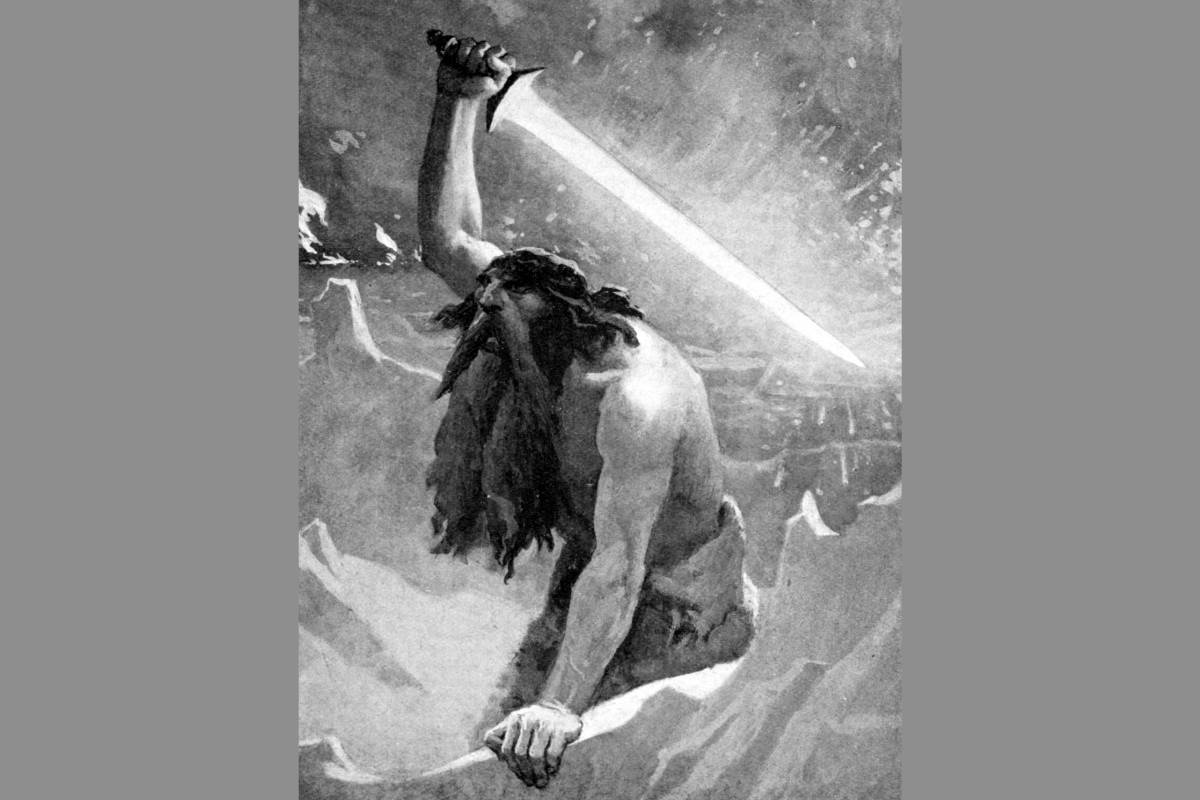
In descriptions of Ragnarök, Surtr is the fire giant who overcomes Freyr, who no longer has his sword. Author: John Charles Dollman (1851–1934)
Fighting fire with... nothing
Despite much of Norse mythology taking shape in a pre-Christian world, a moral lesson still emerges from the loss of Freyr's sword.
To trace this episode back to its source, we turn to Gylfaginning, part of Snorri Sturluson's Prose Edda. In the section that describes Freyr's courtship of Gerðr, Freyr gives his sword to Skírnir, even though it is a weapon that fights of its own accord.
The narrator remarks that this is a great privation for him, one that he will later regret. That regret becomes explicit in the account of Ragnarök. When the final battle is described, Freyr faces the fire giant Surtr without his sword, lacking the very weapon he once gave away.
This absence proves fatal, and Freyr falls in the struggle. By surrendering his sword to satisfy desire rather than duty, Freyr enters the last battle unarmed.
In a mythological world where order and chaos are inseparable, this choice costs him not only his weapon but his life.
For more information on the Norse deities, visit the BBC History Extra website here.
We get to provide readers with original coverage thanks to our loyal supporters. Do you enjoy our work? You can become a PATRON here or via our Patreon page. You'll get access to exclusive content and early access.
Feel free to reach out to discuss potential stories that may be in the public interest. You can reach us via email at [email protected] with the understanding that the information you provide might be used in our reporting and stories.