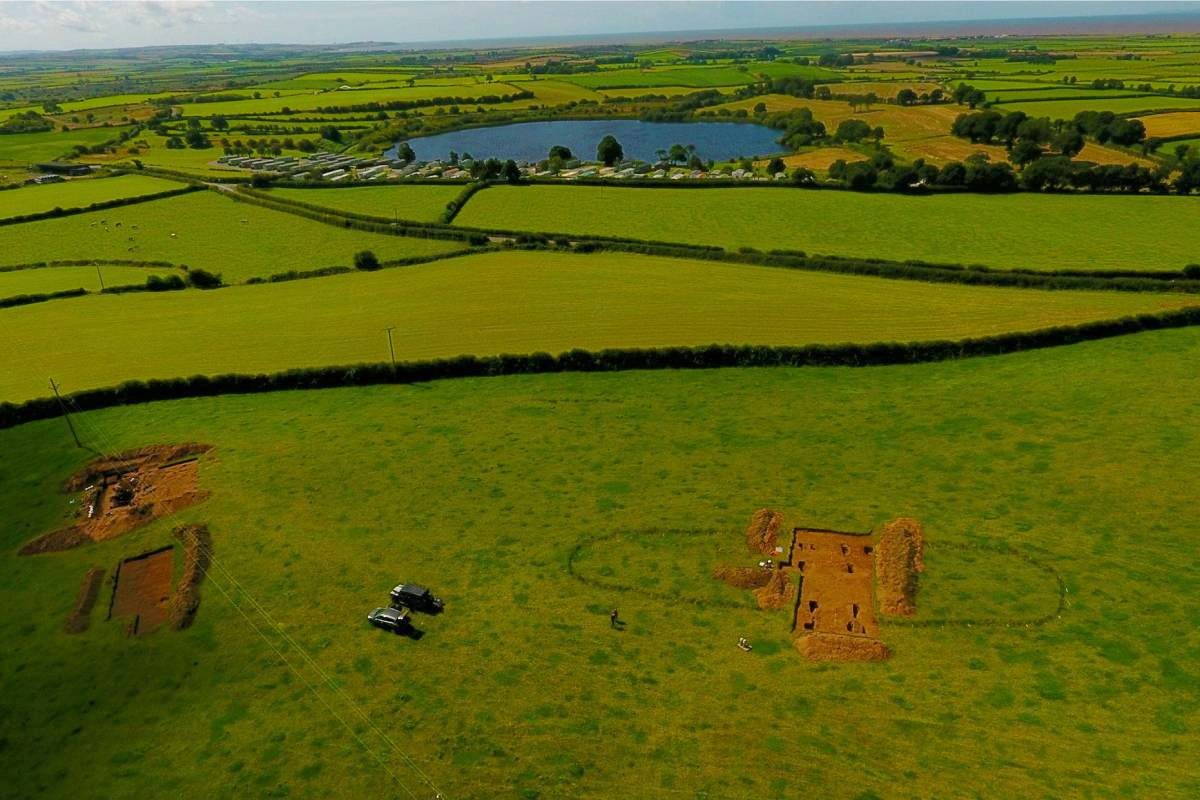


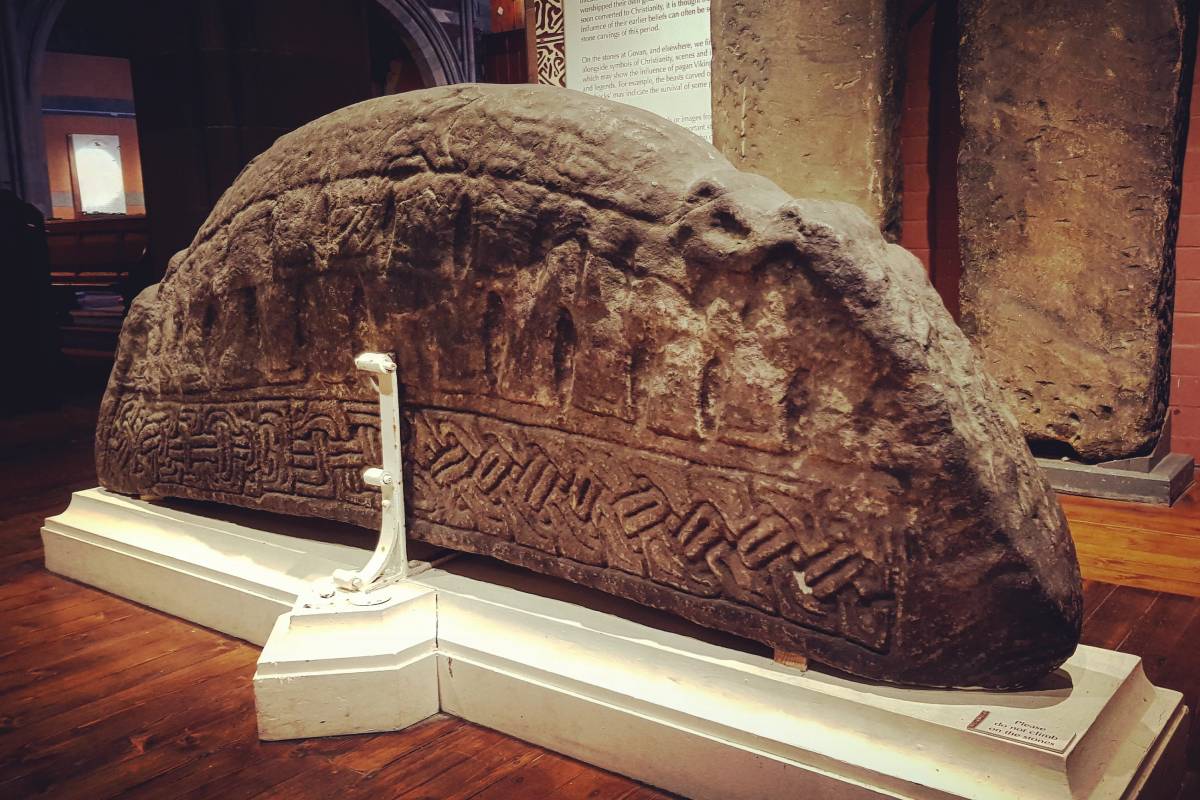
A recent find at the Tarns archeological site in Cumbria, England, indicates that the hogback—a special stone carving that resembles a Viking longhall—could have been based on local buildings constructed by the Norse.
But are hogbacks the same as the famous Govan stones in Scotland, which have become a noted symbol of Norse-Gaelic culture?
The Govan collection
The Govan stones have been described by a curator from the British Museum as "one of the best collections of early medieval sculpture anywhere in the British Isles."
Each of the 31 stone carvings was unearthed or found in the graveyard of Govan Old Parish Church in Glasgow, Scotland.
Perhaps the most famous item is an ornate sarcophagus discovered by gravediggers in 1855 that is thought to depict a royal saint killed by the Vikings in the 870s.
In time, further investigations have revealed a series of other stones, with the latest—the Govan Warrior—emerging in 2023 and featuring a carved inscription of a warrior with a circular shield.
Although the stones vary greatly in terms of content and design, they have all been dated to the Viking Age—the 10th and 11th centuries—and the influence of Norse art is clear throughout.
In addition to several monuments that depict the Christian cross, there are also five large carvings that closely resemble the iconic longhouses prevalent in Scandinavia in the Viking Age. It is these stones that are classified as hogbacks.
Hogbacks have been found in various other parts of Scotland, as well as Ireland and Wales, yet the highest concentration of the stones is found in the English county of Cumbria.
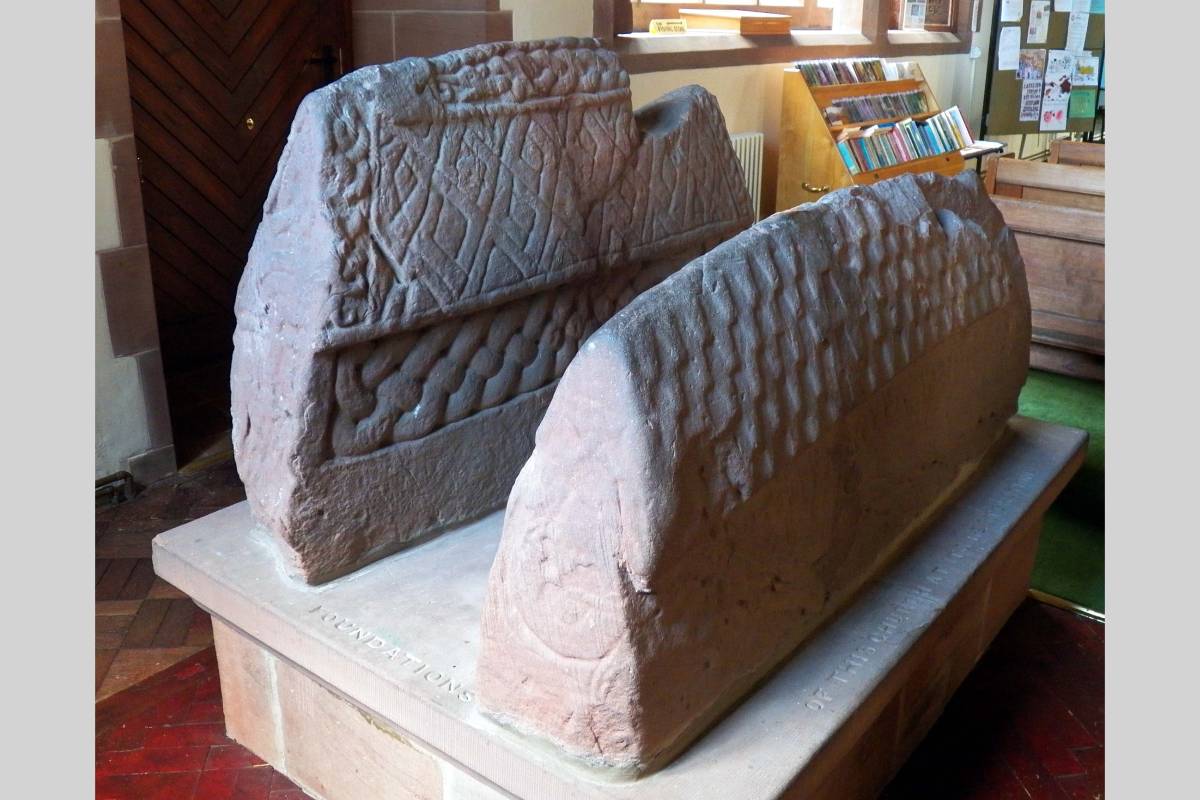
Hogback stones at Gosforth parish church in Cumbria show Norse influence on local burial customs. Photo: Doug Sim (CC BY-SA 3.0)
The Cumbrian connection
Just like the Govan stones, the Cumbrian variety has mostly been dated to the 10th and 11th centuries, with some examples thought to have been made in the 12th century.
While each hogback stone features a distinctive representation of a Viking-like hall, the Cumbrian hogbacks are generally slightly smaller in size—the largest Govan stone is some 2.4 meters long, whereas most Cumbrian hogbacks are 1.5 meters long or less.
As the British archeologist Mark Graham reflected in a recent conversation with The Viking Herald, hogbacks are closely connected to the history of Cumbria.
"They are real features of the Cumbrian region," he tells us.
"The designs on hogbacks vary—some are very ornately decorated with bears and zoomorphic designs, while others, such as at Crosscanonby, are more a simple depiction of a hall. One of the most well-known, at Gosforth, depicts the shield wall of a Viking army."
There are also a number of other hogback stones in the neighboring English county of Yorkshire, with the largest collection found at St Thomas's Church in Brompton.
Yet while the so-called Brompton type still resembles a house, the building is typically grasped by an animal or beast at either end. So, what is the connection between these parts of the British Isles?
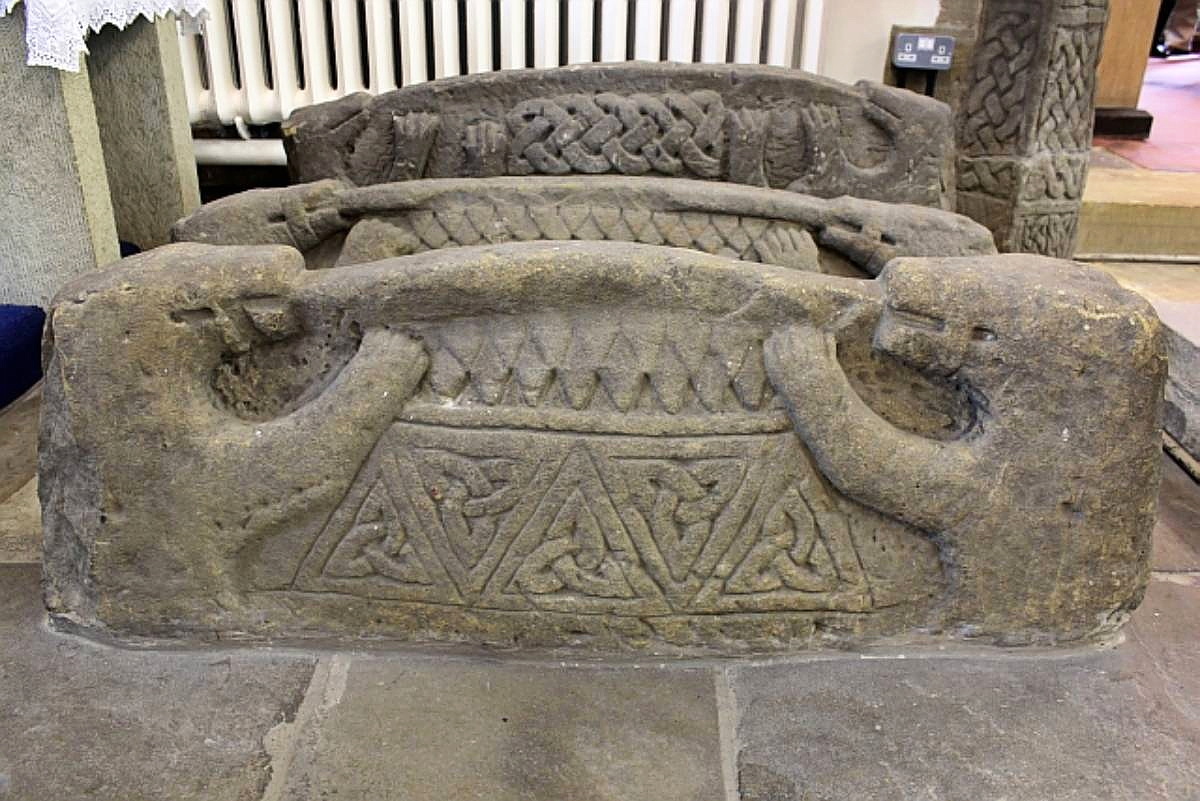
Brompton Church in North Yorkshire is home to the largest collection of Viking Age hogback stones in England. Photo: Bob Embleton (CC BY-SA 2.0)
Common bonds
The areas where hogback stones are found in the British Isles are all known to have been inhabited by the Norse during the Viking Age.
As noted above, each example also contains clear elements of Scandinavian culture, from the longhalls themselves to distinctive lattice patterns and depictions of serpents, bears, and dragons.
Tellingly, however, there have been no examples of hogback stones found in Scandinavia. In other words, the carvings likely originated in the British Isles, presumably as a result of cross-cultural interaction.
In terms of use and symbolic meaning, many experts believe hogback stones were used as grave markers for Viking chieftains or high-status individuals.
There has been debate, however, about whether these house carvings represented wistful depictions of former homes in Scandinavia or were perhaps a reference to Valhalla.
At the same time, a recent discovery of the remains of a Viking longhouse in Cumbria indicates the hogbacks may have simply been a reflection of the local architecture built by Norse settlers.
In any case, the hogbacks remain a clear representation of the symbolic power of the home, and also a cultural connection that extends from Scandinavia across northern England, Scotland, and beyond.
"I've only visited Govan once, but their hogbacks are essentially the same as we find in Cumbria," Mark Graham confirms.
"We are on the Solway Firth, which you might call a large fjord. Here, you have the Isle of Man out as a stepping stone to Ireland, with England and Scotland on either side of the fjord."
"Now, perhaps, we see this fjord as a boundary, but in the Viking Age, this was not the case—water was the main mode of transport, and the Firth provided a bridge from land to the next."
We get to provide readers with original coverage thanks to our loyal supporters. Do you enjoy our work? You can become a PATRON here or via our Patreon page. You'll get access to exclusive content and early access.
Feel free to reach out to discuss potential stories that may be in the public interest. You can reach us via email at [email protected] with the understanding that the information you provide might be used in our reporting and stories.