

Part of what makes Norse mythology ever popular with audiences more than a millennium after they were once told on a cold Nordic night is the universality of the themes therein.
These sagas were an attempt by people from Viking societies to explain the mysteries of the universe and the very human condition itself, and we are all the richer for it. Given that theirs was a society steeped in violence, mostly dished out by a small warrior minority, death features heavily in these ancient tales.
Whilst the stories around Valhalla are widely known today, there are other myths and tales involving the exploration of death and the afterlife found in the Norse sagas.
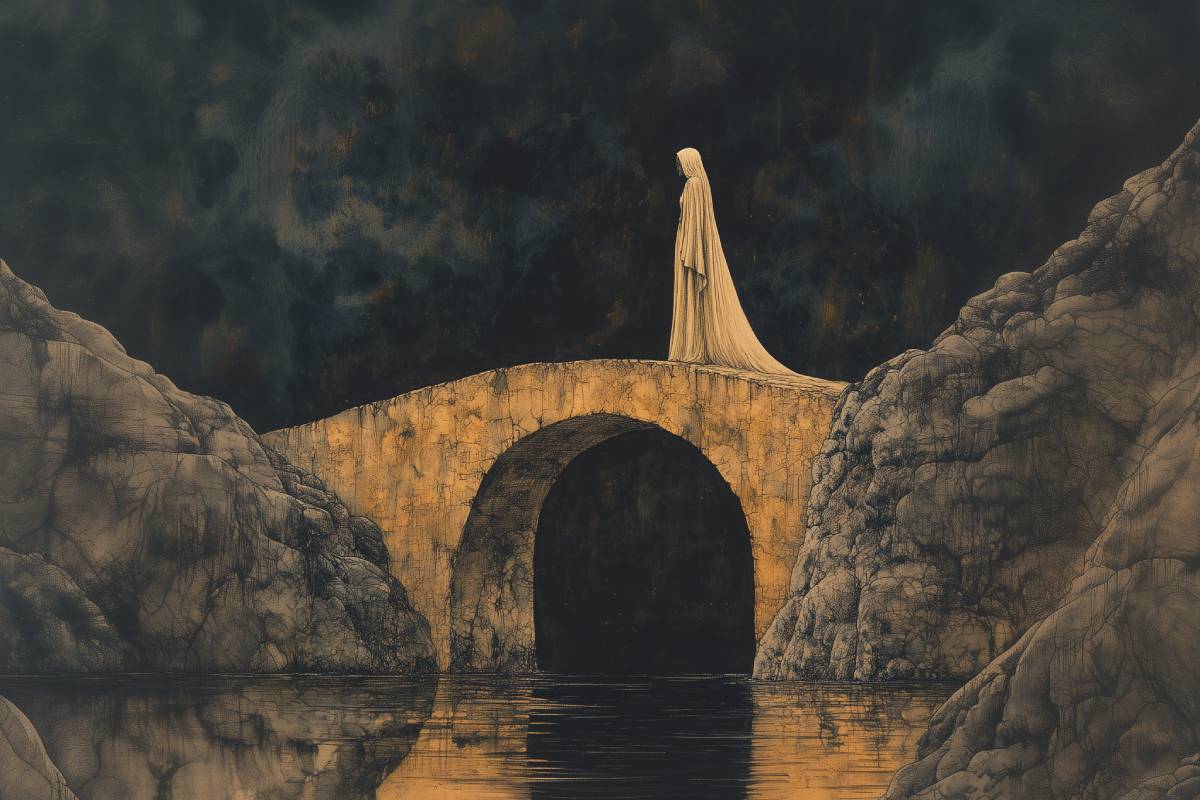
In the collection of mythical stories and sagas known as the Prose Edda, we find a tale about the journey of a Norse god to the bridge Gjallarbrú, which spans the mighty river Gjöll and separates the living world from the dead. Upon this bridge stands a mysterious guardian, Móðgudr, whose assistance the god requires.
These three elements – a bridge, a guardian, and a river separating life from death – speak to how people in Viking societies made sense of the journey into the afterlife.
A Golden Bridge
Whenever we need some aspect of Norse mythology explained, our first stop should never be a quick scroll but to the rich tapestry of the Norse sagas.
In the first part of the Prose Edda lies Gylfaginning (or, in English, The Beguiling of Gylfi), and it is here that we have the tragic details of the Norse god Baldur's death through Loki's scheming and treachery.
With the Norse gods distraught as Baldur has passed into Hel's realm, Hermódr journeyed to plead with Hel to return Baldur to the land of the living.
Using an online version of the 1916 English translation by Arthur Gilchrist Brodeur, we find that to reach the realm of Hel, Hermódr jumps on a horse and, "... rode nine nights through dark dales and deep..." to plead the case for the Golden God to return.
Following this extremely long road trip, he eventually spies:
"... the river Gjöll and [he] rode onto the Gjöll-Bridge, which bridge is thatched with glittering gold." [Stanza 49]
So then this is our only image of the bridge, and indeed the river itself: a bridge thatched with golden light, spanning the roaring river that divides the worlds of the living and the dead.
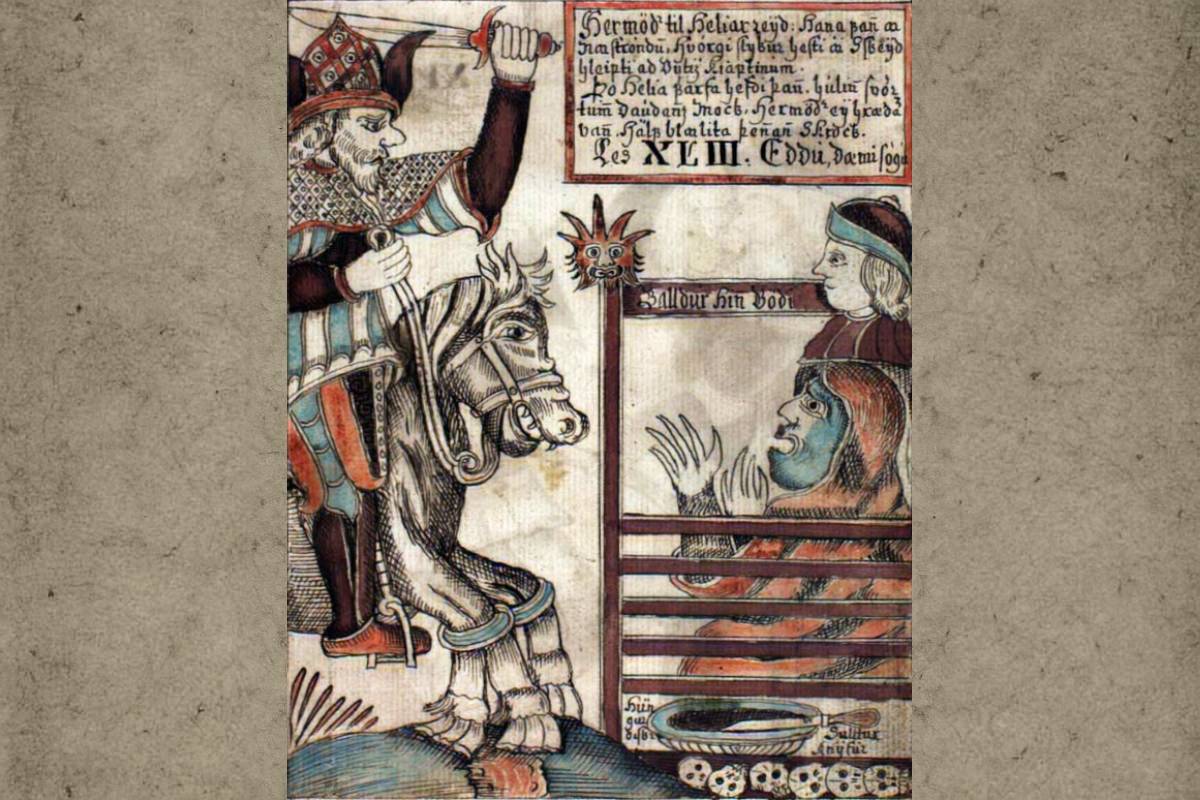
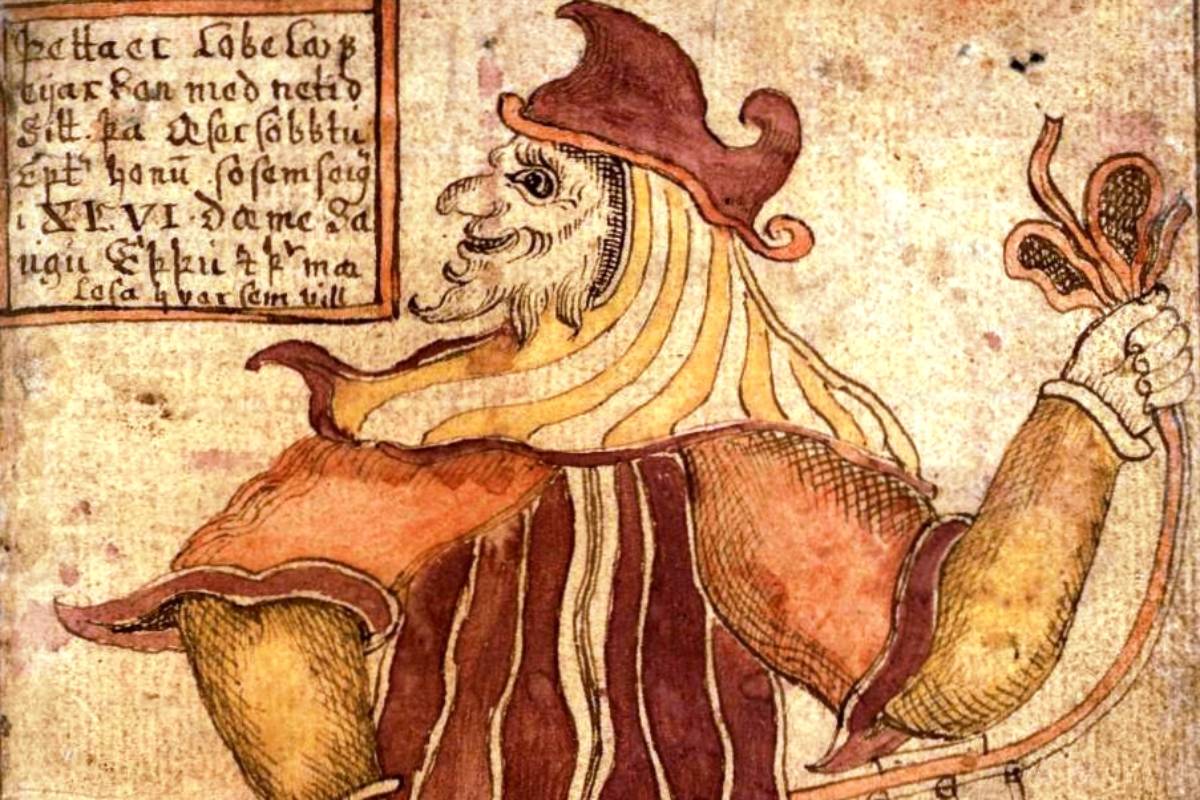
An illustration of Hermódr riding to Baldur in Hel, from an 18th-century Icelandic manuscript. Illustration: Public domain
A threshold guardian
We continue our journey with the Norse god Hermódr. Upon seeing this golden bridge that divides the realms of the living and the dead, he continues, but here he encounters a rather mysterious figure:
"Módgudr is the maiden called who guards the bridge; she asked him his name and race, saying that the day before there had ridden over the bridge five companies of dead men; but the bridge thunders no less under thee alone, and thou hast not the color of dead men." [Stanza 49]
We have the presence of a guardian who keeps watch over the Gjallarbrú, the entry point into the Norse afterlife. Now this appears to have been a rather busy time for Hermódr to journey here, as Móðgudr exclaims how "five companies of dead men" had crossed the bridge (died) the day before.
As Hermódr does not appear to have died, she confronts him and asks:
"Why ridest thou hither on Hel-way?" He answered: "I am appointed to ride to Hel to seek out Baldr. Hast thou perchance seen Baldr on Hel-way?" She said that Baldr had ridden there over Gjöll's Bridge, "but down and north lieth Hel-way..." [Stanza 49]
We know little else about this guardian maiden beyond her brief appearance at the bridge, yet it is enough to establish her as a symbolic threshold – the point at which the living are recognized and questioned before crossing into the realm of the dead.
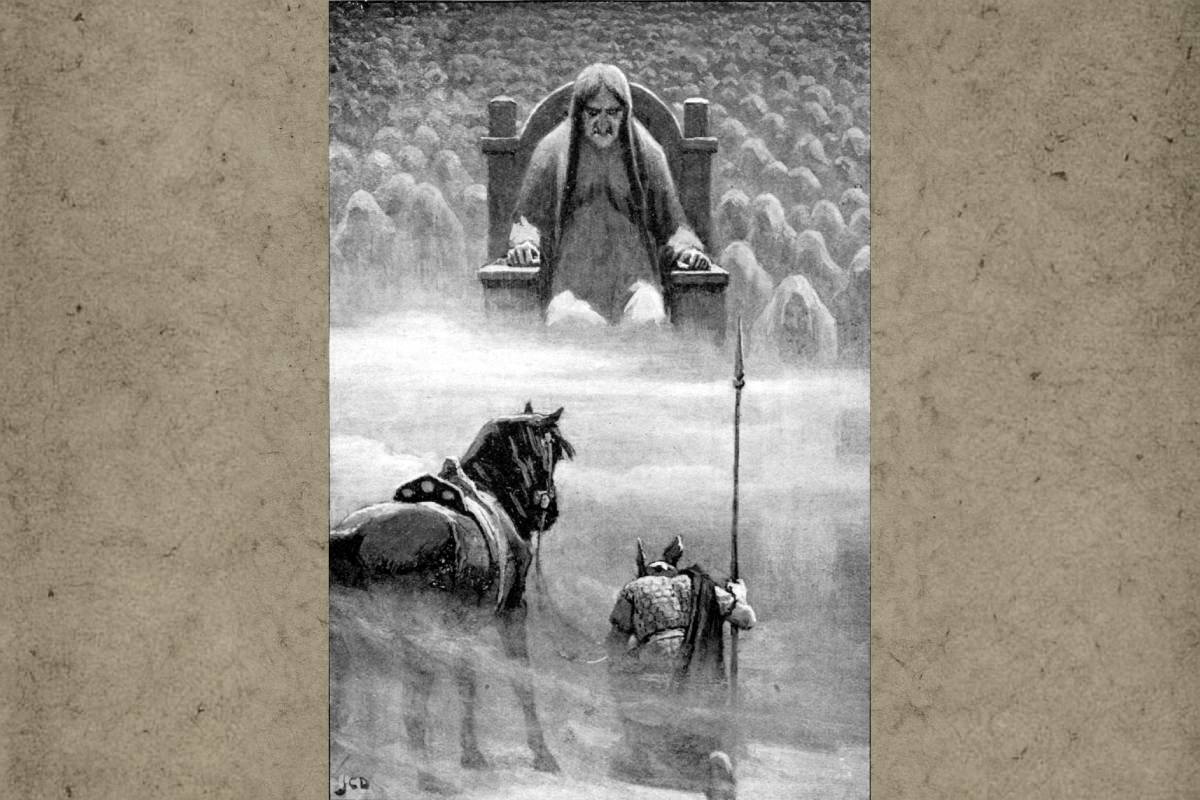
An illustration titled "Hermódr before Hel," published in "Myths of the Norsemen from the Eddas and Sagas." Author: John Charles Dollman (1851–1934)
Links to world mythologies
We know that Norse mythology was influenced by more ancient cultures and societies.
The sagas and stories that people in Viking societies regaled each other with – which formed the basis of what we call Norse literature and mythology – stemmed from earlier, more ancient tales told by their cultural ancestors from Germanic societies.
These, in turn, were influenced by earlier Indo-European tales. Thus, Gjallarbrú and Móðgudr may have been influenced by stories from earlier societies and cultures involving the journey to the afterlife.
As Michael Berman writes in his 2012 book, A Bridge to the Other Side (availabl on Amazon here), we find numerous references to "a bridge between heaven and earth, between this world and the next... in the mythologies of many different peoples."
Amongst them are a river and a threshold guardian over a river that separates the worlds of the living and the dead in Greek (the river Styx and Charon) and Hindu (the river Vaitarani) mythologies.
In the Norse sagas, Gjallarbrú and Móðgudr – though only with the briefest of mentions – serve as a reminder that crossing into the afterlife requires recognition and permission. Even in death, people from Viking societies felt that they needed guidance to reach the realm beyond.
For more information on the Viking afterlife, visit BBC History Extra here.
We get to provide readers with original coverage thanks to our loyal supporters. Do you enjoy our work? You can become a PATRON here or via our Patreon page. You'll get access to exclusive content and early access.
Feel free to reach out to discuss potential stories that may be in the public interest. You can reach us via email at [email protected] with the understanding that the information you provide might be used in our reporting and stories.