


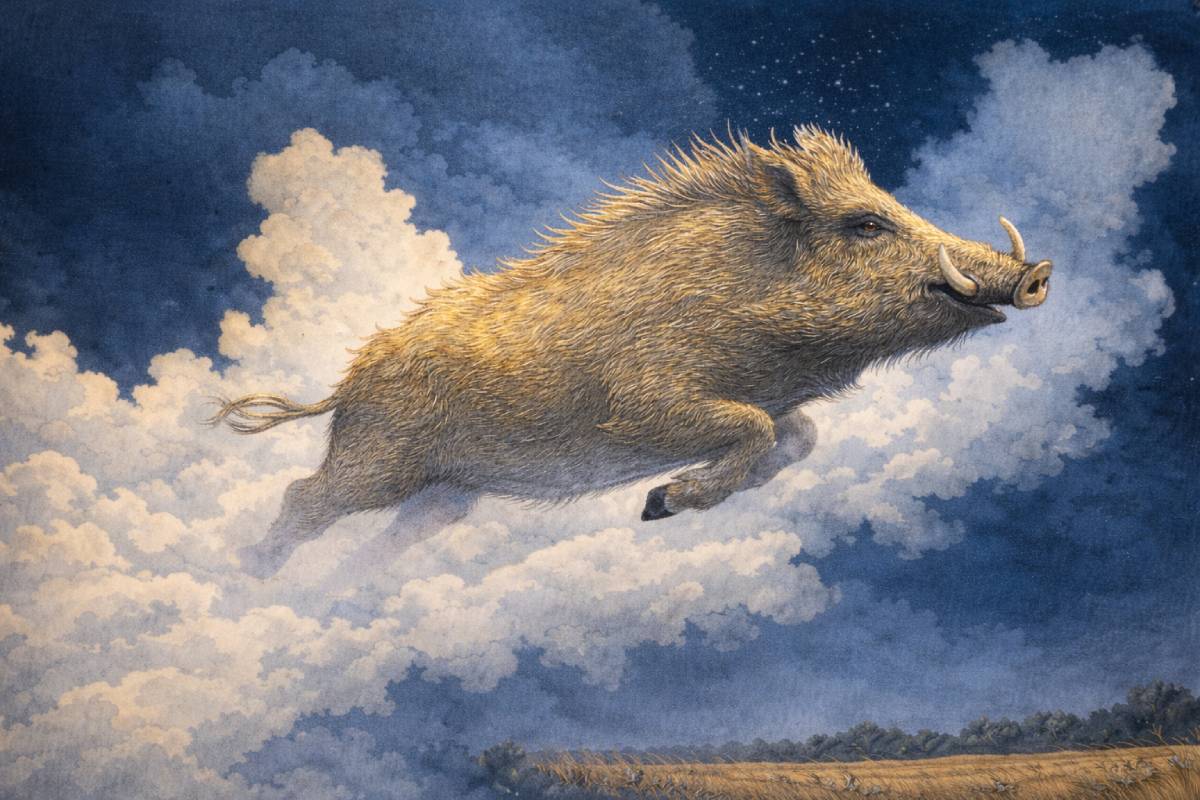
For all you Viking aficionados and lovers out there, like us here at The Viking Herald, you'll be miffed daily that boar isn't more widely consumed in this modern world.
Throughout Old Norse literature – Eddic poems, skaldic verse, and the Icelandic sagas – and indeed wider European legendary and mythological traditions, there was no greater sight for a hungry crowd than a boar that turns on a spit over a fire.
Boar was a meat fit for the highest chieftain or monarch, but also much loved by the common foot soldier or most humble farmer.
People from Viking societies knew a thing or two about the deliciousness of a boar, so much so that the stories they told each other put these succulent swine front and center.
In one of the most vivid scenes of food and feasting found in Old Norse poetry, we have a passage on the preparation of a magical boar, Sæhrimnir (Old Norse for "the blackened").
This scene, from the Grímnismál (one of the major poems in the Poetic Edda, and widely circulated in English via a 1936 translation by Henry Adams Bellows), shows the cook of the Norse Gods, Andrimnir, at work:
"In Eldhrimnir Andhrimnir cooks
Sæhrimnir's seething flesh,--
The best of food, but few men know
On what fare the warriors feast." [Stanza 18]
Aside from a tasty snack as "the best of food", boars were animals that had a deep symbolic and spiritual meaning to people in Viking societies.
Aside from the magical Sæhrimnir (whose flesh grew back the next day, no matter how much the Norse Gods chomped on it when cooked), we find two more memorable boars who speak to people from Viking societies' notions of authority, divine power, and prosperity.
As Bo Gräslund argues in the chapter "Swine, Swedes, and Fertility Gods" in the 2020 edited volume Making the Profane Sacred in the Viking Age (available on Amazon here), boars were seen by people in Viking societies as "the king of animals."
Two in particular stood at the nexus of mythological majesty and royal authority.
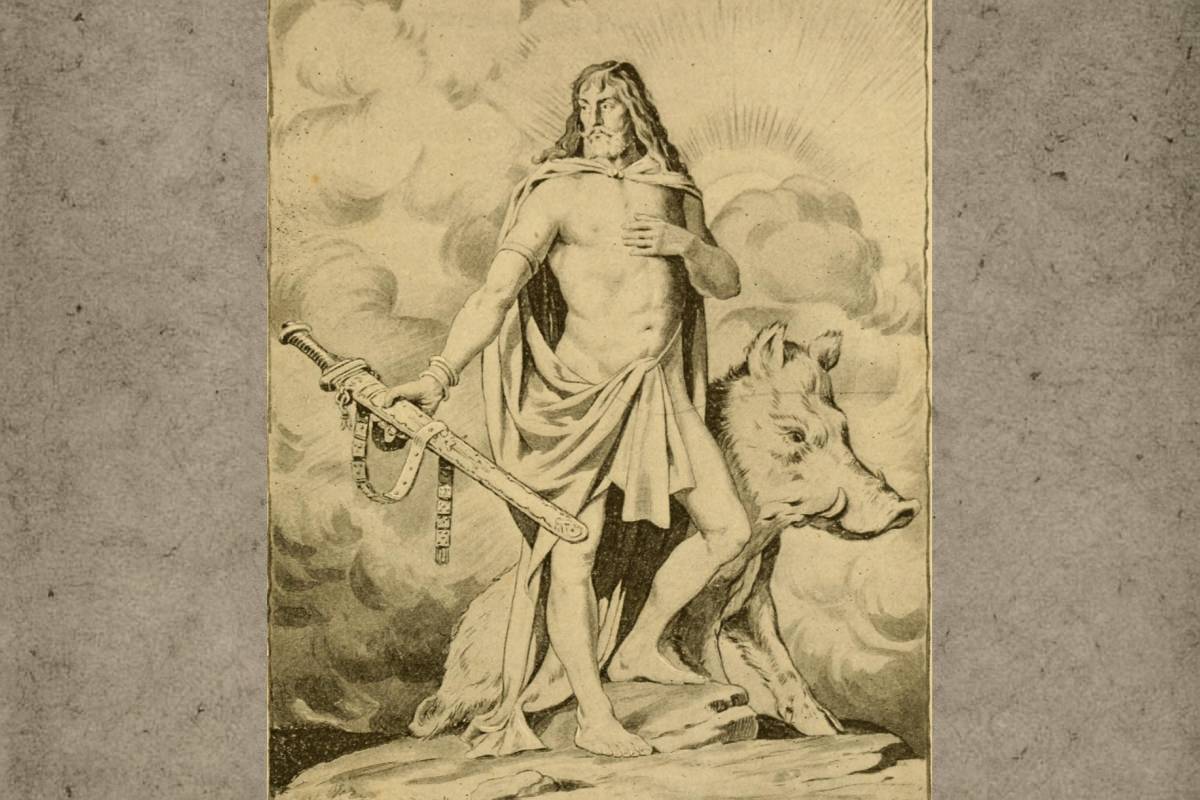
The Norse god Freyr and his boar Gullinbursti. Author: Johannes Gehrts (1855–1921)
Golden and radiant
Loki is one of the most fascinating characters in Norse mythology due to his ambiguous, dare we say duplicitous, nature. Sometimes friend, sometimes foe of many of the Norse deities, his shenanigans sit at the heart of many Old Norse stories.
Having commissioned master dwarf craftsmen to construct some of the most impressive accessories in the Norse cosmos, Odin's spear, Sif's golden hair, and Freyr's magical ship, Loki makes a bet with two other dwarves, Brokkr and Sindri, that they cannot fashion wares of such quality.
This tale appears in the Skáldskaparmál section of the Prose Edda. Using an online version of Arthur Gilchrist Brodeur's 1916 translation, we find that the brothers get to work quickly:
"Sindri laid a pigskin in the hearth and bade Brokkr blow, and did not cease work until he took it out of the hearth." [Skáldskaparmál, ch. 35]
After skillful but quick work, they fashioned a golden boar with bright bristles. Presenting it to Freyr, they told the Norse God that this golden boar could:
"...run through air and water better than any horse, and it could never become so dark with night or gloom of the Murky Regions that there should not be sufficient light where he went, such was the glow from its mane and bristles." [Skáldskaparmál, ch. 35]
Needless to say, Loki lost the bet.
The golden brilliance of Gullinbursti (literally "Golden Bristles") embodies the concept of hamingja, that is, the transferable luck and success that marked a successful ruler (be they chieftain, monarch, or even a Norse God).
Much of this success was measured by material prosperity, and through Gullinbursti, we can see Freyr presented as a rightful and effective figure of authority.
We find Freyr riding Gullinbursti to the funeral of Baldr, a sign that in moments of great loss and tragedy, divine authority endures, helped by the golden force of hamingja.
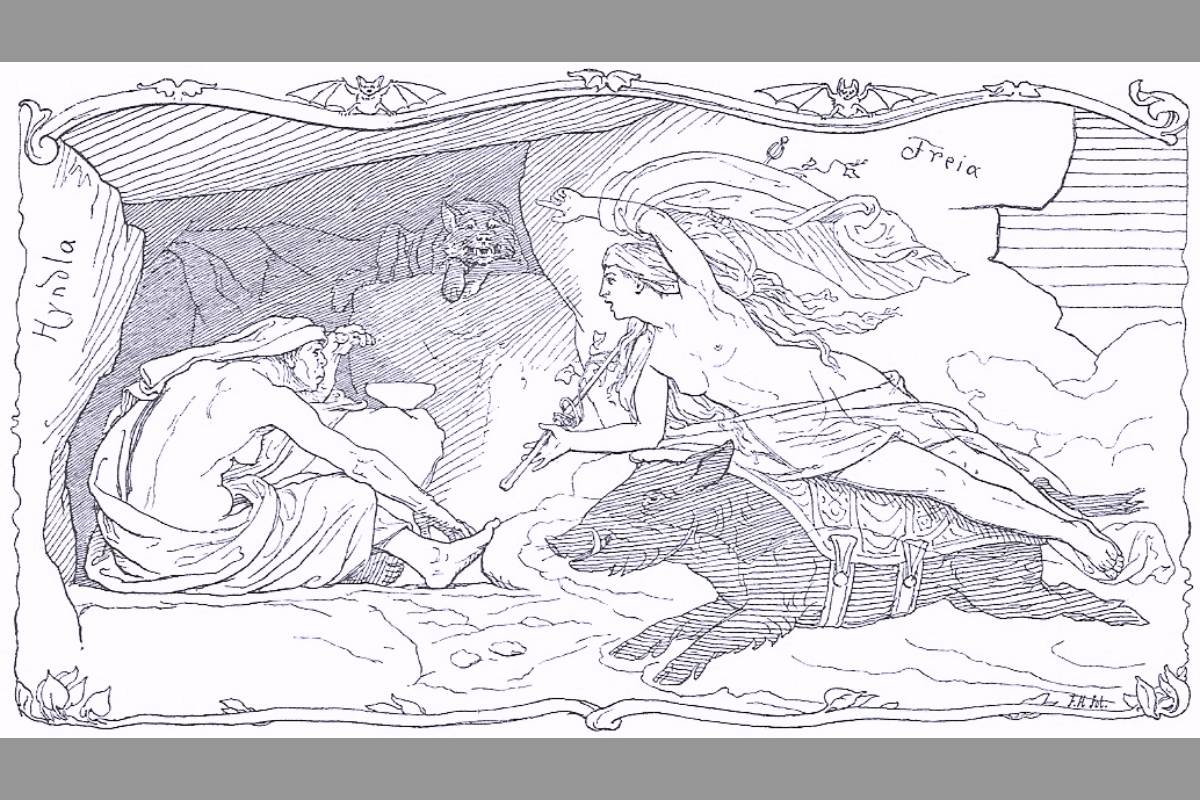
Freyja rides her boar Hildisvíni to visit Hyndla, as described in Hyndluljóð. Author: Lorenz Frølich (1820–1908)
More than just a war hog
Not to be outdone, Freyja, the Norse goddess associated with fertility, love, and (paradoxically) war, also had the aid of a magical boar to ride upon.
However, whilst Gullinbursti was born out of a wager, Freyja's boar had a far more utilitarian purpose: it was to be ridden upon to wage war. Essentially, this was a sort of early medieval transport that, even in Old Norse sources, stands out for being unique.
If we turn to one of the more obscure poems in the Old Norse literary canon, Hyndluljóð (Old Norse: "The Lay of Hyndla"), we find a brief appearance of Freyja's war hog.
Using an online version of the 1936 English translation by Henry Adams Bellows, Freyja exclaims:
"From the stall now one of thy wolves lead forth,
And along with my boar shalt thou let him run;
For slow my boar goes on the road of the gods,
And I would not weary my worthy steed." [Stanza 5]
Here, her boar is named Hildisvíni, which is Old Norse for "The battle swine". As the passage shows, it is indeed a "worthy steed" for a Norse deity.
This scene reinforces the authority and rule of Freyja; she has command not only over wolves but over a warlike boar, too.
She decides to protect her boar, her concern for its endurance highlighting how this is more than just a war hog; it is indeed a fit mount to travel "on the road of the gods".
With Freyja, a Norse goddess associated with war, riding this boar, it helps to underscore the links between that animal and its status, for people in Viking societies, as a sacred and war-linked symbol of might and right.
Differing aspects of Norse golden power
By analyzing these two magical boars, one made to shine and glisten, and the other a noble martial steed, we can see how highly regarded this animal was by people in Viking societies.
By forming close relationships with two different Norse deities, boars can be seen as divine status symbols that help govern, rule, and wage war.
For more information on the complex relationship that people from Viking societies had with animals, visit Science Norway here.
We get to provide readers with original coverage thanks to our loyal supporters. Do you enjoy our work? You can become a PATRON here or via our Patreon page. You'll get access to exclusive content and early access.
Feel free to reach out to discuss potential stories that may be in the public interest. You can reach us via email at [email protected] with the understanding that the information you provide might be used in our reporting and stories.



_(14801561533).jpg)
