

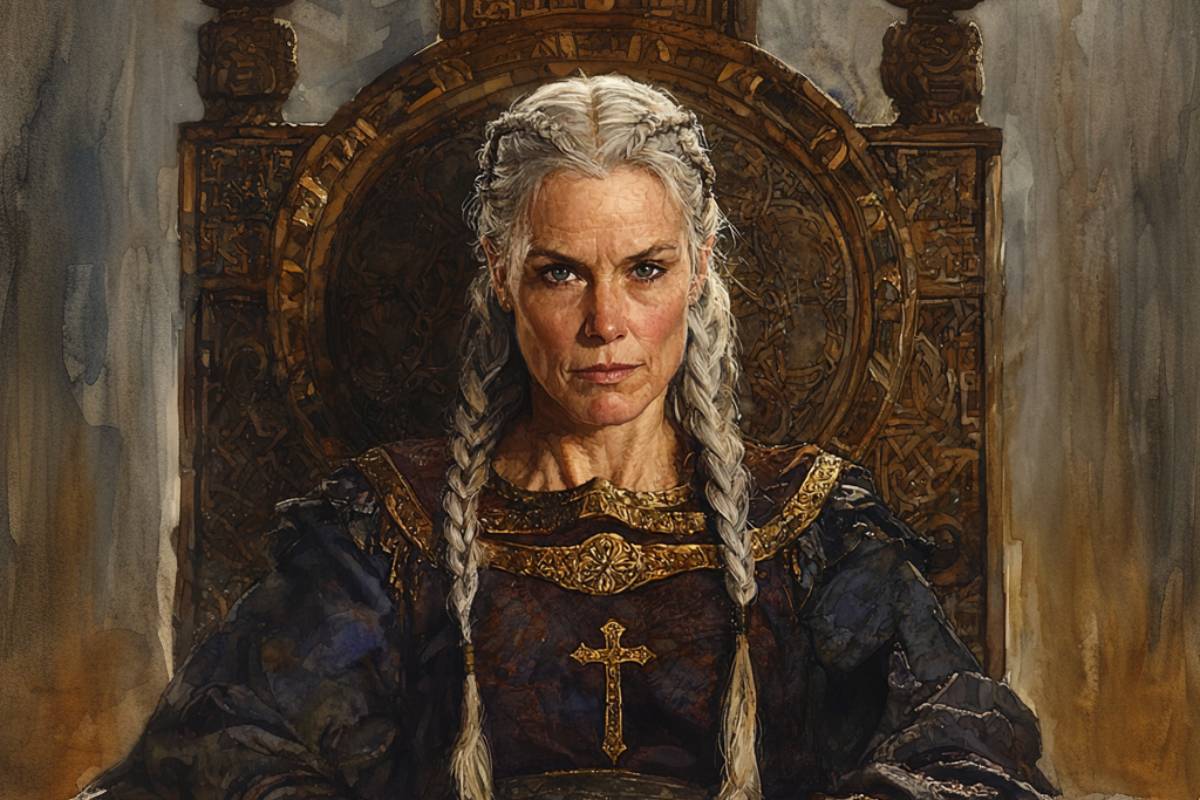
We continue now with the remarkable story of Princess Olga of Kiev, picking it up after the murder of her husband on campaign against the Derevlians. If you missed the beginning of her story, you can read Part 1 here.
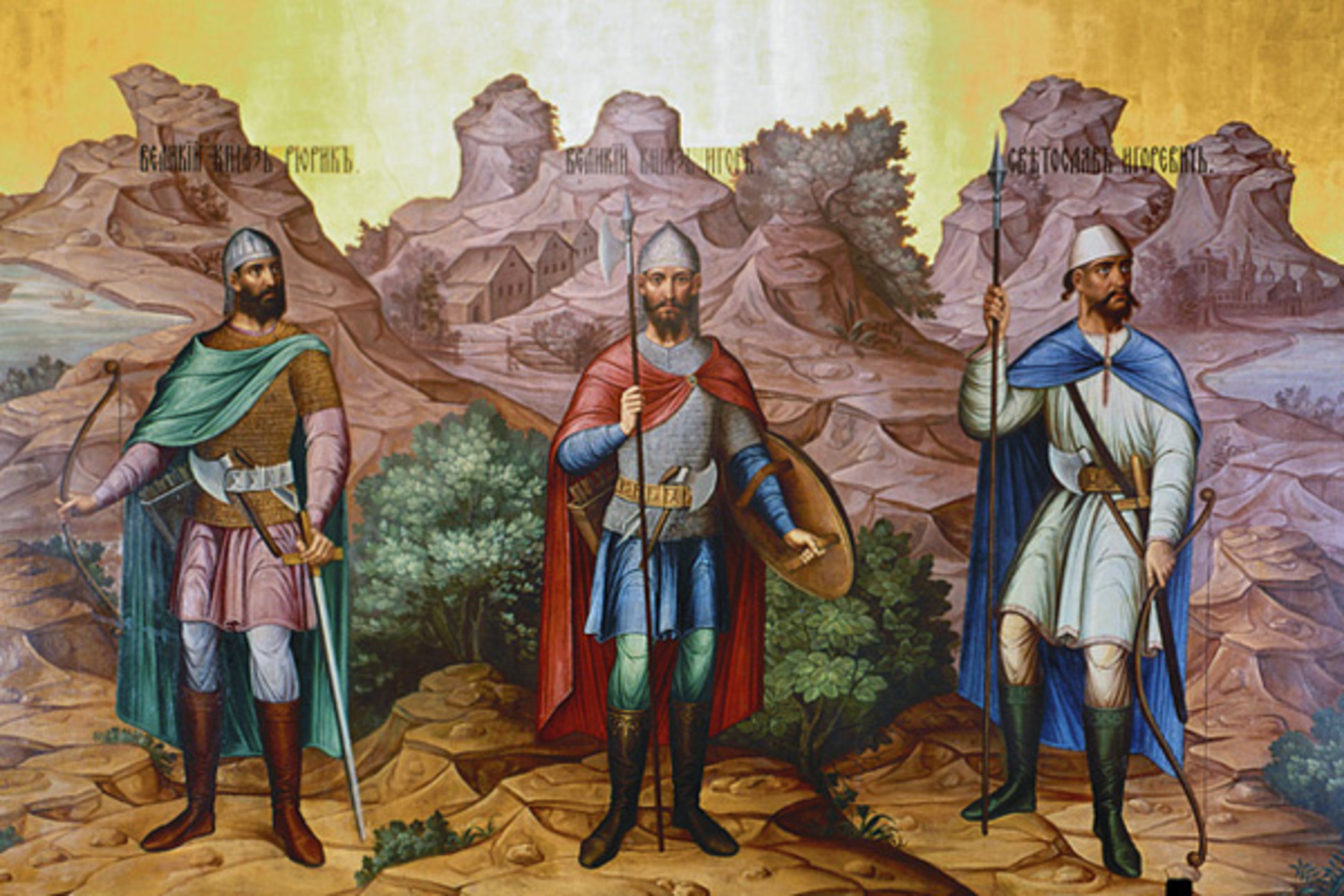
Having married Prince Igor, the son and dynastic heir of Rurik, the founder of the Rurik Dynasty, she found herself alone in total control of the Kievan Rus with a young son.
Her first thought turned to safety. She needed to secure the borders and squash those people who had been a nuisance to her deceased husband.
There was, of course, the added detail of exacting revenge on these people, which gives us the first case of her supreme intelligence and cunning.
Seeking revenge
Following the murder of her husband, we find Princess Olga intent on putting all her efforts into payback for the Derevlians.
The killing of her husband emboldened this tribe and their leader, Prince Mal, to cheekily extend an offer of marriage. This offer was extended by an official diplomatic mission.
Princess Olga, though, it appears, was made of stern stuff and remembered that revenge is a dish best served ice cold. Going along with the marriage proposal, she put the diplomats at ease before seeing that all were buried alive.
This gruesome death of some of the Derevlian nobles is described in the Primary Chronicle as follows:
"They thus were borne into the court before Olga, and when the men had brought the Derevlians in...Olga bent over and inquired whether they found the honor to their taste. They answered that it was worse than the death of Igor'. She then commanded that they should be buried alive, and they were thus buried..." (p. 79)
This was not the end of the matter. Princess Olga would then launch a years-long campaign against them that would ultimately lead to the fiery destruction of their capital, Iskorosten, and their ultimate submission to Princess Olga and the Kievan Rus.
According to Nestor, Princess Olga outwitted her foes through the use of a brilliant strategy. He writes:
"Now Olga gave to each soldier in her army a pigeon or a sparrow, and ordered them to attach by a thread to each pigeon and sparrow a piece of sulphur bound with small pieces of cloth. When night fell, Olga bade her soldiers release the pigeons and the sparrows. So the birds flew to their nests, the pigeons to the cotes, and the sparrows under the eaves. Thus the dove-cotes, the coops, the porches, and the haymows were set on fire. There was not a house that was not consumed, and it was impossible to extinguish the flames, because all the houses caught fire at once. The people fled from the city, and Olga ordered her soldiers to catch them. Thus she took the city and burned it, and captured the elders of the city. Some of the other captives she killed, while she gave others as slaves to her followers. The remnant she left to pay tribute." (p. 82)
This shows that Princess Olga was no meek medieval ruler but the equal of any male warrior or ruler of the age. Nor was it the first time she used her brilliant intelligence for political gain, as we shall see.
The story of a female seeking revenge was a common trope in Viking sagas, as A. L. Hitt talks about in his 2020 thesis, found throughout the stories that Olga's kith and kin would have told.
These tropes were later incorporated into later medieval accounts, including possibly the Primary Chronicle.
- READ MORE: The Viking history of Russia – A primer
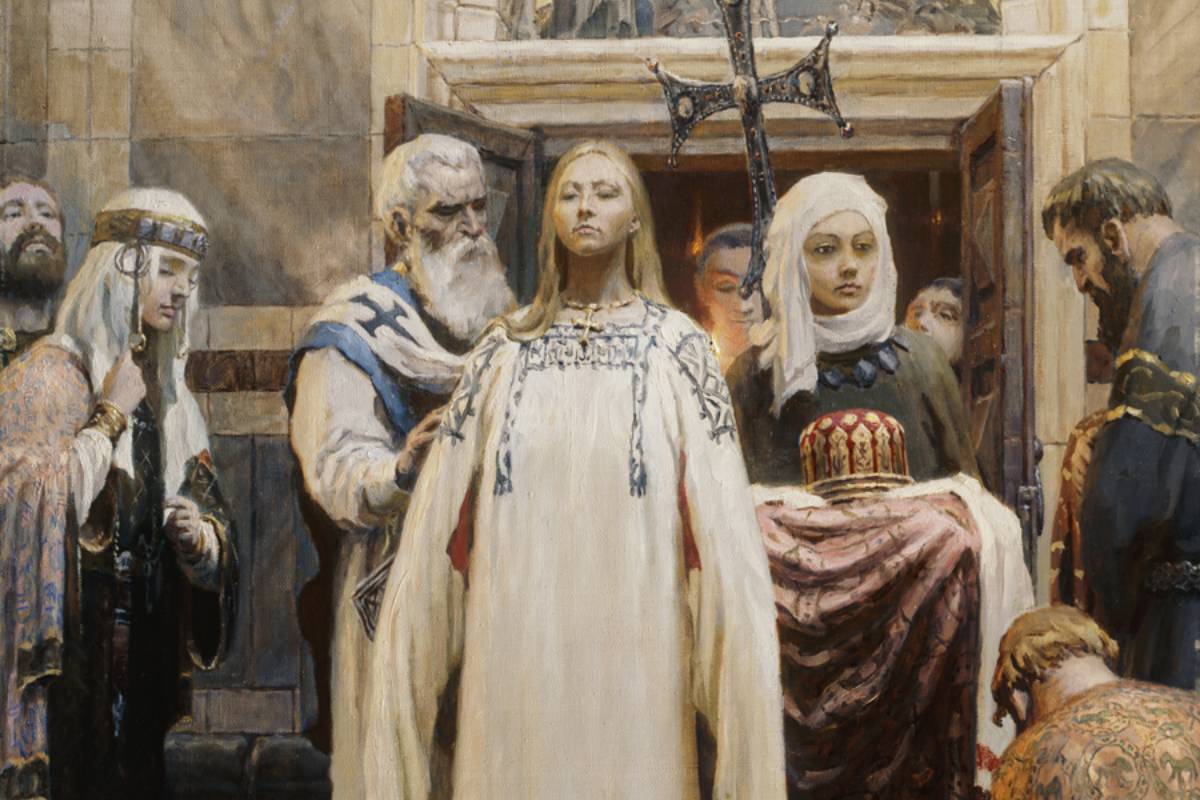
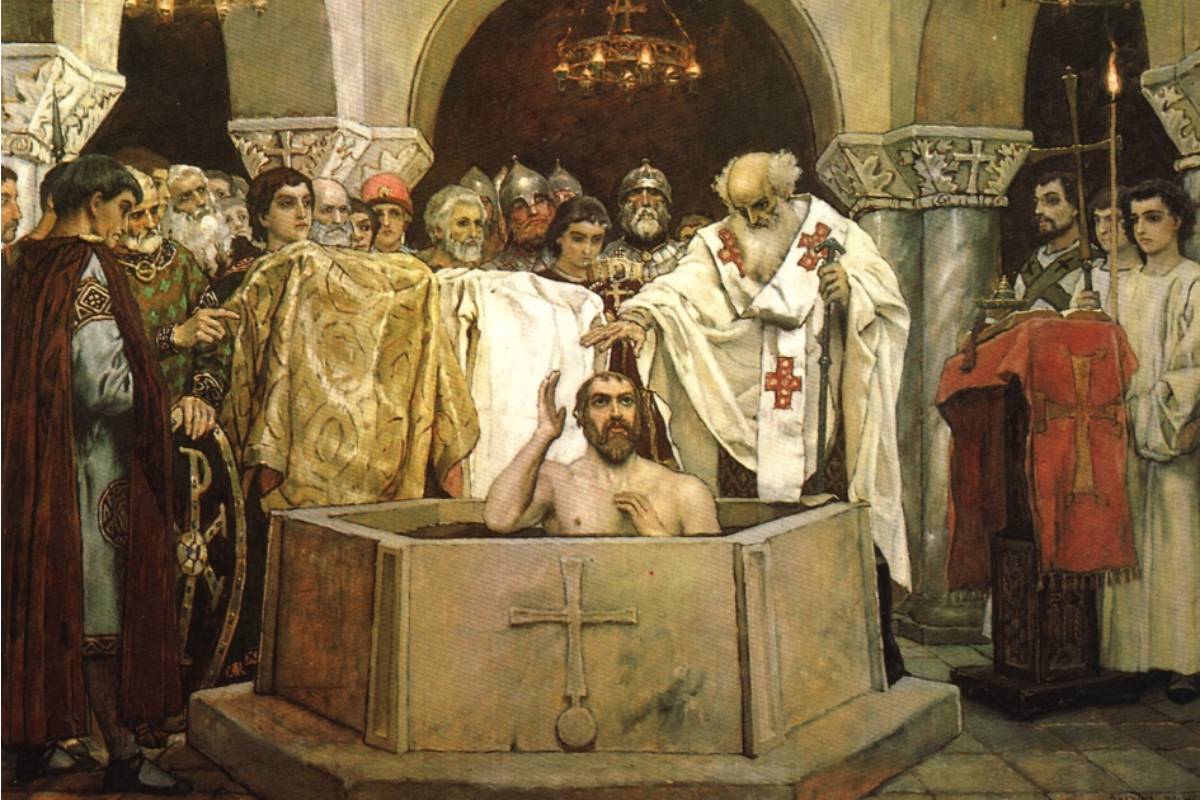
A detail from a painting showing Princess Olga being baptized into Christianity in Constantinople. Illustration: Sergei Kirillov (b. 1960)
Constantinople, Christianity, and conversion
With the Derevlians subdued, she turned her focus to matters of the soul. In the 950s, she traveled to Constantinople to meet with the Byzantine emperor, Constantine VII.
We have three historical sources of this meeting of two powerful medieval figures, but all differ in the events and reasons for the said meeting.
Turning to the Primary Chronicle, Olga was said to have been baptized whilst in Constantinople and taken the name Helena, after Saint Helena, the mother of Constantine the Great, who refounded the city as Constantinople.
Nestor writes that:
"...Olga went to Greece, and arrived at Tsar'grad [Constantinople]. The reigning Emperor was named Constantine, son of Leo. Olga came before him, and when he saw that she was very fair of countenance and wise as well, the Emperor wondered at her intellect. He conversed with her and remarked that she was worthy to reign with him in his city. When Olga heard his words, she replied that she was still a pagan, and that if he desired to baptize her, he should perform this function himself; otherwise, she was unwilling to accept baptism. The Emperor, with the assistance of the Patriarch, accordingly baptized her." (p. 82)
Again, Olga showed her supreme intelligence by selecting the Byzantine emperor as her spiritual sponsor and godfather.
The emperor apparently offered two marriage proposals, but Olga, knowing that any marriage to a Byzantine emperor would see the Kievan Rus fall under Byzantine control, resisted, arguing that their religious connection through her baptism forbade it.
"...After her baptism, the Emperor summoned Olga and made known to her that he wished her to become his wife. But she replied, "How can you marry me, after yourself baptizing me and calling me your daughter? For among Christians that is unlawful, as you yourself must know." Then the Emperor said, "Olga, you have outwitted me." (p. 82)
Whether this is exactly what happened, we will never know, but it does appear that Olga converted to Christianity and was instrumental in its introduction to the Kievan Rus.
Yet this would not be the Latin Christianity centered in Rome, but what would become the Orthodox version, heavily influenced by Constantinople.
Whilst she was not heavy-handed in her religiosity, she did construct churches throughout the region, including in Kiev. She did not win over her son and future ruler to convert, but he did promise to stop the persecution of Christians.
The Primary Chronicle records:
"...Now Olga dwelt with her son Svyatoslav, and she urged him to be baptized, but he would not listen to her suggestion, though when any man wished to be baptized, he was not hindered, but only mocked..." (p. 83)
This decision to live and let live was a major reason for its further spread in the region throughout the late 10th and into the 11th centuries.
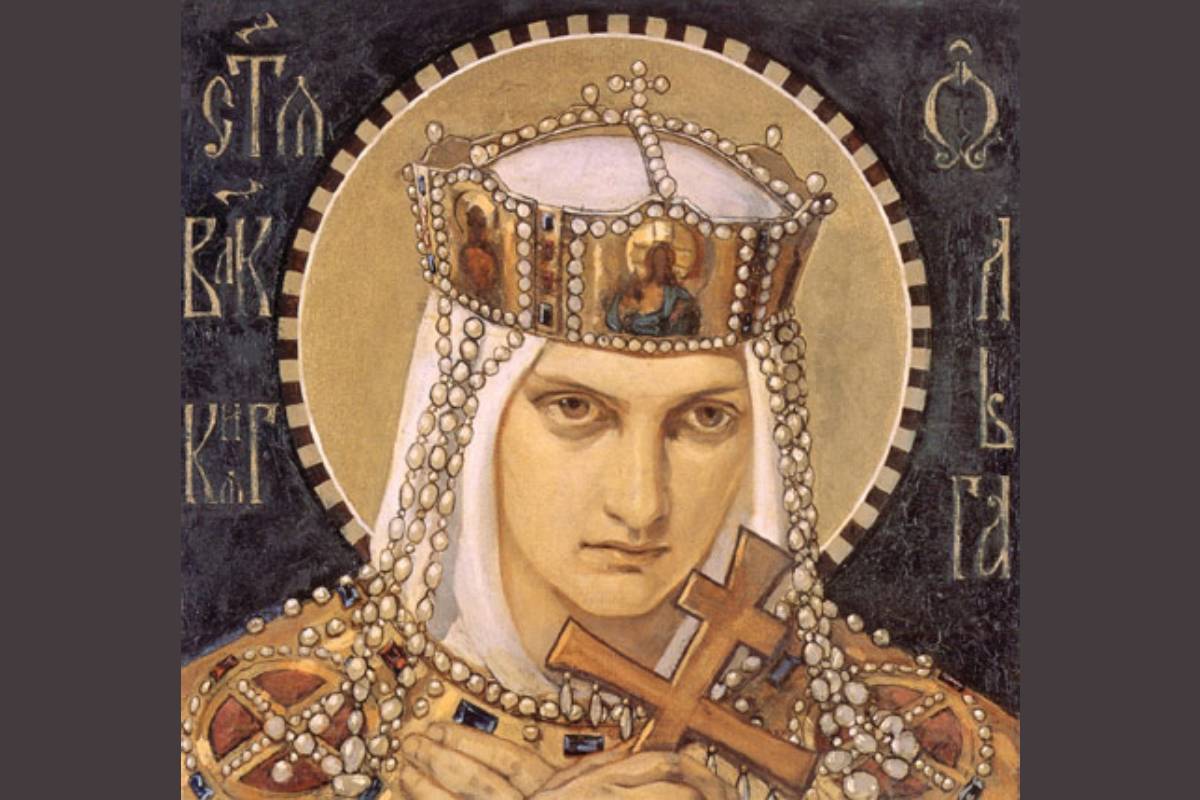
Olga of Kiev died a Christian ruler and was later venerated as a saint in both Eastern and Western traditions. Illustration: Nikolay Bruni (1856–1935)
Death, veneration, and legacy
Her son, Sviatoslav, would reign in his own right from sometime in the early 960s. An impatient man by this time, he was willing and able to forge his own path and rule in his own right.
Regardless, by the mid-960s, Sviatoslav had become the Grand Prince of Kiev and would lead the Kievan Rus into a brand-new age.
He would, unlike his mother, still believe in the old ways—the old gods that his ancestors had believed in.
Princess Olga is believed to have died in 969 CE—a remarkably long life given the lack of personal or political agency and security she had for much of her younger years.
Despite the Great Schism of Roman Catholic and Orthodox Christianity, Princess Olga is revered in both the Roman Catholic and Orthodox pantheon of saints for her religious promotion and patronage.
She is also fittingly the patron saint of widows and converts, two roles she played during her life.
Yet it is her decision to convert to Orthodox Christianity, under the auspices of Constantinople, that would prove her greatest legacy.
This personal decision, very much a tender affair of the heart and soul, has seen much of what was once Kievan Rus remain firmly in the Orthodox camp in the centuries since.
So, this 11 July, the Feast Day of Saint Olga, pause to consider what a formidable and remarkable woman this Viking queen was.
From a child bride at the age of 15 to smiting troublesome armies and gaining bloody revenge, hers was a life forged by power, faith, and war.
Hers was also a double life—pagan and Christian, princess and ruler, child bride and fierce ruler.
Death did not stop this constant transformation, as she was turned from a Viking queen into a venerated saint, honored with the title Equal to the Apostles.
Her life story is even more remarkable when we remember the total lack of political or social agency that women were afforded throughout the early medieval period.
For more information on Princess Olga and her role as a symbol of defiance by Ukrainians, visit The Conversation here.
We get to provide readers with original coverage thanks to our loyal supporters. Do you enjoy our work? You can become a PATRON here or via our Patreon page. You'll get access to exclusive content and early access.
Feel free to reach out to discuss potential stories that may be in the public interest. You can reach us via email at [email protected] with the understanding that the information you provide might be used in our reporting and stories.