

When the archaeologist Gabriel Gustafson lifted an ornate bronze bucket out of the Oseberg ship burial in 1904, he is said to have exclaimed, "But that’s a Buddha!"
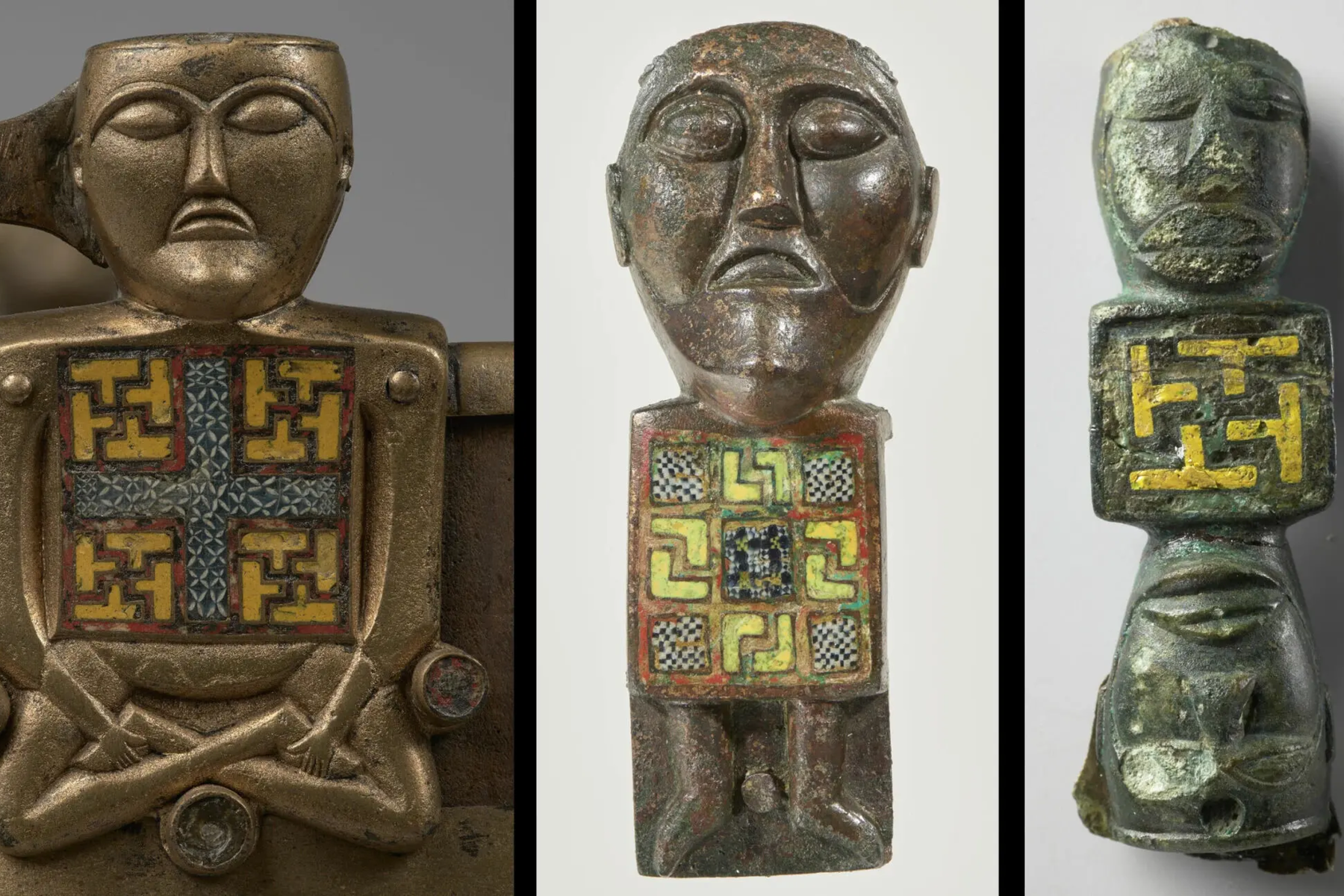
He might be forgiven for the reaction. The small enameled figure on the bucket sits cross-legged in something close to the lotus position, eyes closed, face composed. The chest is decorated with four swastikas in red and yellow enamel. Anyone who had spent an afternoon in a museum of Asian art would have thought the same thing.
He was wrong, but his mistake is the interesting part. The figure was not Buddhist, and neither was the bucket. Both were almost certainly made in a Celtic workshop in the British Isles in the seventh or eighth century, perhaps in a monastery, and brought to Norway by trade or raid.They ended up in the grave of the Oseberg queen two centuries later.
What makes the figure interesting is not the journey it made from Ireland or Britain to a ship burial near Tønsberg. It is the much longer journey the symbols on its chest had made to get there.
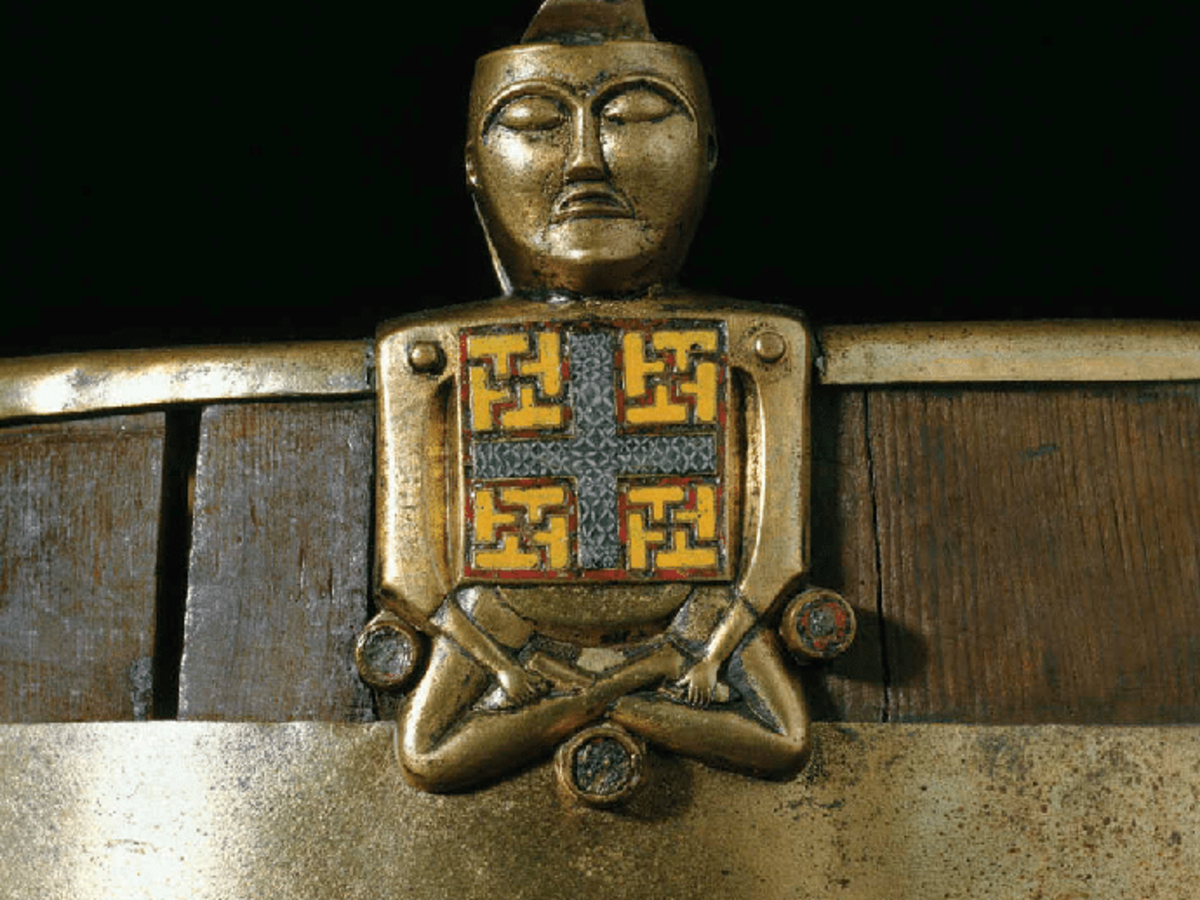
The Buddha on the Oseberg bucket. Source: Museum of Cultural History, Oslo/Eirik Irgens Johnsen
Two ships, two figures
The Oseberg bucket was not alone. When the Myklebust ship was excavated at Nordfjordeid in 1874 under the direction of Anders Lorange, another bronze figure came out of the mound. This one was smaller and rather different. The Myklebust Man (depicted in the center of the main image of this article) stands upright rather than sitting, and his body is covered in dense geometric ornamental details: interlocking bands, cyclical spirals, patterns of the sort that recur in Celtic metalwork through the centuries before and during the Viking Age.
Aurora Leivdal, chief operating officer at the Sagastad Viking Centre in Nordfjordeid, reads the Myklebust ornamentation as a meditation on cycles and balance. The geometry, she suggests, speaks to the turning of seasons and the order beneath them. It is not far from what the yin-yang figure expresses in East Asia.
Here, we should stress that it is not the same symbol. Nbody is claiming a direct influence. But they could be seen as cousins of a sort: images of cosmic balance made in cultures that had not seen each other for thousands of years.
Hanne Lovise Aannestad, at Oslo’s Museum of Cultural History, points to the workmanship. The metalwork and the geometric vocabulary are typical of the British Isles in this period, and the quality is exceptional. These were not second-rate objects. A Viking who buried a king or queen with such pieces was parting with something of real value.
Where the swastikas came from
It should also be noted that these figures were not foreign curiosities, the way a Chinese silk in a Viking grave would be. They were decorated with symbols the Norse already knew.
Take the swastika. It was not a Buddhist sign that had wandered improbably into a Celtic monastery. It was already old when the first Buddhists took it up. By then it had been sacred across the Indo-European world for thousands of years. In Sanskrit the word means "conducive to wellbeing", and it denotes the sun’s turning and the order of the cosmos.
The same four-armed solar wheel appears in ancient Greece, in pre-Christian Scandinavia, in Celtic Ireland, and in Vedic India. It carries roughly the same meanings in all of them. It appears in all of them because all these cultures descend from one shared population that had carried the symbol with them when they moved.
That population lived on the Pontic-Caspian steppes, in what is today southern Russia and Ukraine. They began to move outwards sometime between 5,000 and 3,000 BCE. The linguistic evidence has been clear for more than a century. The genetic evidence, published over the last decade, has now confirmed it in detail. Their descendants stretched from Ireland to India, and from Greece to Scandinavia. They spoke related languages and carried related gods. They also brought a shared vocabulary of symbols with them. The solar wheel was one of them.
When a seventh-century Irish craftsman incised swastikas onto a bronze bucket, he was not borrowing from a foreign tradition. He was drawing on something his own ancestors had known for at least 4,000 years. When a Norse jarl acquired that bucket three centuries later and gave it an honored place in a royal burial, he was putting his queen into the ground with symbols his ancestors had also known for the same 4,000 years, through a different line of descent. The two branches of the family had not seen each other in a very long time, but the symbols on the bucket would not have been completely strange to either of them.
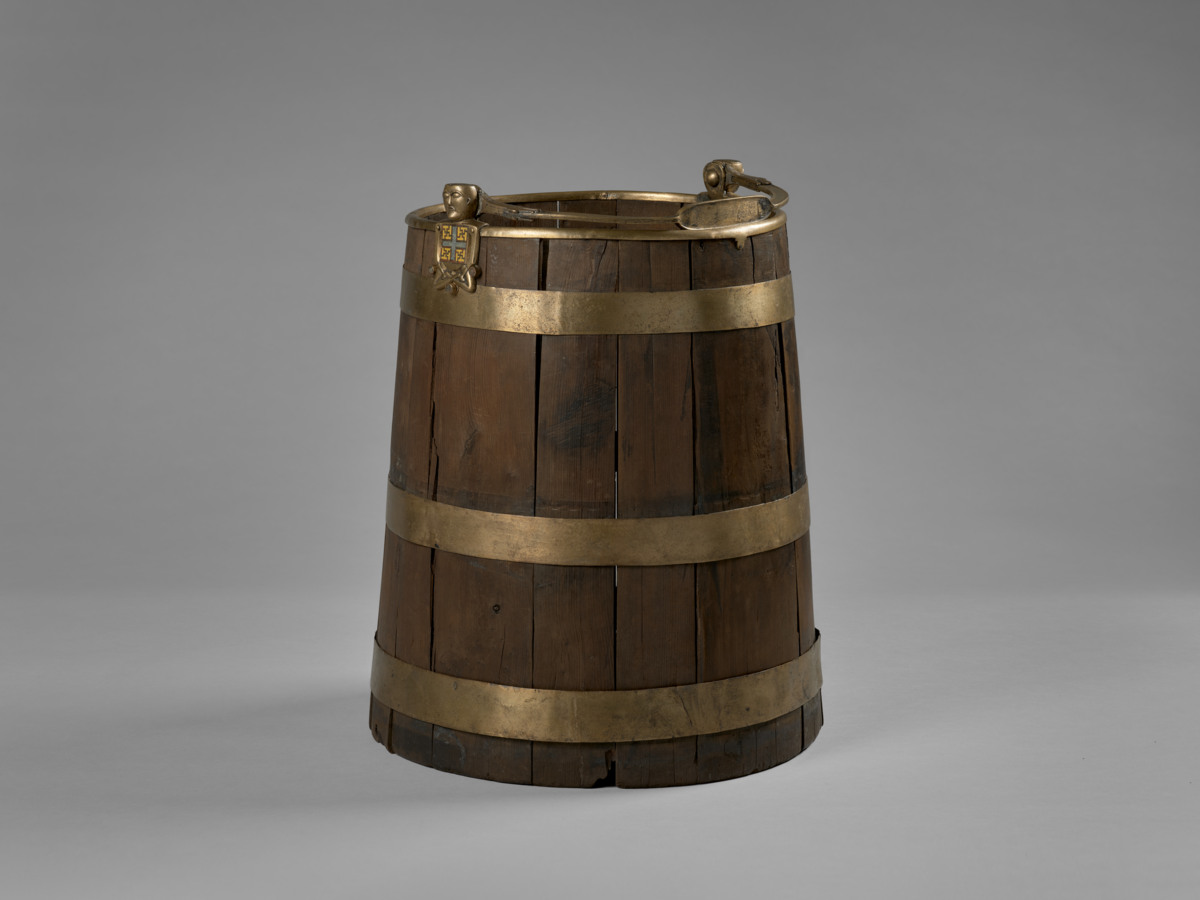
The Buddha on the Oseberg bucket. Source: Kirsten Helgeland
How to tell cousins from strangers
Of course, similar symbols can turn up anywhere. The question is how we tell real cousinship from coincidence, or from cultural borrowing at a distance.
The clearest example is half a world away. In the Tarim Basin, in what is now Xinjiang in western China, archaeologists have been uncovering remarkably preserved mummies for over a century. Some of them have light or red hair.
They were buried in boat-shaped wooden coffins covered with cattle hides, with oars placed by their heads. Their clothes include woven tartans of a kind familiar from ancient Celtic Europe. When European explorers first saw them in the early 1900s, and again when large-scale excavation resumed in the 1990s, the obvious reading was that these were Indo-European migrants. They had come east from the steppes, bringing their weaving and their burial customs with them.
The DNA told a different story. When genetic analysis was finally carried out, the Tarim people, who date from around 2100 to 1700 BCE, turned out not to be Indo-European at all. They were a population called the Ancient North Eurasians, a lineage that had lived in the region since the end of the last Ice Age. What they had done was adopt their Indo-European neighbors’ tartan weaving, certain kinds of dairying, and very probably boat burial. They had taken the technology and the customs without taking the ancestry.
That is a useful warning. Deep similarity can come from common descent, but it can also come from neighbors who lived next to each other long enough to share habits. Telling the one from the other requires the genetic evidence to be layered carefully over the archaeological evidence.
In the case of the Vikings and the Celts, the layering is clear. Both come out of the steppes. Both are genuine cousins. The symbols on the Oseberg bucket are, in some sense, family heirlooms.
Vikings going the other way
There is a further wrinkle, and the Norse themselves may have remembered some of it.
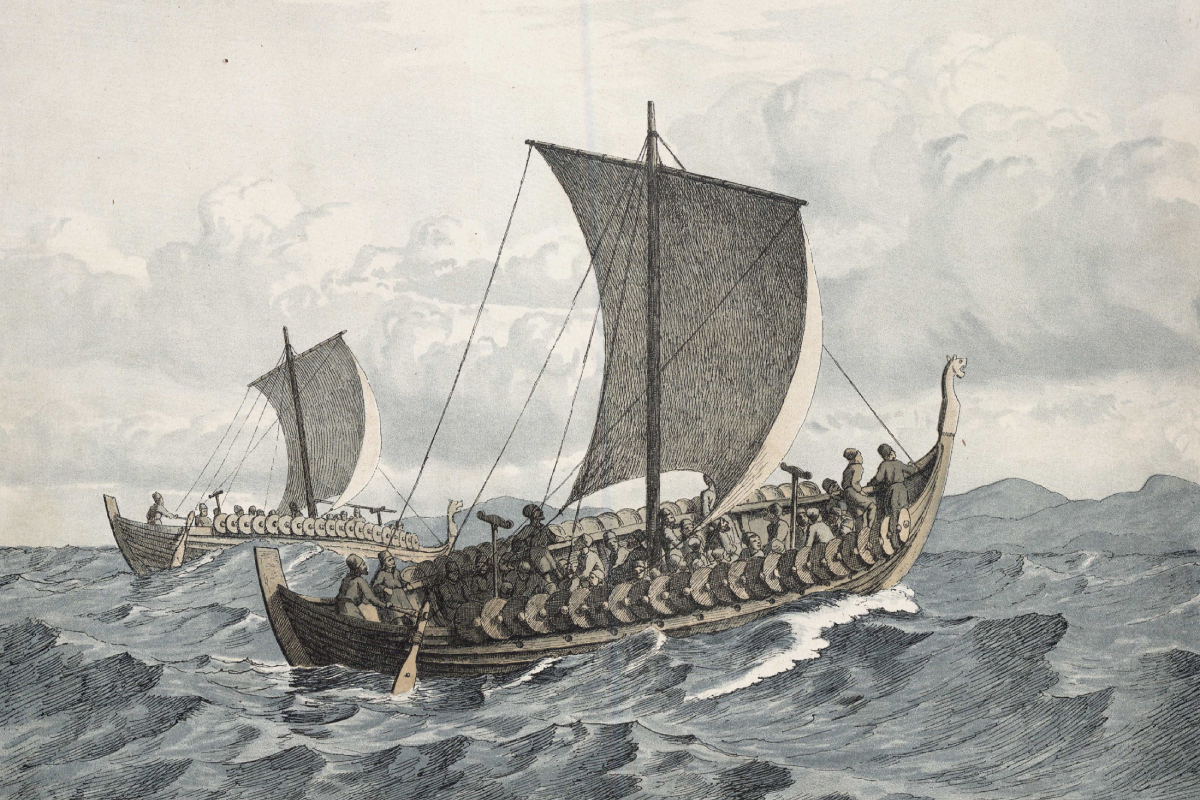
From the ninth century onwards, the people we now call the Rus were working their way down the great river systems of what is now Russia and Ukraine. They followed the Volga and the Dnieper to the Caspian and the Black Sea. They opened trade routes that ran from Scandinavia to Byzantium and to the Islamic world, traded slaves and furs and amber, and brought silver home. Without knowing it, they were travelling back along the route their own distant ancestors had taken in the opposite direction four or five thousand years earlier. Their trade routes ran straight toward the region from which the whole Indo-European story had set out.
Some cultural memory of that may have survived. Snorri Sturluson, writing in the thirteenth century, begins the Ynglinga saga with an account of the origins of the Aesir. He places their homeland in Asaland, a country east of the river Don. He has them migrate from there through what he calls Gardarike, the Norse name for the territories around the upper Volga and the Dnieper, before eventually settling in Scandinavia.
Saxo Grammaticus, writing in Denmark around the same time, gives the same essential story: Odin and his people came from Asia and made their way north. Thor Heyerdahl, late in his life, became convinced of the same thread, though he placed the migration too late and several thousand kilometers south of where the genetic evidence now points. You can dismiss the medieval accounts as learned speculation.
Snorri Sturluson may simply have noticed the similarity between Aesir and Asia and built a story around it. But it is striking that two independent thirteenth-century sources place the ancestral homeland of the Norse gods in, of all possible directions, exactly the region that modern genetics now identifies as the homeland of the Indo-Europeans.
Whether the Vikings of the 9th and 10th centuries knew, in any conscious sense, that they were reversing an ancient migration, we cannot say. Probably not. Traders follow rivers for the same reasons in every age, and a river does not need to explain its history to be useful. But under the sagas, something about the direction is right.

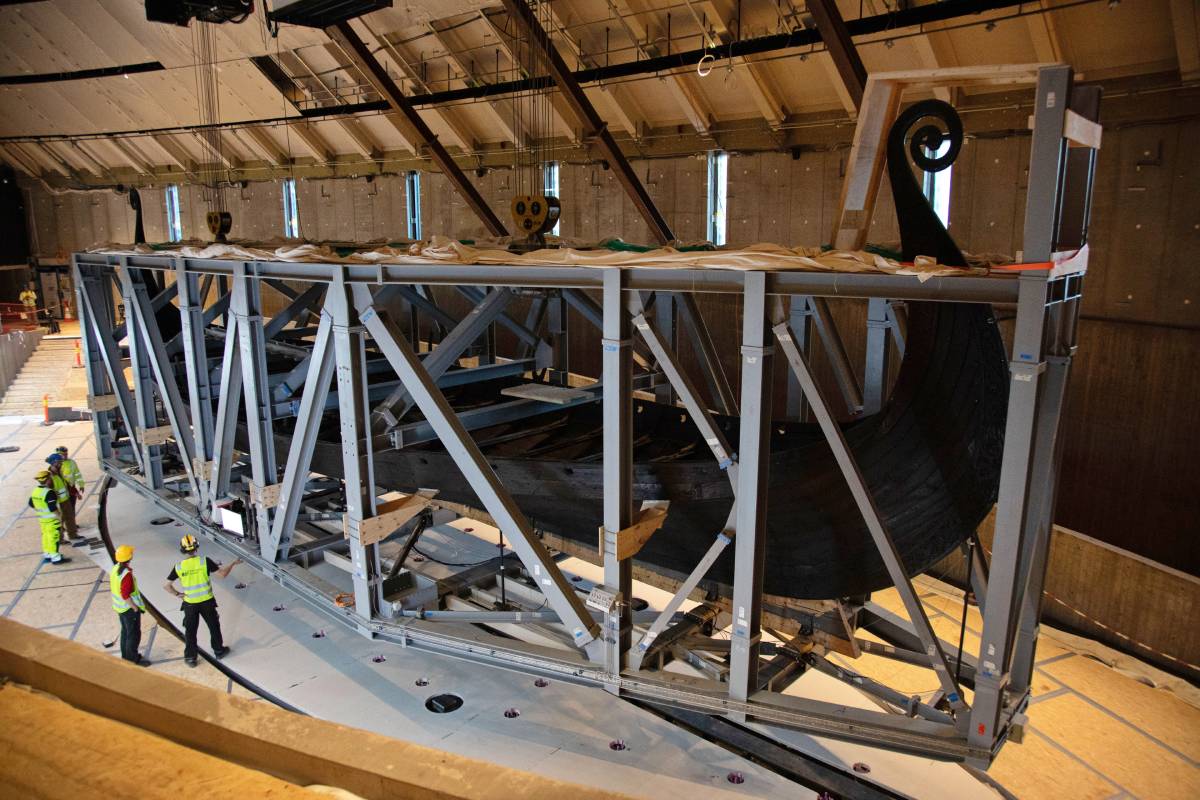
The replica of the Myklebust ship. Source: Sagastad
Back to the ship
The Sagastad centre in Nordfjordeid has built a full-scale reconstruction of the Myklebust ship. It stands indoors at almost thirty meters long. When Lorange excavated the burial in 1874 he found the cremated remains of what was probably a Viking king. Around him lay weapons, jewelry, gaming pieces, and the bronze vessel topped with its standing figure. More recent research on the original find has brought the scale of the vessel into focus: over 7,000 rivets and nails, ash layers across the full 30-meter diameter of the mound, and at least 44 shield bosses. Those are the numbers of a royal burial.
Standing next to the reconstruction, with the bronze figure in its display case behind you, you can almost see how the pieces connect. A king was buried here in a ship whose pattern of construction descended, ultimately, from boatbuilding traditions brought north by peoples whose deepest ancestors had lived on the grasslands north of the Black Sea. His grave goods included a Celtic vessel decorated with the solar wheel, which his own Germanic ancestors had known under another name. Some of his contemporaries, or perhaps his grandsons, would take the opposite road and trade their way back toward the steppe.
The swastika on the Oseberg bucket had been sacred somewhere in the Indo-European world for more than 5,000 years by the time it was buried in a Norwegian mound. It did not come to Norway from the East. It had never really left.
The Myklebust ship reconstruction and the original bronze figure can be seen at the Sagastad Viking Centre in Nordfjordeid. Images of the original Myklebust vessel are available through Unimus.
We get to provide readers with original coverage thanks to our loyal supporters. Do you enjoy our work? You can become a PATRON here or via our Patreon page. You'll get access to exclusive content and early access.
Feel free to reach out to discuss potential stories that may be in the public interest. You can reach us via email at [email protected] with the understanding that the information you provide might be used in our reporting and stories.