

For the past decade, successive British governments have had to fend off several attempts at disuniting Great Britain.
Whilst the 2014 Scottish independence referendum made global headlines and sent shockwaves around the world (for all fans of the 1994 film, Braveheart, sadly, there was no "Freeeeeedom" from the English yoke), almost a decade later, a small local council followed in the footsteps of the SNP.
The Orkney Islands Council, in July 2023, voted on a motion to explore "greater autonomy" and look beyond the British Isles to build "Nordic connections." There was heavy talk that the islands could become a future fylke (county) of Norway itself!
Following on from the 2014 referendum, and a similar motion passed by local government on the Shetland Islands, it seems that the United Kingdom has been anything but united lately.
Why did the Orkney Islands look across the Norwegian Sea to Norway rather than further south? The answer, like all great ones, lies in the medieval period when the islands were a thriving part of the Viking world.
Despite being Scottish for almost half a millennium, the Orkney Islands have long ties to the Viking world through the Jarls of Orkney, Norse rulers who linked Norway, Scotland, and the wider North Atlantic.
- READ MORE: The Viking history of the Orkney Islands

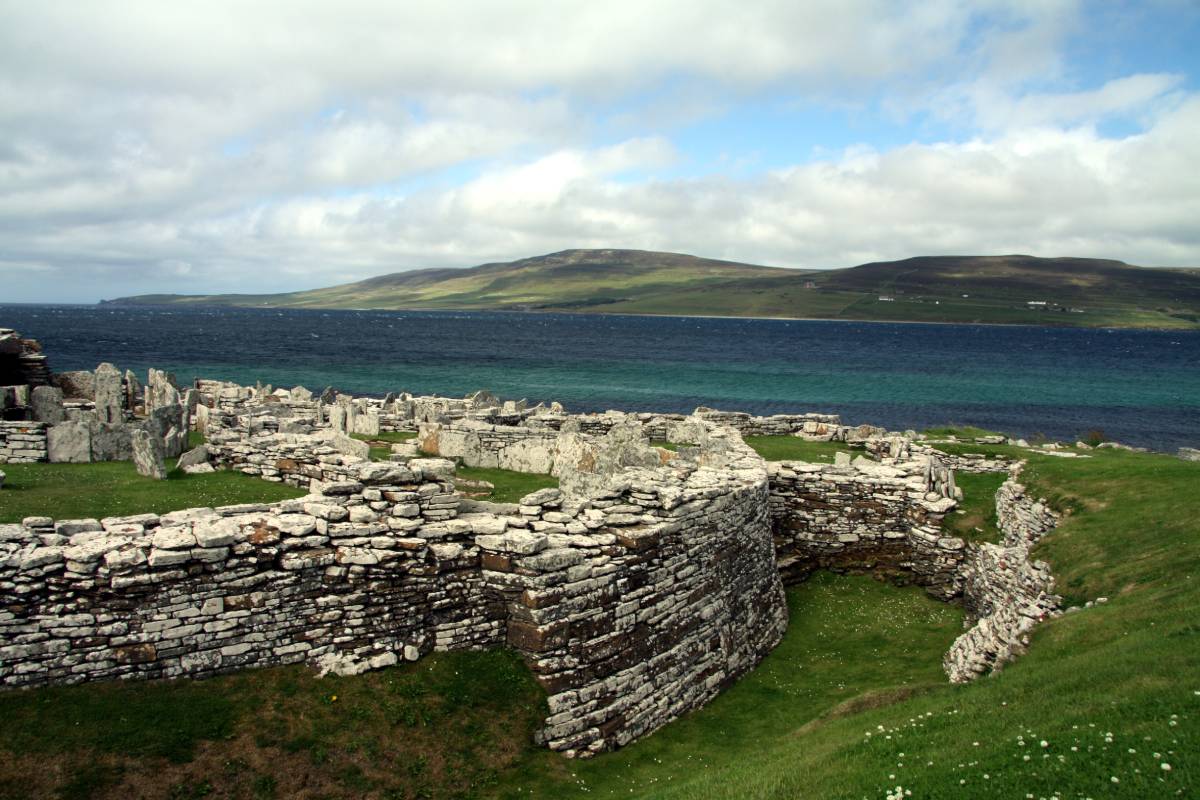
Coastal view of Birsay on Orkney's west coast. Author: rphstock / Shutterstock
The icemen cometh
Modern historians believe that people from Viking societies first arrived in the Orkney Islands sometime toward the end of the 9th century CE.
If we are to believe the Norse sagas, it was malcontents fleeing from Harald Fairhair's recent unification of Norway that were the first Vikings to head to the windswept British Isles.
Turning to the Orkneyinga Saga, or, as we say in English, the Orkney Saga, we use an online version based upon the 1873 English edition edited by Joseph Anderson. We find the beginnings of the Viking history of the Orkneys described as thus:
"By the victory of Hafursfiord in 872, Harald Harfagri made himself sole monarch of Norway. Large numbers of the wealthy and powerful odallers, whom he had dispossessed of their territorial possessions, fled to the islands of Orkney and Shetland." [Chapter 3]
One modern note may help here. The Battle of Hafrsfjord is a standard name in current scholarship, but both the battle's exact date and its role in "unification" remain debated. The spellings and the date in the quotation above follow the 1873 English edition.
Here, these malcontents turned the tables on people from (Scandinavian) Viking societies and gave them a taste of their own medicine: they soon began raiding and pirating, much to the chagrin of Fairhair.
He thus sent a naval force and swept their coasts clear of the plunderers. However, during this operation, like all military operations, there were casualties. A son was lost. Further on, the Orkney Saga describes how:
"In this expedition, Ivar, a son of Rögnvald, Earl of Moeri, was killed. In order to recompense Rögnvald for the loss of his son, King Harald bestowed on him the territory of the subjugated isles of Orkney and Shetland, with the title of Earl of the Orkneys." [Chapter 3]
Regardless of the historical accuracy of this story of the creation of the Jarls of Orkney, we know that Rognvald of More (Rognvald Eysteinsson) seems to have some sort of role in the founding of this noble line.
However, turning to another later medieval source, historian and chronicler Adam of Bremen, he claims that the Orkney Islands were not brought under the heel of royal Norwegian control until the mid-11th century CE.
Now, it's important to note that Adam of Bremen wrote in the late 11th century, and his account reflects a single perspective and set of priorities. "Royal control" can also mean different things in different sources, so this claim needs to be read with caution and in context.
We have, however, a date, a name, and a noble. Rognvald died soon enough and passed the earldom (or jarl in Old Norse) to his brother, Sigurd the Mighty.
Despite his name, he barely lived a few years longer than his brother, and it was Rognvald's son, by a slave, Torf-Einarr, that would secure the political control of Orkney.
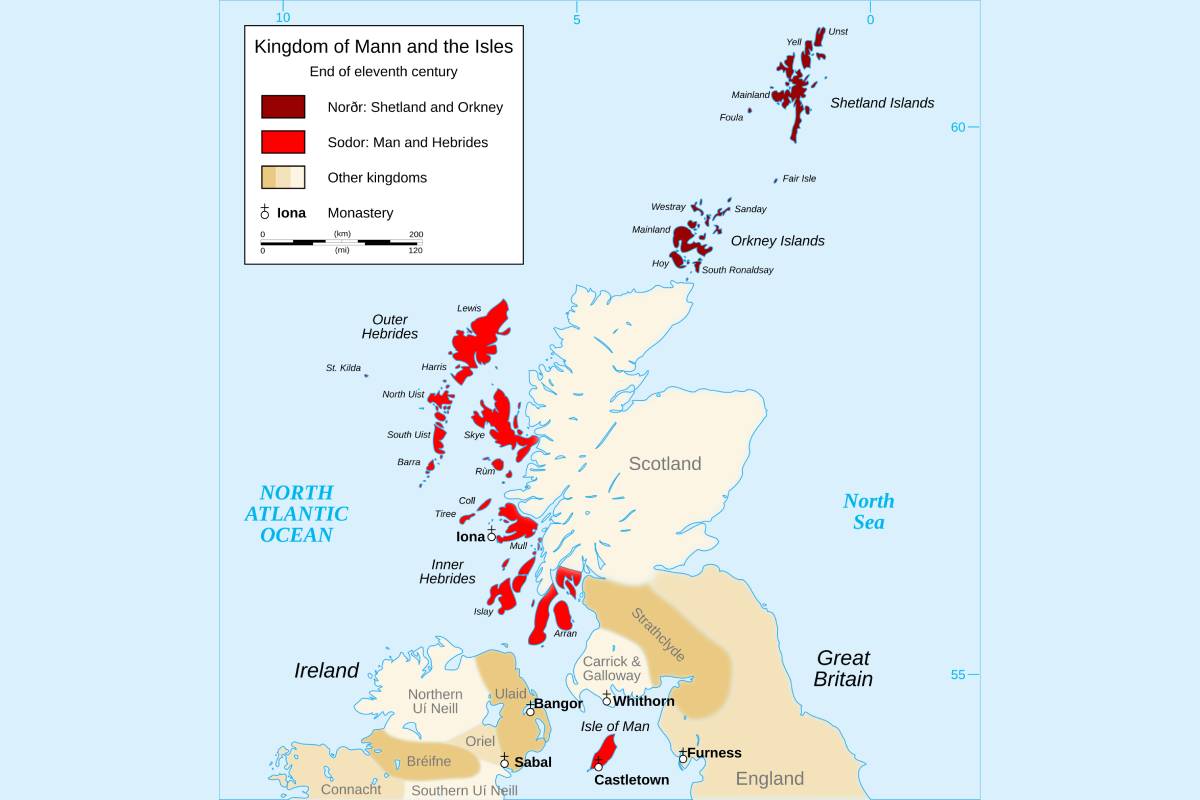
The Earldom of Orkney (Norðr) and the wider Norse world in the late 11th century. Source: © Sémhur / Wikimedia Commons / CC-BY-SA-3.0
Pirate prevention to long-term planning
From these semi-legendary beginnings, tied to the political fallout from the wars of Harald Fairhair, the Jarls soon grew in importance.
The Orkneys, often now dismissed and/or idolized as a remote part of Europe, were strategic crossroads for people in Viking societies, for trade and warfare.
Sailing across the North Sea, Viking warriors or merchants could use the islands as a base for further economic or military expansion to the south, especially in the north of the British Isles, in what is now the northern political parts of the island of Ireland, northern England, and the Highlands of Scotland.
From Torf-Einarr onwards, the Jarls of Orkney not only established a fiefdom of their own, known as the Norðreyjar (Old Norse for Northern Isles), but also became important players in the politics of this western edge of the Viking world.
In Norse usage, these northern islands were often grouped as Norðr, distinct from Sodor, which referred to Man and the Hebrides further south.
In a world where Viking warriors ruled much of northern Scotland, a Viking king sat on the throne in Dublin, and many of the other islands of Britain fell under royal rule, Orkney sat at the center of competing powers.
Whilst they were first raised up to nobility to ward off greedy Vikings, the Jarls soon began to develop the islands, focusing on administration, law, and long-term settlement planning.
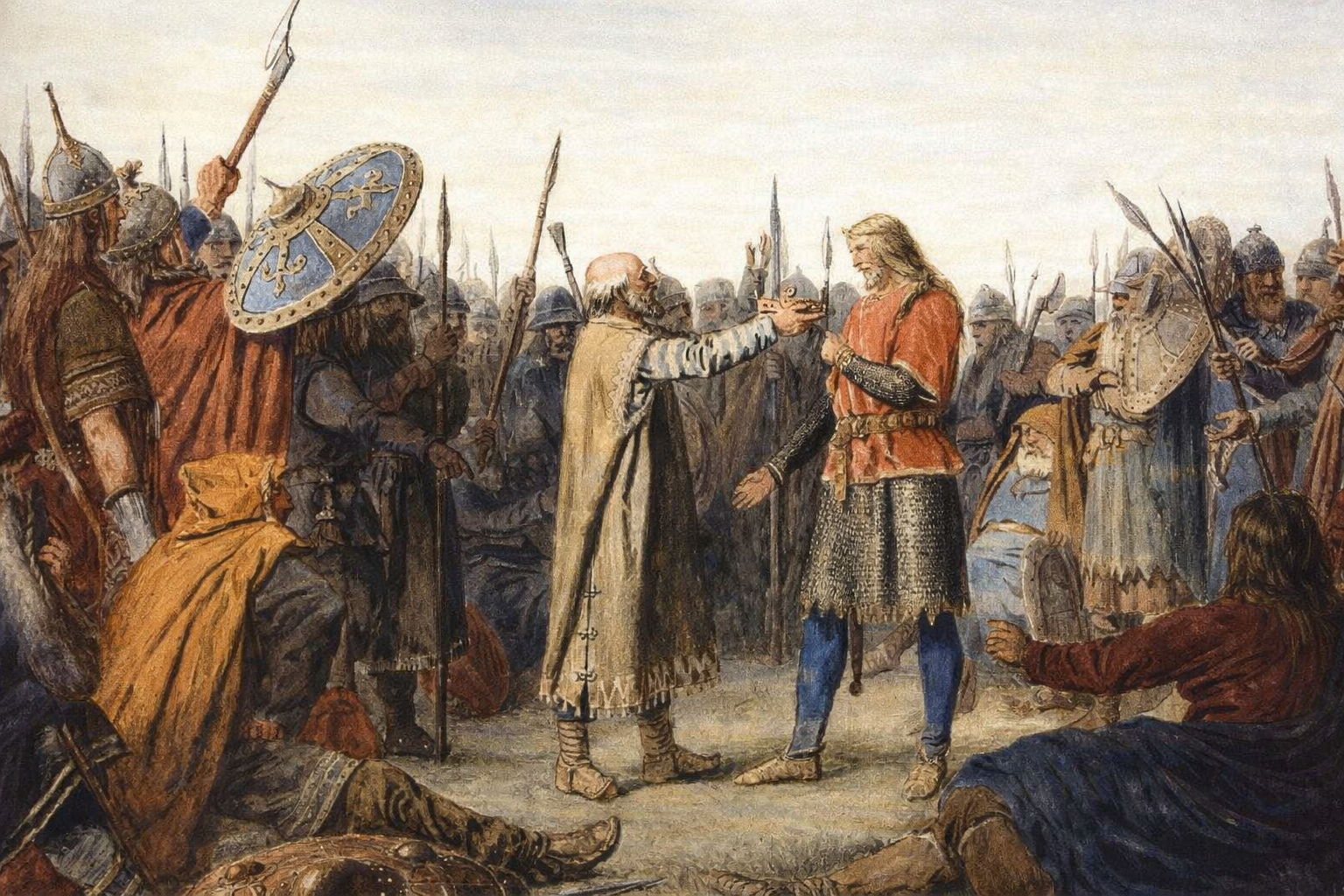
King Olaf Tryggvason of Norway, traditionally linked to the forced Christianisation of Orkney. Author: Peter Nicolai Arbo (1831–1892)
The conversion of the islands and the later influence of Christianity
However, it was Christianity that would signal the change at the long end of the Jarls of Orkney.
According to the sagas, it was Norway's great proselytizer, Olaf Tryggvason, who was said to have converted the islands en masse to Christianity.
The saga relates that when Tryggvason visited the islands in the 980s CE, he summoned the Jarl, Sigurd the Stout, to his boat. Grabbing the Jarl's son, he then:
"...gave the earl [Jarl] the choice of renouncing the faith of his fathers, or of seeing his boy slain on the spot." [Chapter 4]
Sigurd abandoned his old pagan faith, saved his son, but Christianity was very much enforced from the top down throughout the islands.
Though this may be of questionable historical accuracy, Christianity would bring the islands and the Jarls closer to the network of European Christian nations.
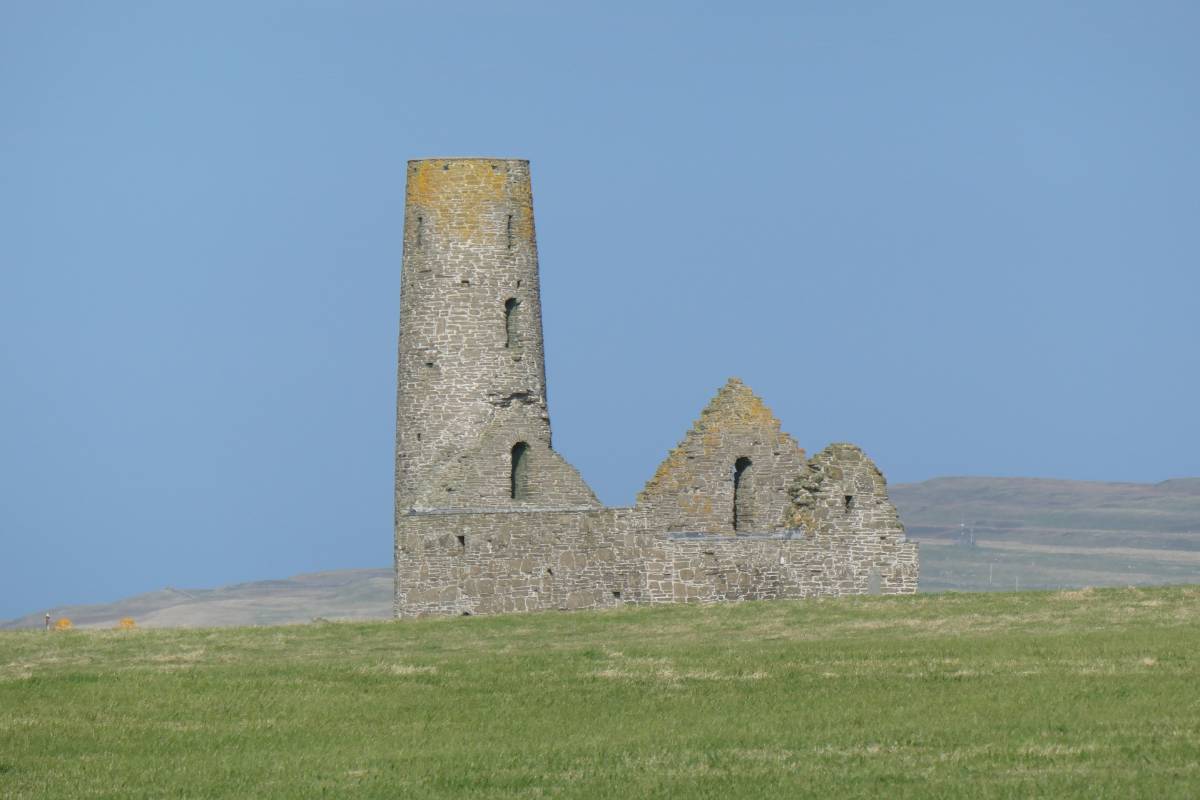
Later, Jarls would expand the influence of the Church in the islands, with one, Thorfinn the Mighty, said to have established a church at Birsay. This earlier church is often associated with Christ Church, and it predates St. Magnus Cathedral in Kirkwall.
This iconic cathedral was named after a steadfast and stubborn Jarl, Magnus Erlendsson, whose refusal to wage war would see him martyred and canonized. Later Jarls would promote his sanctity to strengthen their spiritual legitimacy.
Norwegian control, a wedding, then Scottish links
Despite trying to forge an independent line for much of the early medieval period, despite having nominal vassalage to monarchs across the North Sea in Norway, this would eventually end in the early 13th century CE.
As Barbara E. Crawford writes in her 2013 book, The Earldoms: Orkney and Caithness AD 870–1470 (available on Amazon here), the earldom of the Orkney Islands was "a distinctive political phenomenon, difficult to match elsewhere in medieval Europe," and it was a miracle it survived relatively independent as long as it did.
The islands later came under closer control of the Norwegian crown, with King Hakon IV of Norway (Hakon Hakonsson) appointing a jarl.
For the next two centuries, the jarls owed their allegiance not only to the Norwegian crown but also to the growing power of the Kingdom of Scotland, which was expanding northward toward the islands.
Orkney and Shetland were later pledged as security for a dowry by King Christian I of Denmark (also King of Norway under the Kalmar Union) for his daughter, Margaret, to marry King James III of Scotland.
The full payment was never made, and Scotland retained possession, which later hardened into Scottish sovereignty. This became the final severance between Orkney and Norway, a relationship that had lasted for over six centuries.
From then on, both Orkney and Shetland lay with the British Isles rather than Scandinavia, despite modern debates about autonomy and "Nordic connections."
For more information on Orkney's long Viking history, visit The Conversation here.
We get to provide readers with original coverage thanks to our loyal supporters. Do you enjoy our work? You can become a PATRON here or via our Patreon page. You'll get access to exclusive content and early access.
Feel free to reach out to discuss potential stories that may be in the public interest. You can reach us via email at [email protected] with the understanding that the information you provide might be used in our reporting and stories.