

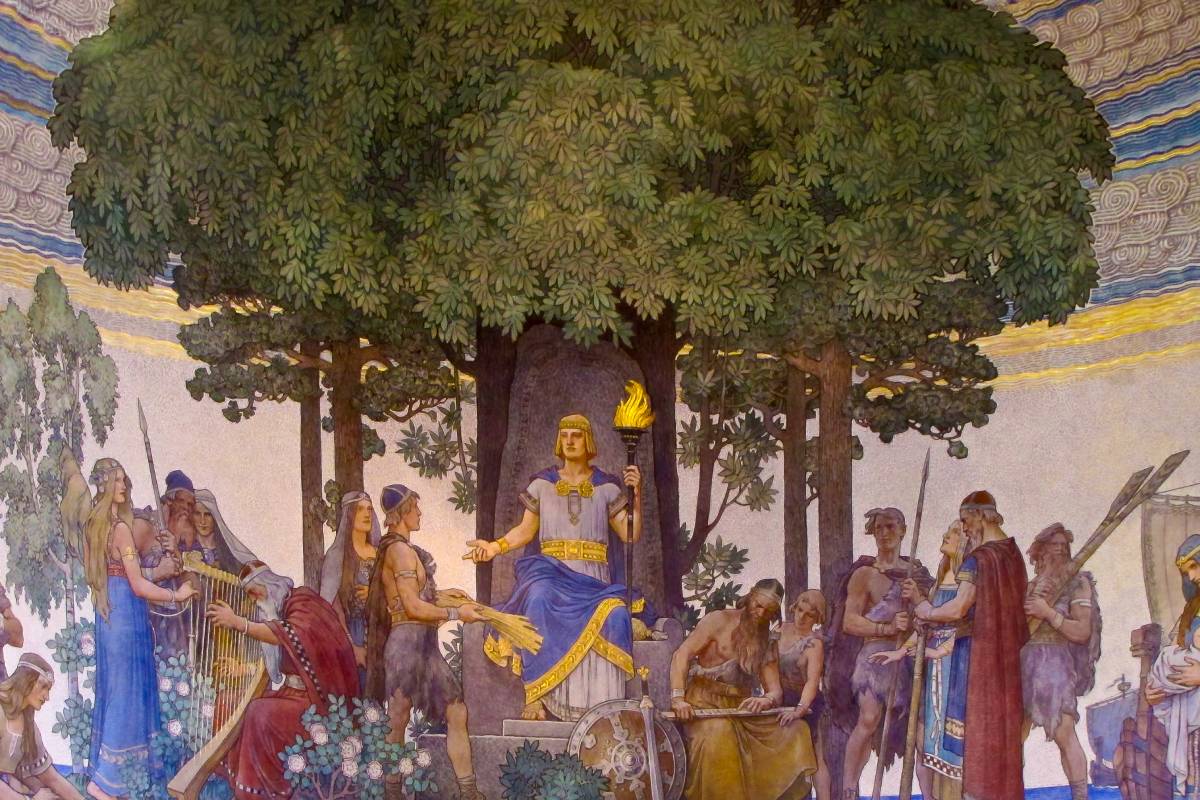
According to the latest United Nations estimates, nearly 400,000 babies are born every day.
For those whose skills lie in Viking history rather than mathematics (guilty as charged), that's almost 140 million newborns a year. Yet not a single baby, whether born in any of the four corners of the globe, has ever had such an unusual birth as the Norse god Heimdall.
We know that Heimdall, often referred to as the "Watchman" of the Norse deities, guards the brilliant rainbow bridge, Bifrost, which connects the realm of mortals, Midgard, to the realm of the divine, Asgard.
Heimdall is also said to play a part in signaling the very beginning of the apocalyptic Norse end of times, Ragnarök, by blowing his horn, Gjallarhorn.
This signals to the other Norse deities that the end of times has begun, so they better buckle up, because rough times are a comin'!
With his extra special senses—he can hear all and see all—he plays an important role as both a protector of and messenger to the other Norse deities.
Let us, however, as we love to do here at The Viking Herald, delve deeply into the rich tapestry of the Norse sagas to understand how such an important deity was born of nine mothers.
Nine giant women
Like all good Viking aficionados, we turn our attention now to the Norse sagas.
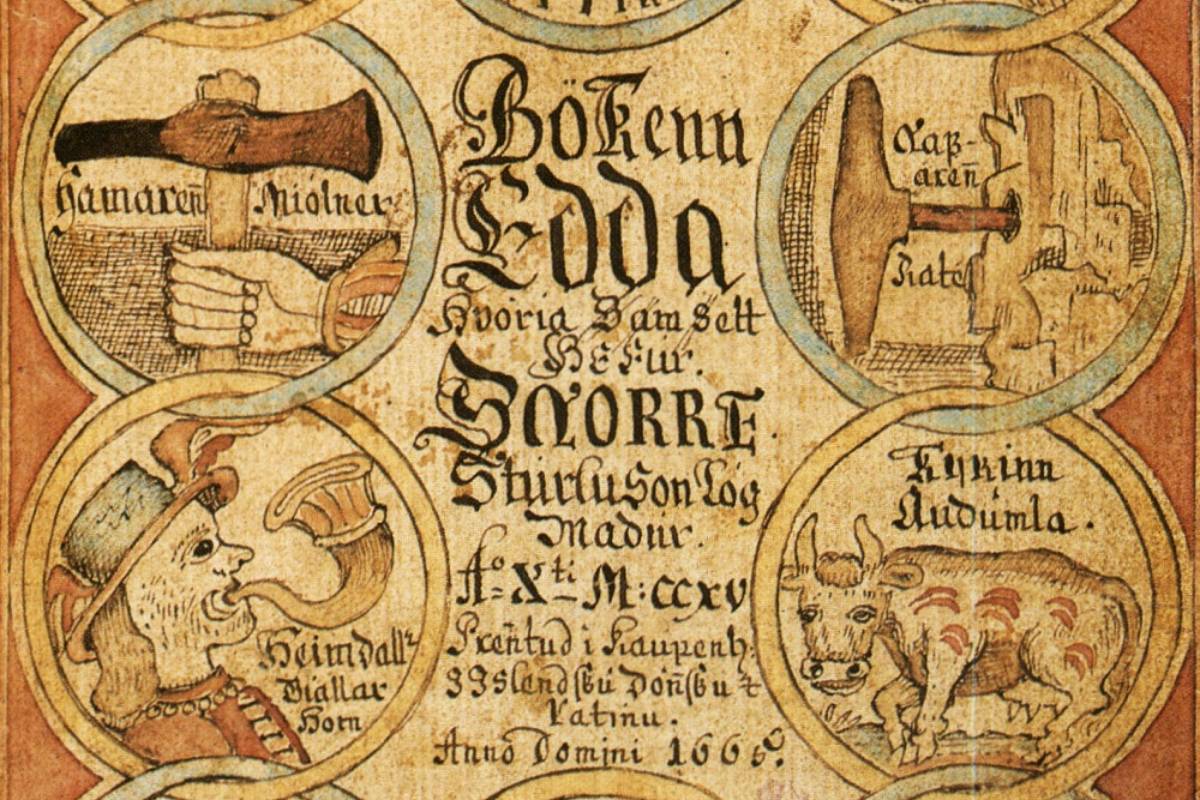
We aficionados (and writers at The Viking Herald) are indebted to that 13th-century CE poet and politician, Snorri Sturluson, for it was he who largely transcribed older oral tales once told in Viking societies.
It was he, then, to a large extent, who was the handmaiden for the rich tapestry of Norse mythology. Without his work, the Norse sagas would have been long dead by the time the last Viking ship sailed.
Whilst Snorri Sturluson compiled the Prose Edda, giving us the best overview of Norse mythology, the authorship of the Poetic Edda remains a mystery.
In this Edda, just as entertaining and insightful as anything Sturluson compiled, we find a poem entitled Hyndluljóð (The Lay of Hyndla).
Originally not included in the original compilation of the Poetic Edda, it worked its way into the collection sometime in the early 15th century CE.
In this poem, we find the Norse goddess Freyja seeking out genealogical information from a wise woman, Hyndla. In it, noble lineages and hidden truths are revealed that include the birth of Heimdall.
Turning to an online version of the 1936 English translation by Henry Adams Bellows, we find that Hyndla tells Freyja:
"There is much that I know, wilt thou hear yet more?" [Stanza 36]
Thankfully for us, Freyja says yes. The next stanza [37] deals with the birth of Heimdall. Hyndla explains that:
"One was born in the bygone days,
Of the race of the gods, and great was his might;
Nine giant women, at the world's edge,
Once bore the man so mighty in arms."
So here we have the first reference to Heimdall's nine mothers that "bore the man so mighty in arms."

This painting depicts the nine daughters of Ægir, reflecting the Norse mythological fixation on the number nine. Author: Nils Blommér (1816–1853)
Norse love for the number 9
The words numerology and Norse mythology probably weren't on your "bingo list" today when you woke up, I bet. However, the rich tapestry of the Norse sagas is littered with references to magical numbers, especially the number nine.
As Li Tang writes in their 2015 article, some numbers—such as nine, which appear frequently in the two Eddas—held special significance. For people in Viking societies, this significance meant a symbolic meaning often associated with the cosmic order, mysticism, and power.
Scanning the sagas, we have numerous references to the number nine, other than Heimdall's mothers. Think, for example, of the nine realms of the Norse cosmos, of which we, mere mortals, reside in only one (Midgard).
Zooming down from the cosmos to the cool, blue ocean, we find that the jötunn Ægir and his wife, Ran, were said to have nine daughters that personified the relentless push, power, and force of oceanic waves.
Adding to this love of the number nine, we find that Odin hung himself on the great world tree, Yggdrasil, for nine nights to gain the wisdom and power of the magical runes. Thor was also said to have taken nine steps before dying, having slain the great world serpent, Jörmungandr.
So here again, with Heimdall's mothers, we find the number nine. Not only that, but we have, in stanza 38, the actual name of this brood of mothers:
"Gjolp there bore him, Greip there bore him,
Eistla bore him, and Eyrgjafa,
Ulfrun bore him, and Angeyja,
Imth and Atla, and Jarnsaxa."
The fact that this was no ordinary birth appears to have endowed young Heimdall with the power that he would need later in life to stand guardian for the Norse gods. The poem relates next how:
"Strong was he made with the strength of earth,
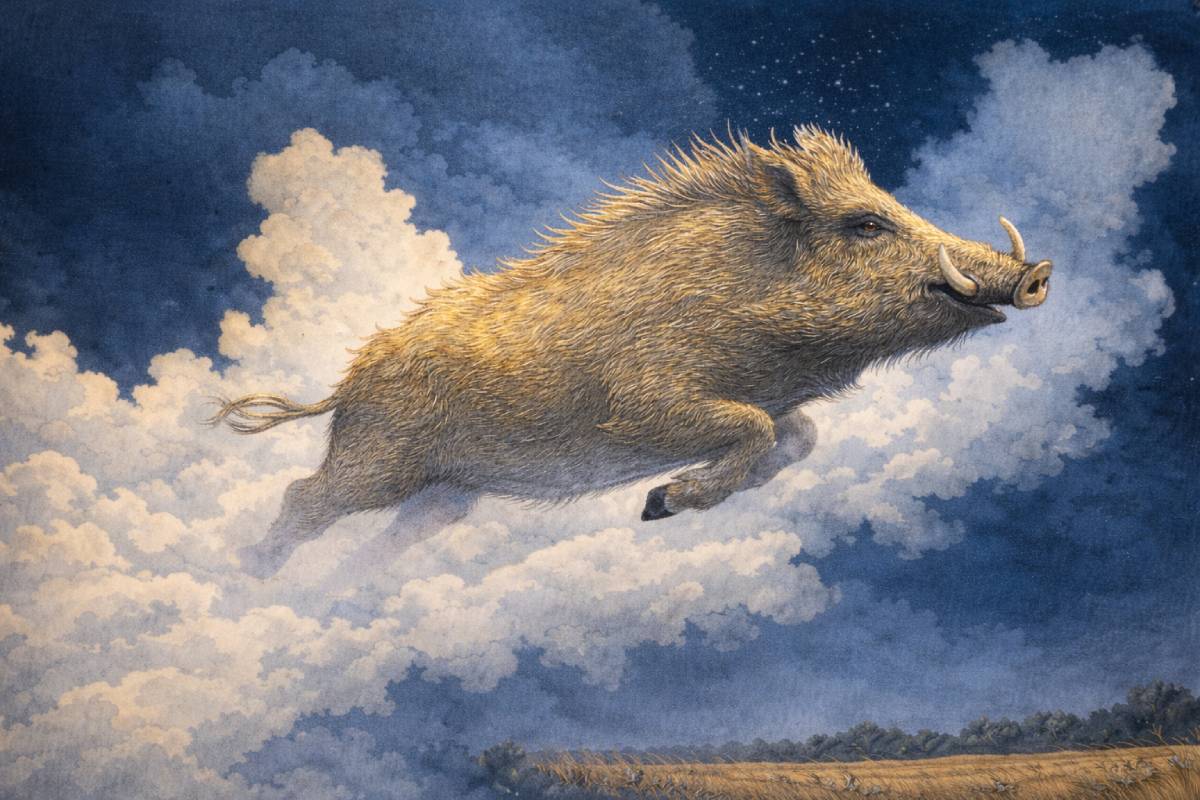
With the ice-cold sea, and the blood of swine." [Stanza 39]
All this talk of strength sounds great, especially from the "ice-cold sea." Given that Scandinavia is a peninsula and girt by sea, we know the reverence and respect that people from Viking societies had for the sea.
The sea gave life—through fishing, trade, and transport—as easily as it took it away with its brutal force.
It was these journeys that were, as Judy Quinn notes in her 2014 paper Mythologizing the Sea: The Nordic Sea-deity Rán, published in Nordic Mythologies: Interpretations, Institutions, Intersections, spoken about in Norse mythology as "...often the metaphor used for the course of earthly life."
This added credence to the life-giving nature of Heimdall's nine mothers.
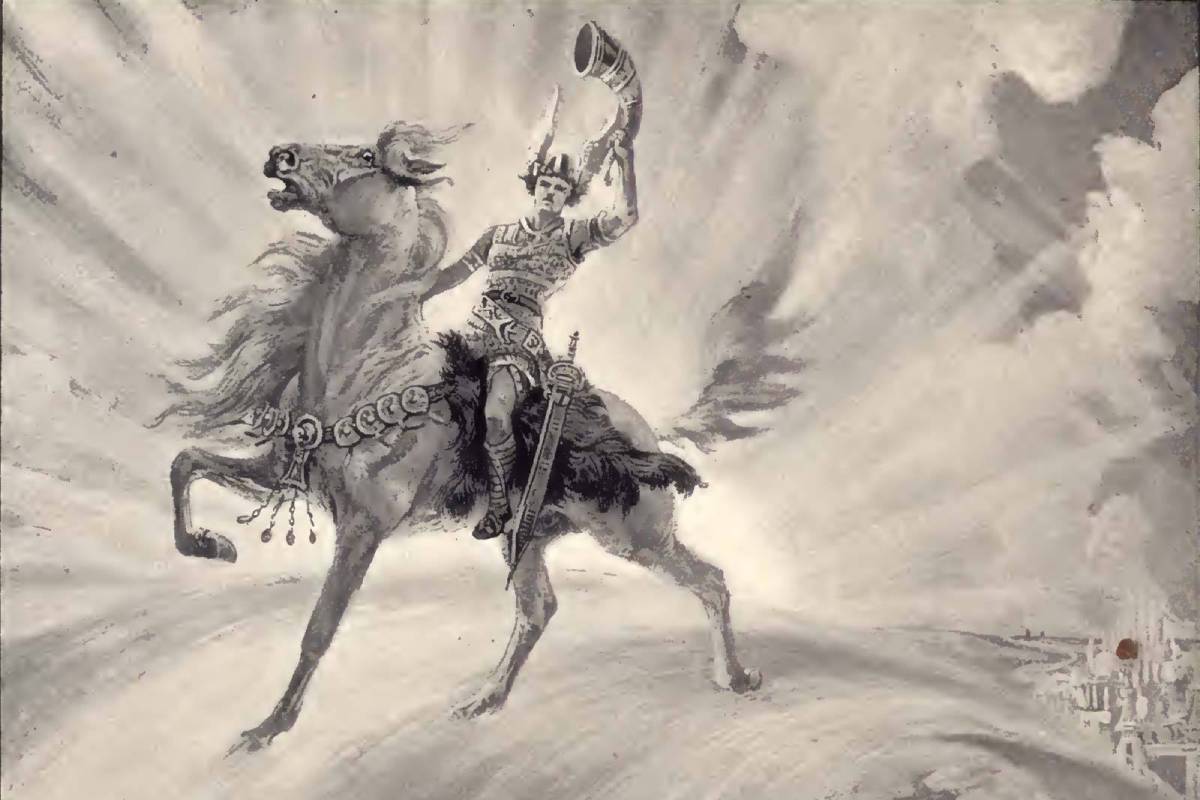
This 1908 illustration shows Heimdall with Gulltoppr, the horse he rides while guarding Bifrost, the rainbow bridge. Author: Dorothy Hardy (1868–1937)
Cosmic and mystical origins
Like so many other Norse deities and mythical beings, Heimdall emerges into life from cosmic, mystic forces.
The fact that nine giant women birthed him singled him out as being special and set him apart as a god who was mysterious, as he would be powerful.
Little mention is made of his nine mothers in the further sagas, but we can see him endowed with a mighty strength that serves him well as the "watchman" and guardian of the Norse gods.
As the old saying goes, it does indeed take a village to raise a baby, which may very well be true, but then again, not every baby—like Heimdall—has nine magical mothers.
For more information on the events of Ragnarök and a recent runic discovery, visit Forbes here.
We get to provide readers with original coverage thanks to our loyal supporters. Do you enjoy our work? You can become a PATRON here or via our Patreon page. You'll get access to exclusive content and early access.
Feel free to reach out to discuss potential stories that may be in the public interest. You can reach us via email at [email protected] with the understanding that the information you provide might be used in our reporting and stories.