

Yet wind the clock back a millennium and there was a level of mutual intelligibility between what modern linguists call Old Norse and Old English, the two dominant language groups of early medieval England.
From raiders to rulers
Cake. Glitter. Ransack. Wreck. These are just four of hundreds of English words that trace their origins to Old Norse.
Whilst nowadays the only hordes of Scandinavians that venture across the North Sea are tourists, during the early medieval period, these hordes were rather less peaceful.
We know that much of the early medieval history of England is dominated by the interactions, peaceful, profitable, and violent, between the inhabitants of what is now England and people from Viking societies.
Whilst they first came to England as mere predatory raiders, people from Viking societies would, as the early medieval period progressed, eventually go on to dominate a huge chunk of the land and place it under their control, the Danelaw.
However, despite the subjugation, massacre, and control of some English by these blow-ins from across the North Sea, one thing that united them was language. Well, sort of.
Ancient and shared origins
Much has been written on how the people from Viking societies who came to raid, trade, conquer, and eventually settle in England were culturally different from the locals living in the Anglo-Saxon kingdoms and later the nascent Kingdom of England.
Religion, military force, power, and culture all divided the new arrivals from the old inhabitants.
Yet language was a surprisingly unifying force where there was a degree of mutual intelligibility between the Old Norse tongue of people from Viking societies and the form of English (which historians and linguists have dubbed Old English) that most locals spoke.
This mutual intelligibility in part stems from the shared origins of the two languages.
These were both Germanic languages that had evolved from the Proto-Germanic language that was spoken by the ancestors of both the English and people from Viking societies in earlier Germanic cultures.
The early medieval English population was a mélange of peoples that saw Angles, Jutes, and Saxons mix in (sometimes peacefully, often not) with a local population that was descended from earlier Celtic, Brittonic, and Roman populations.
Over the course of centuries, a linguistic split occurred between the ancestors of these Germanic peoples, who by then inhabited a huge chunk of England and much of the Scandinavian peninsula.
This linguistic break, however, was only a few centuries old when the first Viking ships arrived in England, meaning that many words, and indeed the grammatical structure of the two languages, were still similar enough to ensure a degree of mutual understanding.
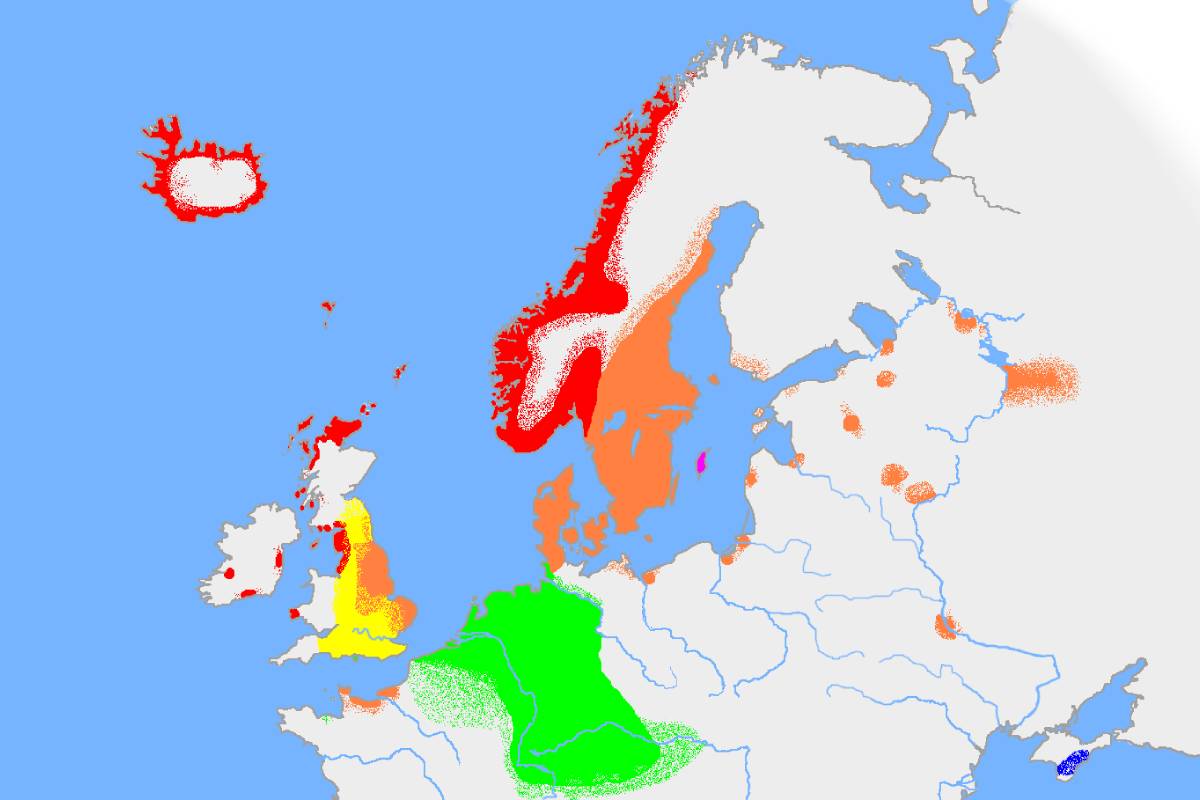
Map showing the approximate extent of Germanic languages in the early 10th century: red marks Old West Norse, orange Old East Norse, pink Old Gutnish, yellow Old English, green Continental West Germanic languages, and blue Crimean Gothic. Source: Wiglaf (CC BY-SA 3.0)
Linguistic similarities
Aside from their shared origins, there was a large overlap between the grammar, vocabulary, and structure of these two languages that helped to make them rather mutually intelligible.
Without wanting to get bogged down in the linguistic weeds, both Old English and Old Norse were "inflected" languages. This essentially means that nouns, adjectives, and verbs changed their endings depending on case, gender, or tense.
A website funded by University College Cork discusses some of the grammatical structures of Old English words, whilst Jan Terje Faarlund writes about the structure of the Old Norse language in his 2007 book The Syntax of Old Norse.
Drawing on these two works, we can use the English word "stone" to see the similarities between the two languages.
This modern English word "stone" was stān in Old English and steinn in Old Norse. This then became stanas (OE) and steinar (ON) when changing it into the nominative plural form. When talking about the stone as an object, however, the two words were almost identical: stan (OE) and stein (ON).
Another example of the similarity of the two languages arises from pronouns.
The pronoun "I" in modern English was ic (OE) and ek (ON), "he" in modern English was hē (OE) and hann (ON), "she" in modern English was hēo (OE) and hon (ON), and finally "we" in modern English was wē (OE) and vér (ON).
Whilst there were some linguistic differences, the similar grammatical structure meant that there could be mutual understanding between speakers of Old English and Old Norse.
Everyday contact
Speakers of Old Norse and Old English lived side by side, in England, for hundreds of years.
Given the proximity of these two groups, who lived together in a huge swath of what is now northern and eastern England, there was, naturally, a large degree of intermingling, intermarriage, and, ultimately, bilingualism.
Words like sky, window, or even egg have survived down the centuries of the linguistic evolution of the English language and are direct borrowings from Old Norse.
The English language that we use today has, according to Sandra Dögg Friðriksdóttir, in her 2014 article "Old Norse Influence in Modern English," somewhere "...around 400 Old Norse borrowings."
This speaks to the pragmatic nature of language, that despite the speakers of Old English often being subjugated by Old Norse speakers, there was a need for comprehension and mutual understanding.
- READ MORE: Where can people learn Old Norse today?

From Eoforwic to Jórvík to York, the city's name changes show a strong Viking imprint on English place names. Photo: David Ionut / Shutterstock
Later linguistic developments
Towards the end of the Viking history of England, Old Norse had left such an imprint on Old English that there seemed to be little linguistic division.
As Joseph Embley Emonds and Jan Terje Faarlund write in their 2014 article in Olomouc Modern Language Monographs, many in the early medieval period felt that those living in the Danelaw were united by language, as:
"one contemporary observer, a writer of Icelandic sagas, wrote that in the 11th century, 'there was at that time the same tongue in England as in Norway and Denmark.'"
However, despite this close linguistic relationship, which led to a large degree of mutual intelligibility and bilingualism for centuries in much of England, the speakers of Old English saw their language change not by the Vikings' tongue but by that of another set of invaders: the Normans.
This new linguistic direction for England is best summed (albeit crudely) in the Saga of Gunnlaug the Worm Tongue and Rafn the Skald (we use an online version of the 1901 English translation by William Morris and Eirikr Magnusson), when the narrator regales how:
"the tongues changed when William the Bastard won England, for thenceforward French went current there."
It was only the Normans' cultural and linguistic subjugation of the English, and their language, following victory at Hastings, that saw the centuries-old close relationship between Old English and Old Norse finally severed, never to unite again.
This is one of the reasons why, in England today, French is a more popular and easier language to learn for schoolchildren than any Scandinavian tongue.
For more information on the linguistic legacy that Old Norse has bequeathed to English, visit Discover Magazine here.
We get to provide readers with original coverage thanks to our loyal supporters. Do you enjoy our work? You can become a PATRON here or via our Patreon page. You'll get access to exclusive content and early access.
Feel free to reach out to discuss potential stories that may be in the public interest. You can reach us via email at [email protected] with the understanding that the information you provide might be used in our reporting and stories.