

For people in Viking societies, marriage was more than an excuse for a good party. It held a spiritual significance, could cement political alliances, and could secure great riches or better social standing.
Given the importance of this sacred institution, it should be no surprise that the rich tapestry of Norse sagas abounds with numerous examples of marriage. However, many of these unions were not between us mere mortals but between jötnar (giants) and the mighty Norse gods themselves.
We have written widely here on the wild and chaotic forces of nature that are the jötnar (the Old Norse term for "giants," singular jötunn) and the civilized and orderly nature of the Norse gods (those in both the Æsir and Vanir pantheons).
Yet we have not examined how, despite their opposing and conflicting natures, the stories and sagas of people in Viking societies show that their fates are deeply intertwined through marriage.
What makes these marriages even more remarkable is that, in many Norse myths, the jötnar were often direct adversaries of the gods, creating conflict and, sometimes directly and bloodily, challenging their authority.
An unsuccessful union
Turning to the sagas, we can find two unusual examples of the union of jötnar and the Norse gods.
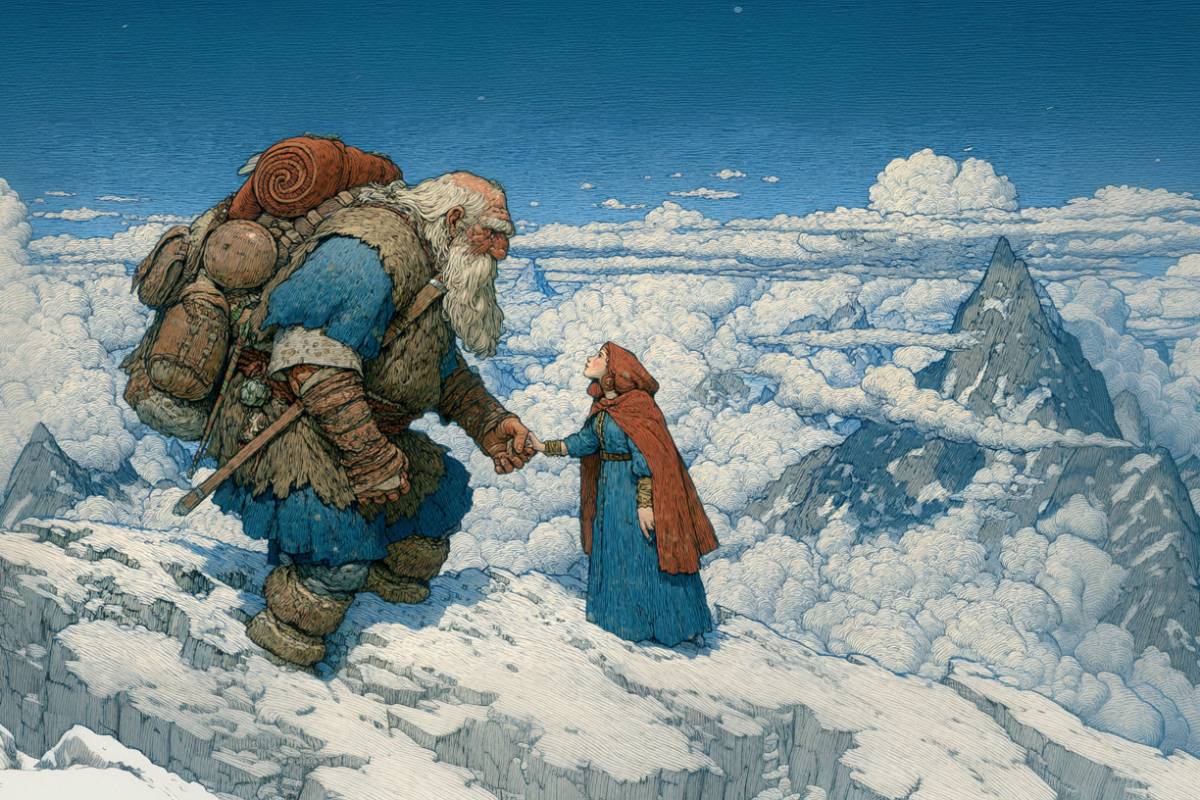
The first involves the wintry giantess, Skádi, and the rather unusual selection of her husband, the Norse sea god, Njörðr. We rely on the online version of Arthur Gilchrist Brodeur's 1916 English translation of Skáldskaparmál in the Prose Edda.
We pick up the story as Skádi comes to avenge her murdered father (he did steal Iðunn's magical apples, though) and talk to the Æsir. Here:
"...Skádi, the daughter of the giant Thjazi, took helm and byrnie and all weapons of war and proceeded to Ásgard, to avenge her father. The Æsir, however, offered her reconciliation and atonement: the first article was that she should choose for herself a husband from among the Æsir and choose by the feet only, seeing no more of him. Then she saw the feet of one man, passing fair, and said: 'I choose this one...' was Njörðr of Nóatún. [p. 93]"
To avenge her father's death, Skádi was offered a husband from the brood of the Æsir.
Yet their marriage was ultimately unsuccessful due to their very different environments: Skádi was associated with the wintry mountains, whilst Njörðr pined for the sounds of the sea. They would eventually live in their different abodes but remain married.
Whilst an unusual union, their marriage speaks to how people in Viking societies saw marriage, like their cosmos, as the interconnection of opposing forces.
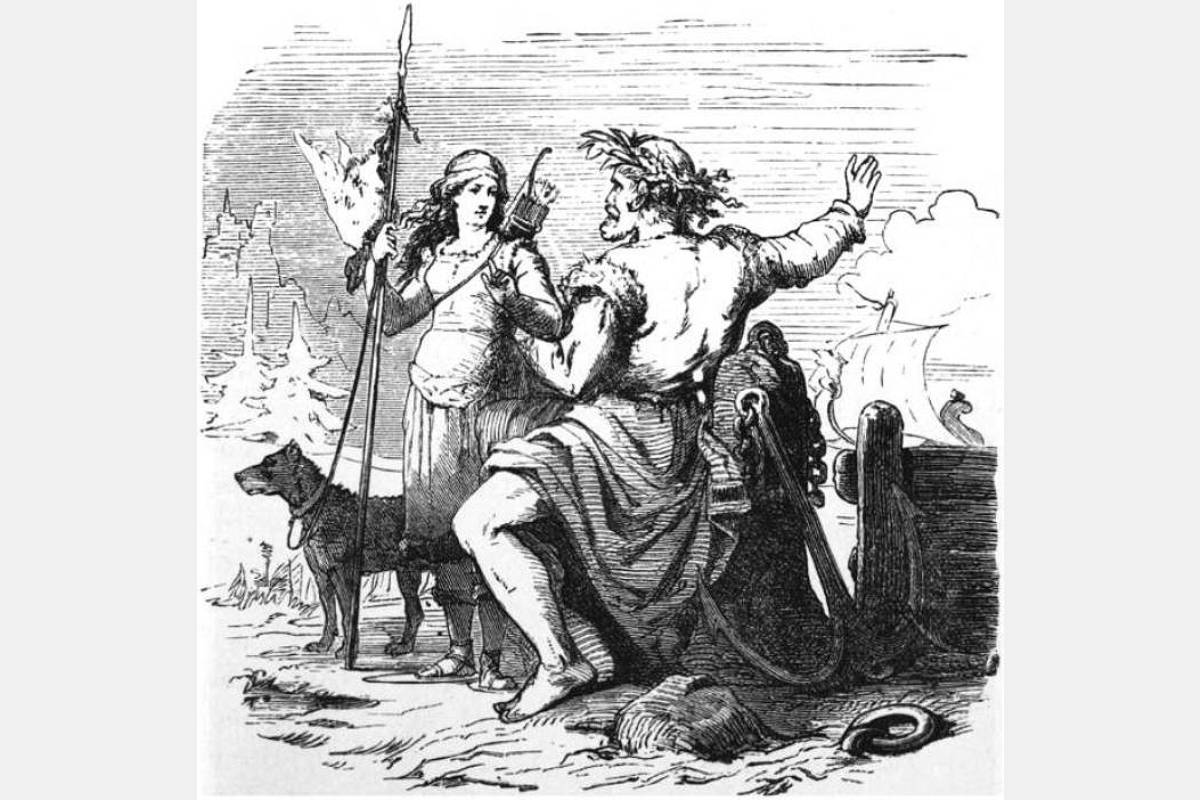
An 1882 illustration shows Njörðr and Skaði on their way to Njörðr’s coastal home, Nóatún. Author: Friedrich Wilhelm Heine (1845–1921)
Children, creation, and destruction
Shifting from that rather poignant union to a more fruitful one, we turn to Loki and Angrboða.
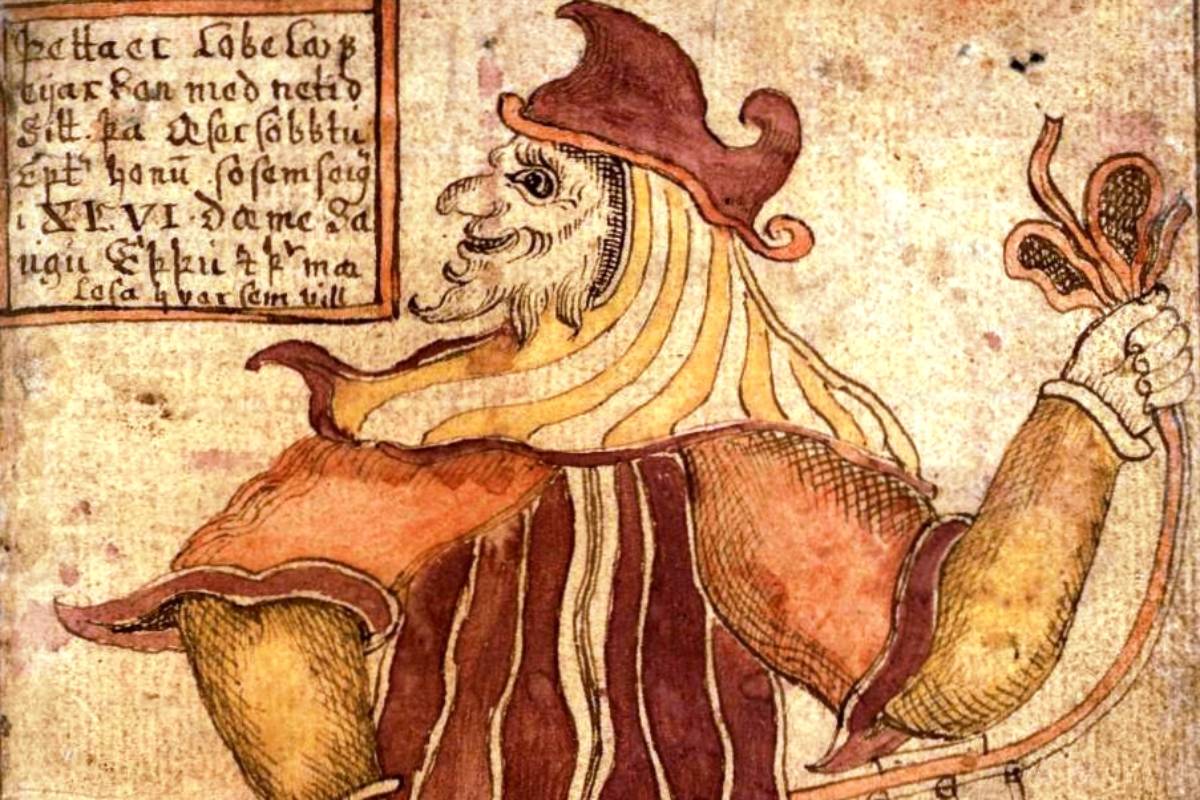
Though technically not a Norse god, he is associated especially with the Æsir (sometimes aiding them but often not), is seen as a mythical being, and is the blood brother of Odin.
Further on in the Prose Edda, we find the section entitled Gylfaginning (The Beguiling of Gylfi), perhaps our best overview of the characters of Norse mythology. In this section, we find:
"Yet more children had Loki. Angrboda was the name of a certain giantess in Jötunheim, with whom Loki gat three children: one was Fenris-Wolf, the second Jörmungandr – that is the Midgard Serpent, – the third is Hel..." [Section 34]
Now, whilst they do not specifically mention a marriage, the fact that they created three children together is proof of their union.
For Norse communities in the Viking Age, children born out of wedlock did not lead to social ostracism, which occurred when Christian morality greatly influenced hearts and minds in these societies in the later medieval period.
Whilst three children are produced, all have tormented fates: Fenrir is bound until Ragnarök, Jörmungandr is cast into the sea, and Hel is sent to rule over a portion of the dead.
These fates show how death, disorder, and fate were understood as intertwined in stories told within Norse communities in the Viking Age.
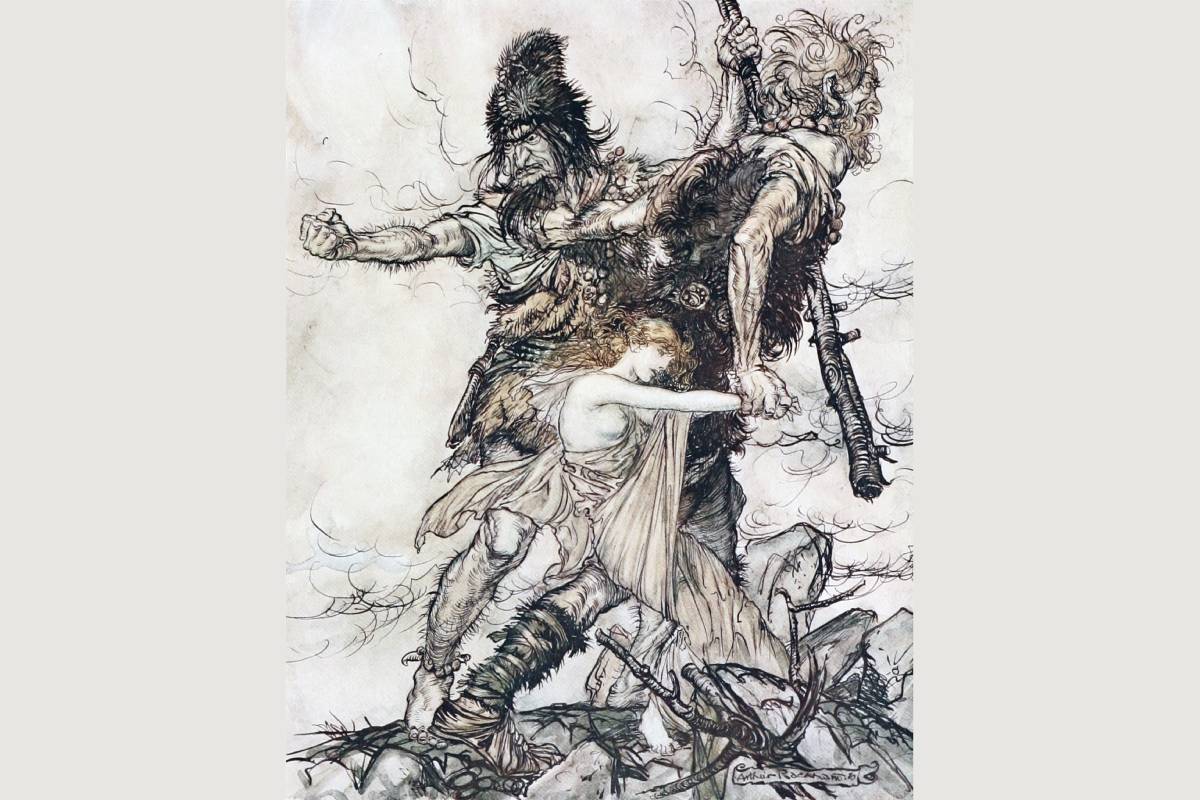
The giants Fasolt and Fafner seize Freyja and drag her away as payment for the construction of Valhalla. Author: Arthur Rackham (1867–1939)
Exploitation by Viking rulers
The intermarriage of these mythical beings in Norse mythology can be seen as a need for there to be balance in the cosmological worldview of Norse communities in the Viking Age.
Whilst the giants represented primordial chaos, there was a need to balance this destructive force with the order and regulation of the Norse deities.
This pursuit of harmony between opposing forces was exploited by the powerful and the elite, not in the pages of the sagas, but in the real Viking world. Viking-era chieftains, rulers, and later monarchs would claim descent from the union of Norse gods and giants to legitimize their authority.
As Gro Steinsland notes in her chapter in The Viking World (2008), "the prototypic [Viking] ruler was the offspring not only of a god, but of a giantess as well."
Viking rulers thus sought to link their ancestry to the Norse gods and giants to present themselves as the living embodiments of cosmic balance. This ancestry allowed them to garner support through their authority as scions of the natural and the godly realms.
For more information on medieval marriage, children, and the "invention of the term bastard," visit Aeon here.
We get to provide readers with original coverage thanks to our loyal supporters. Do you enjoy our work? You can become a PATRON here or via our Patreon page. You'll get access to exclusive content and early access.
Feel free to reach out to discuss potential stories that may be in the public interest. You can reach us via email at [email protected] with the understanding that the information you provide might be used in our reporting and stories.